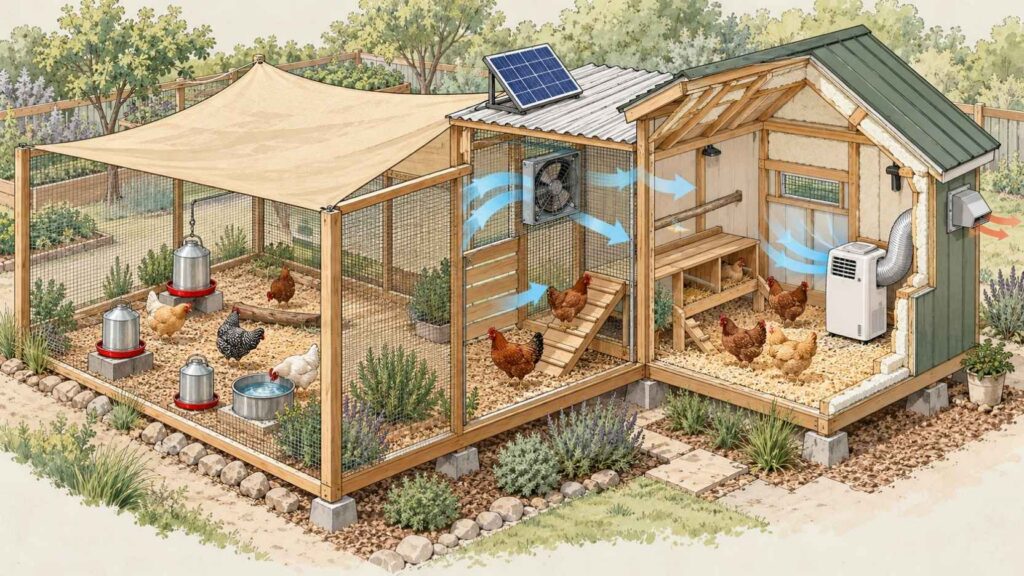
When summer temperatures climb, keeping chickens comfortable becomes a daily concern for backyard flock owners. ☀️ You might consider installing a solar fan for your chicken coop, stretching shade cloth over the run, or purchasing a portable air conditioner to make the space cooler. However, the best way to cool a chicken coop is not necessarily the most expensive option, and buying equipment before identifying the problem can waste money.
A coop that traps afternoon sunlight needs a different solution from one with poor ventilation or dangerously high indoor temperatures. 🌡️ Shade, fresh water, and adequate airflow often provide the foundation for effective chicken coop cooling without complicated electrical installations. Understanding which upgrade addresses your flock’s actual conditions helps you prioritize spending while avoiding unnecessary equipment.
Do you really need an air conditioner for your chicken coop?
Most backyard chicken coops do not require air conditioning when they have effective ventilation, sufficient shade, and dependable access to fresh water. Chickens release excess body heat partly through panting, making hot, humid conditions particularly challenging when airflow is inadequate. 🐔 Before purchasing a chicken coop air conditioner, determine whether the structure is trapping heat or simply experiencing the same high temperatures as the surrounding environment.
A thermometer that records maximum temperatures can help you compare conditions inside the coop with those outside. If the interior becomes significantly hotter during sunny afternoons, roof exposure, inadequate ventilation, or restricted airflow may be contributing to the problem. Air conditioning deserves consideration only when simpler improvements cannot provide safe conditions and the structure can accommodate a properly designed cooling system.
Start with the cheapest upgrades that solve the biggest problems
Add shade cloth before buying expensive equipment
Shade cloth is often one of the most practical first purchases because it reduces direct sunlight reaching chickens and exposed surfaces. 🌿 Install it above sunny sections of the run or beside particularly exposed walls while preserving natural airflow. Choose a material with an appropriate shade rating, secure it against wind, and avoid covering ventilation openings.
Natural tree shade, a separate canopy, or a properly installed shade sail can provide similar benefits. Keep shaded areas large enough for the entire flock to spread out comfortably rather than forcing birds into one crowded corner. Remember that shade reduces solar heating but cannot independently remove heat already trapped inside an enclosed coop.
Improve roof shading and ventilation
Dark roofing exposed to afternoon sunlight can absorb considerable solar energy, increasing heat entering the structure. A lighter-colored roof finish, ventilated roof assembly, or separate overhead shade may help reduce this heat gain. 🏠 Protected openings near the roofline can also allow accumulated warm air to escape when sufficient replacement air enters elsewhere.
Provide additional water stations
Fresh drinking water is essential during hot weather because chickens increase consumption while attempting to regulate body temperature. 💧 Place multiple clean waterers in shaded areas, especially when dominant birds might prevent others from drinking. Inspect them throughout particularly hot days because containers can empty or become excessively warm faster than expected.
Do solar-powered chicken coop fans actually work?
A solar fan for a chicken coop can improve ventilation when sufficient sunlight reaches its panel. Solar-powered fans convert photovoltaic electricity into airflow, making them attractive for backyard coops without convenient electrical connections. ☀️ Their effectiveness depends on actual airflow capacity, solar-panel output, sunlight exposure, installation design, and whether the coop has adequate air inlets.
The important distinction is between direct-solar fans and solar systems with battery storage. Direct-solar equipment generally slows or stops when sunlight becomes insufficient, while a compatible battery system can operate after sunset if it has adequate stored energy. 🔋 Before buying, check whether the package actually includes a battery, charge controller, suitable wiring, and the capacity required for your intended operating hours.
Exhaust fans vs. circulation fans: Which does your coop need?
An exhaust fan removes indoor air and allows replacement air to enter through designated openings. This approach helps remove accumulated heat, moisture, odors, and airborne contaminants, particularly when installed near the upper portion of an enclosed coop. 🌬️ However, installing a powerful exhaust fan without sufficient intake openings can restrict its performance and produce uneven airflow.
A circulation fan primarily moves air within an area rather than deliberately exchanging indoor air for outdoor air. It can improve air movement around chickens, helping them lose heat more effectively, but it does not replace stale air by itself. For a poorly ventilated coop, improve air exchange first; for a well-ventilated but still-air run, a suitably rated circulation fan may be the more useful addition.
Can portable AC work in a small chicken coop?
A portable air conditioner can lower indoor temperature when installed in a sufficiently enclosed, insulated space with adequate cooling capacity. ❄️ However, ordinary backyard coops frequently have large ventilation openings, uninsulated walls, dusty bedding, and significant heat exposure that make maintaining conditioned air difficult. Equipment designed for residential rooms may therefore operate inefficiently or require substantial modifications before delivering meaningful cooling.
Portable units also require safe electrical power, proper exhaust arrangements, condensate drainage, regular filter maintenance, and continued fresh-air ventilation. A single-hose portable unit may draw replacement outdoor air into the space, while poorly managed cooling can introduce condensation or moisture problems. For most small backyard flocks, portable AC should be considered a specialized solution rather than the first cooling upgrade.
Chicken coop cooling upgrades by budget
For a limited budget, prioritize shade, accessible water, roof improvements, and unobstructed ventilation before considering powered equipment. These upgrades address common causes of heat exposure without creating substantial ongoing electricity costs. 💰 A small temperature-and-humidity monitor can also help determine whether your improvements are working during the hottest part of the day.
With a moderate budget, consider a properly sized outdoor-rated fan, secure mounting hardware, and reliable temperature monitoring. Higher budgets may support engineered ventilation, battery-backed solar equipment, structural improvements, or specialized climate control where necessary. Spending more only makes sense when the additional equipment addresses a documented problem that lower-cost changes cannot adequately solve.
Chicken coop cooling upgrade decision matrix
The following comparison helps match different chicken coop cooling upgrades with actual operating needs. Costs are relative estimates rather than retailer quotations because coop size, equipment quality, and local installation requirements vary considerably. 📊 Compare maintenance and installation demands alongside purchase prices because inexpensive equipment can become costly if it repeatedly fails or requires unnecessary modifications.
| Cooling upgrade | Purchase cost | Electricity use | Installation | Maintenance | Main limitation |
|---|---|---|---|---|---|
| Shade cloth | Low | None | Simple to moderate | Inspect tension, damage, and fasteners | Does not actively remove heat |
| Roof shading and vents | Low–medium | None | Moderate | Clear openings and inspect weatherproofing | Relies on airflow and conditions |
| Circulation fan | Low–medium | Low–moderate | Safe mounting and electrical supply | Clean dust and inspect guards | Does not replace stale air |
| Solar exhaust fan | Medium | Solar; battery systems may add storage | Panel, wiring, fan, and intake installation | Clean panel, fan, and vents | Performance depends on sunlight and system capacity |
| Portable AC | High | High relative to simple fans | Complex power, exhaust, and drainage | Filters, coils, condensate, and electrical checks | Inefficient in open or poorly insulated coops |
When comparing fans, look beyond advertised wattage and examine airflow ratings, weather resistance, noise, mounting requirements, and replacement-part availability. A fan’s rated airflow may decrease once shutters, guards, screens, and restrictive openings are added. The most useful purchase is equipment sized for the actual structure rather than whatever product advertises the largest fan diameter.
Electrical and fire safety around chicken coops
Chicken coops contain combustible bedding, dust, moisture, and curious birds, making electrical installation particularly important. ⚡ Choose appropriately rated equipment, protect wiring from pecking and rodents, and position switches and connections away from drinking stations and water intrusion. Fans should have protective guards, stable mounting, and accessible cleaning points without exposed moving components.
Avoid relying on permanent extension-cord arrangements, overloaded power strips, or improvised connections to run cooling equipment. A qualified electrician should assess permanent wiring, suitable protective devices, grounding, and outdoor electrical requirements. 🔥 Solar equipment also needs proper circuit protection, compatible electrical components, and secure battery placement rather than assuming low-voltage systems are automatically risk-free.
Check for heat stress before focusing on equipment
Equipment shopping should never delay helping birds already showing concerning signs of overheating. Persistent open-mouth panting, wings held away from the body, weakness, or unusual lethargy can indicate that chickens are struggling with hot conditions. 🚨 Move affected birds toward a cooler, well-ventilated, shaded environment, provide accessible fresh water, and seek prompt veterinary assistance for severe or persistent symptoms.
Humidity matters alongside temperature because panting becomes less effective when evaporative heat loss is limited. Monitor actual conditions and bird behavior rather than assuming that a running fan means the coop is safe. During extreme heat, checking the flock repeatedly is more useful than trusting a single thermometer reading.
What should you upgrade first?
Begin by identifying the primary cause of discomfort: direct sunshine, trapped indoor heat, insufficient air movement, or inadequate drinking-water access. 🌤️ Correct obvious shade and water problems first, improve ventilation next, and add powered fans when natural airflow remains insufficient. Consider air conditioning only after evaluating whether the coop’s construction, operating requirements, and local climate justify a more complex system.
The best way to cool a chicken coop is a combination of practical improvements chosen for the flock and its environment, not a single expensive appliance. A shaded, well-ventilated coop with dependable drinking water can often serve backyard chickens better than an overheated enclosure equipped with an improperly installed air conditioner. 🐔 Invest in the problem you can identify, measure the results, and upgrade further only when your chickens genuinely need it.