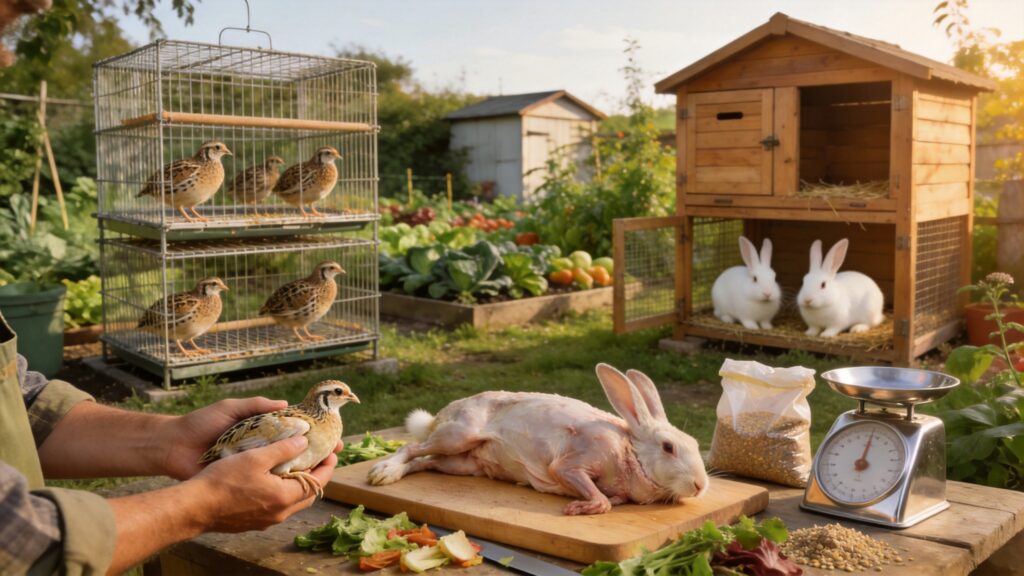
Backyard meat production is booming among American homesteaders, preppers, and families who want to know exactly where their food comes from. Two of the most popular small-scale protein sources—quail and rabbits—both offer fast turnover, quiet raising, and manageable upfront costs. But which one fits your yard, your schedule, and your stomach? This deep dive compares feed conversion, space requirements, processing ease, ethics, and real-world tradeoffs to help you decide.
Feed Conversion Efficiency: The Cost of Growth
Feed is the single largest recurring expense in meat production, and conversion ratios directly affect your bottom line. Quail, specifically the Coturnix (Japanese quail) breed, are among the most efficient poultry. A typical quail needs about 2.5 to 3 pounds of feed to gain one pound of live weight. Rabbits, on the other hand, have a feed conversion ratio (FCR) of roughly 3.5 to 4.0 pounds of feed per pound of gain, depending on breed and diet.
The difference becomes dramatic when you scale up. If you aim for 10 pounds of dressed meat (after processing), quail require approximately 35–42 pounds of feed, while rabbits need 50–60 pounds. However, quail produce smaller carcasses (about 5–7 ounces per bird), so you’ll be processing many more individuals. Rabbits—especially New Zealand Whites or Californians—yield 3–5 pounds of meat per animal after dressing, which can simplify your weekly cooking schedule.
“I switched from rabbits to quail because I was spending half my paycheck on feed. The quail paid for themselves in three months.” — M. Nguyen, backyard homesteader in Texas
One nuance: rabbits can partially offset feed costs by consuming hay and garden scraps, while quail require a high-protein game bird feed (often 28% protein). If you have a source of cheap hay or pasture, rabbits may narrow the FCR gap. Quail, conversely, offer faster growth (6–7 weeks to slaughter vs. 10–12 weeks for rabbits), meaning fewer days of feeding per pound of meat.
Comparison Table: Key Feed and Growth Metrics
| Metric | Quail (Coturnix) | Rabbit (New Zealand) |
|---|---|---|
| Feed conversion ratio (live weight) | 2.5–3.0 : 1 | 3.5–4.0 : 1 |
| Days to slaughter | 42–50 days | 70–90 days |
| Dressed weight per animal | 5–7 oz (140–200 g) | 3–5 lb (1.4–2.3 kg) |
| Feed type (typical) | 28% game bird starter/grower | 16–18% pellet + hay |
Space Requirements: Compact vs. Vertical
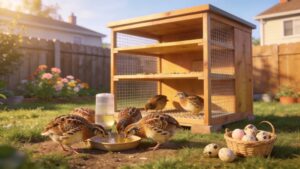
If your “backyard” is a suburban quarter-acre or even a large balcony, space logistics can make or break your project. Quail win hands-down for small spaces. A single quail requires only about 0.5–1 square foot of floor space inside a cage or aviary. Because they don’t need to fly (Coturnix are ground birds), you can stack cages vertically—think a three-tier rabbit hutch repurposed for quail. A 2×3 foot footprint with three tiers can house 30–40 quail, producing roughly 8–10 pounds of meat every 7 weeks.
Rabbits demand more horizontal space. Each breeding doe needs a cage of at least 3–4 square feet, and grow‑out pens of similar size. A small rabbitry of two does and one buck will require 12–16 square feet of floor space, plus room for hay storage and water systems. Unlike quail, rabbits cannot be stacked densely because they need headroom for periscoping (sitting up). And if you live in a hot climate, rabbits suffer more from heat stress than quail.
Vertical Stacking for Quail: A Practical Setup
Many urban raisers use stackable wire cages or modified rabbit hutches, placing a tray underneath each level. The key is good ventilation—quail are sensitive to ammonia from droppings. A simple 2×2×1 ft cage with ½‑inch hardware cloth floor holds 8–10 quail. With 4 tiers (total floor footprint 2×2 ft), you can house 32–40 quail, producing about 8–10 lbs of meat every cycle. Contrast that with a 4×4 ft rabbit hutch that holds at most 2–3 rabbits, yielding around 6–12 lbs of meat in 10 weeks.
One major caveat: quail are escape artists. They can fly straight up if startled; their cages need a soft top (or high sides) and covered corners. Rabbits, conversely, are more predictable and easier to contain.
- Quail: 1 sq ft per bird, stackable, low headroom, requires predator-proof cover (raccoons, opossums).
- Rabbits: 3–4 sq ft per mature animal, one tier only, need 18–24 inch height, strong chewing behavior (wire or metal cages preferred).
Processing Ease: Speed and Skill Levels
This is where many homesteaders hit a wall. If you’re squeamish about slaughter, the learning curve matters. Quail processing is radically simpler. A small cone dispatching system lets you cut the carotid artery, and after a 2‑minute bleed, you can either pluck (with a scalding dip of 140°F for 30 seconds) or skin the bird. Skinning a quail takes 20–30 seconds and doesn’t require plucking; you can even leave the skin on if you’re short on time. One person can process 20 quail in under an hour.
Rabbits require more steps and more strength. First, you must humanely stun the rabbit (often a cervical dislocation or captive bolt). Then bleeding, skinning (which requires careful cuts to avoid tearing the hide), evisceration, and removal of the liver, heart, and kidneys. The skin can be tanned for fur, adding value but also work. Expect 30–45 minutes per rabbit for a beginner; even experienced processors need 10–15 minutes. A batch of 5 rabbits can take a whole morning.
What about storage?
Because rabbits yield larger individual portions, they fit better into standard freezer bags and meal planning. Quail are best stored in vacuum-sealed bags of 4–6 birds each. However, quail lend themselves to batch processing—you can do 30 in one afternoon and freeze them all. Rabbits require more scheduling: you’ll want to space out slaughter days to avoid overwhelming your freezer.
Ethical and Practical Considerations
Both quail and rabbits can be raised ethically in a backyard setting, but they present different concerns. Rabbits are often kept as pets, so neighbors and family may react emotionally. The “fuzzy factor” is real; many first‑time meat raisers find it harder to dispatch something that looks like a pet than a bird. Quail, being smaller and less anthropomorphic, typically generate less resistance.
On the welfare side, quail are highly social and need to be kept in groups (minimum 6–8). Isolated quail become stressed and peck each other. Rabbits are territorial and must be housed separately after weaning; fighting can cause serious injuries. Both species require clean bedding and plenty of fresh water. But rabbits have a more complex behavioral need for chewing and digging—they require items to gnaw (wood, cardboard) or they will damage cages.
Noise and smell
Quail are surprisingly quiet. Males give a soft call, but it won’t bother neighbors (hens are silent unless disturbed). Rabbits are mostly silent, except for occasional growling or thumping. Odor management is similar: both produce dry droppings that compost quickly, but rabbit urine is stronger and can build up ammonia faster in an enclosed space.
- Quail pros: Less emotional attachment, faster growth, simple processing, very quiet.
- Quail cons: Small carcass (many birds per meal), escape risk, need specialized feed.
- Rabbit pros: Larger portion sizes, edible byproducts (liver, fur), can use hay/garden waste.
- Rabbit cons: Stronger odor potential, longer processing, requires more floor space, higher “pet factor.”
Case Studies: Two Backyard Scenarios
Scenario A: The Urban Renter with a Patio
Jessica lives in a Denver apartment with a 6×8 ft concrete patio. She tried quail after her HOA banned chickens. She built a custom 4‑tier wire rack (2×2 ft footprint) that holds 36 birds. Total cost: $150 for materials + $40 for incubator. She hatches eggs in a cheap incubator, raises them for 50 days, and butchers 12 birds every week for a family of two. Feed cost: ~$12 per week. “I have a constant supply of fresh meat, and the neighbors don’t even know,” she says. “Processing 12 birds takes me 30 minutes.”
Scenario B: The Suburban Homesteader with a ¼‑Acre
Mike and his wife have a large garden and want to produce most of their protein. They chose rabbits (New Zealand Whites) because they also have goats and chickens. They built a 6×8 ft rabbitry with three does and one buck, rotating grow‑out pens. They use garden trimmings (carrot tops, kale stems) to supplement pellets. Slaughtering is done once a month—four rabbits yield about 14 lbs of meat. “The learning curve was steep,” Mike admits, “but I love that I can make liver pâté and use the hides for leather. My kids help with feeding, but they don’t watch the killing yet.”
Both approaches work, but they serve different lifestyles. Jessica values discreetness, speed, and low volume; Mike values self‑sufficiency and variety.
How to Choose: Recommendations Based on Your Goals
After weighing all factors, the decision comes down to your constraints. Here’s a simple decision framework:
- Choose quail if:
- You have very limited space (balcony, tiny yard) or no ability to build a large hutch.
- You want the fastest turnover and easiest processing.
- You don’t mind processing many small carcasses for meals.
- You need to keep your operation nearly invisible to neighbors.
- Choose rabbits if:
- You want larger, family‑sized portions (a single roast or stew from one animal).
- You have room for a dedicated rabbitry (at least 4×4 ft plus storage).
- You’re willing to invest time in learning humane slaughter and skinning.
- You want dual‑purpose byproducts (manure for garden, fur, organ meats).
One hybrid approach: start with quail to build your butchering confidence and refine your feed management. Once you’ve mastered the workflow (3–4 cycles), add a pair of rabbits for variety. Many homesteaders maintain both: quail for quick, weekly meat and rabbits for monthly stews and bone broth.
Final practical tips for either choice
- Always have a biosecurity plan: quarantine new animals, change shoes between pens, and sanitize feeders.
- Invest in a chest freezer—you’ll need it for batch processing.
- Join local backyard meat Facebook groups for breed‑specific advice and processing workshops.
- Check zoning laws: some cities ban rabbits but allow quail (or vice versa). Call your county extension office first.
Both quail and rabbits can provide clean, ethical, and sustainable meat in your backyard. The “better” choice depends on your space, time, and tolerance for small‑scale processing. If you lean toward efficiency and speed, quail will fill your freezer fast. If you prefer robust portions and a deeper connection to the whole animal, rabbits will reward your effort. Either way, you’ll be eating meat you raised yourself—and that’s a victory for any homesteader.