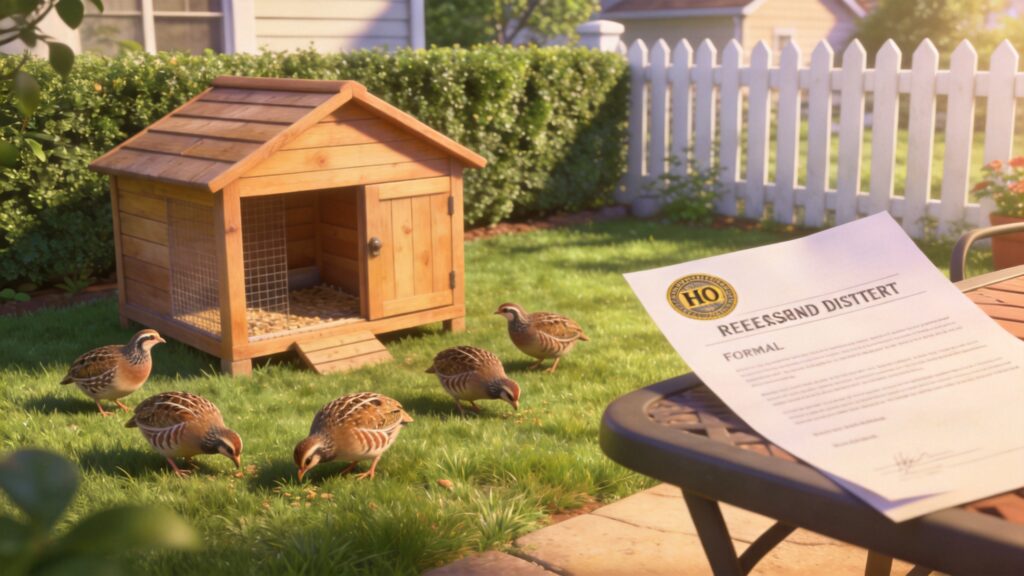
In the quiet suburbs of Austin, Texas, Maria Torres started keeping five quail in her backyard for fresh eggs and natural pest control. Within a month, she received a cease-and-desist letter from her homeowners association citing a vague “prohibition on exotic animals.” Across the country in Portland, Oregon, James Chen spent $2,000 on legal fees to prove that his Coturnix quail were “domestic fowl” permitted under city zoning. These stories represent a growing tension: as more Americans embrace backyard homesteading, the clash between HOA covenants and the desire for food self-sufficiency is becoming a defining suburban battle.
Why Quail Trigger Such Strict HOA and Zoning Rules
Quail occupy a legal gray zone that frustrates both homeowners and regulators. Unlike chickens, which have established exemptions in many municipalities, quail are often classified as “wild,” “exotic,” or “game birds.” This ambiguity gives HOAs and local governments broad discretion to restrict them. To understand the conflict, we must first examine the two primary regulatory layers:
Typical HOA Covenants, Conditions, and Restrictions
Most HOAs were designed to preserve property values through uniformity. Their rules regarding animals generally fall into three categories:
- Species bans: Many CC&Rs explicitly prohibit “poultry,” “fowl,” or “livestock,” leaving no room for quail—even if kept in a clean, quiet enclosure. A 2022 survey by the Community Associations Institute found that 78% of HOAs in the U.S. prohibit backyard poultry, with quail implicitly included.
- Size and sight restrictions: Even when animals are allowed, outbuildings, pens, and coops often violate aesthetic standards. HOAs may limit structures to 6 feet in height or require them to match the color of the primary residence, which can be impractical for adequate quail housing.
- Nuisance clauses: The most common weapon against quail keepers is the “nuisance” provision. Noise, odor, and pest attraction are cited—often without evidence. Quail are notably quieter than roosters, but their soft calls can still be weaponized by neighbors.
Local Zoning Ordinances: The Second Hurdle
Even if an HOA allows quail, zoning laws may not. These ordinances vary dramatically by city and county:
| City | Species Classification | Permitted? | Key Restriction |
|---|---|---|---|
| Austin, TX | “Domestic fowl” | Yes (with conditions) | Must be housed 50 ft from neighbors; max 6 birds per lot |
| Denver, CO | “Exotic wildlife” | No | Permits available only for educational institutions |
| Orlando, FL | “Game birds” | Conditional | Requires $150 permit; veterinarian inspection every 6 months |
The inconsistency is staggering. What one city considers a harmless hobby, another treats as a regulatory violation. This patchwork creates confusion for homeowners who assume that small-scale quail keeping is comparable to rabbits or guinea pigs.
Real Conflicts: When Good Intentions Met HOA Resistance
Behind every legal citation is a human story. These three cases from online homesteading communities reveal the emotional and financial toll of regulatory battles.
The Case of the Silent Coop: Phoenix, Arizona
When Mark and Julie bought their home in a master-planned community, they carefully reviewed the CC&Rs. “No poultry” was listed, but they assumed it referred to chickens. Their ten Japanese quail lived in a soundproofed greenhouse. “You couldn’t hear them from the street,” Julie recalls. Yet a neighbor, with whom they had a property-line dispute, reported them. The HOA sent a violation notice, and after six months of letters, the couple faced a $5,000 fine or removal of the birds.
“We were told that ‘poultry’ means any bird kept for eggs or meat—even if it weighs less than a pound. Our quail were quieter than their dog, but the HOA wouldn’t budge. We rehomed them to a rural friend, and the neighbor who complained now has a ‘quail-free’ view of our sad, empty coop.” — Julie, Phoenix
The resolution came only when they moved to a property without an HOA—a drastic measure that not every homeowner can afford. This case illustrates that even the most considerate setup may not survive a motivated complainant.
The Zoning Loophole: Portland, Oregon
James Chen’s story had a more favorable outcome. His HOA had no explicit “fowl” restriction, but the city of Portland classified Coturnix quail as “exotic wildlife,” requiring a $300 permit and a 100-foot setback from all property lines—impossible on his 6,000-square-foot lot. Rather than abandon his birds, James hired a lawyer who argued that commercially available Coturnix quail are selectively bred for domestic life and are biologically distinct from wild game birds.
- Strategy: James presented breeding records from the American Poultry Association showing that his quail were three generations removed from wild stock.
- Outcome: The zoning board reclassified his birds as “domestic fowl” exempt from the exotic wildlife ordinance.
- Cost: $2,200 in legal fees, but he now has a clear precedent for other quail keepers in Portland.
This case offers a blueprint for challenging overly broad classifications. However, it required financial resources and legal knowledge that many homeowners lack.
The Compassionate HOA: Raleigh, North Carolina
Not all conflict leads to hostility. In Raleigh, retired teacher Sandra Mills approached her HOA board proactively. She invited board members to her yard to see the quail setup: a clean, elevated hutch with a composting system that eliminated odor. She also offered to sign a written agreement limiting her quail count to six and agreeing to unannounced inspections.
The board, impressed by her transparency, voted to allow quail under a conditional use permit—a first for that HOA. Sandra’s story demonstrates that education and collaboration can override rigid rules. “Most board members have no idea what quail are,” she says. “Once I showed them that it’s just a quiet, clean bird that lives in a box, they stopped seeing it as a livestock operation.”
Strategies for Negotiating With Your HOA
Whether your HOA has a firm rule or merely a vague clause, there are several ways to build a case for keeping quail. These strategies draw from successful negotiations documented in community forums and legal guides.
1. Know Your Documents Inside Out
Request a current copy of your HOA’s Covenants, Conditions, and Restrictions. Identify the exact language used to restrict animals. If the document says “poultry” but does not define it, that ambiguity works in your favor. Similarly, if the nuisance clause requires evidence of “disturbing noise,” you can argue that quail produce calls at 35–40 decibels—comparable to a conversation in a quiet room.
2. Build a Data-Backed Profile of Quail
Prepare a one-page summary with these facts:
- Coturnix quail reach maturity in 6–8 weeks and weigh 100–200 grams—smaller than most house cats.
- They are ground-dwelling birds that do not fly and require minimal vertical space.
- Their manure is dry and low-odor compared to chicken manure, making composting feasible.
- They are silent compared to other poultry; male calls are soft trills that do not carry beyond 30 feet.
Present this information in a binder with photographs of your proposed setup, including soundproofing, odor control, and predator-proof housing.
3. Propose a Written Agreement Before You Buy Birds
HOAs are more likely to approve a request that includes enforceable limits. Offer to sign a document that specifies:
- Maximum number of quail
- Typically 4–8, depending on lot size
- Enclosure requirements
- Must be screened from neighbors, with sight-blocking materials
- Inspection rights
- Allow the board or a designated representative to inspect quarterly
- Revocation clause
- If two verified nuisance complaints are filed, the permit is revoked
This approach gives the HOA control while meeting your needs. It also sets a precedent that can help other homeowners in your community.
4. Use the “Educational” Argument
Frame quail keeping as an educational activity for children or as part of a sustainable living project. Many HOAs have provisions for educational exemptions, particularly if the birds are housed in a manner that is not visible from the street. If you have school-aged children, involve them in writing a short letter to the board about what they hope to learn. Emotional connection can soften institutional resistance.
5. Seek Legal Recourse as a Last Resort
If your HOA is unwilling to negotiate, you have limited options. Some states have laws protecting agricultural uses on residential land, though these rarely apply in HOAs. The most effective legal argument is “selective enforcement”—if your HOA permits dogs that bark or cats that roam but targets your quail specifically, you may have a case. Consult an attorney who specializes in HOA law, but be prepared for costs of $500 to $3,000 for a formal dispute.
The Path Forward: Why This Matters Beyond Quail
The conflict over quail is a microcosm of a larger debate about what constitutes “home” in 21st-century America. As housing density increases and climate concerns drive interest in local food production, HOAs must evolve. A backyard flock of five quail produces over 1,000 eggs per year, uses minimal water, and creates a fraction of the waste of a medium-sized dog. Yet current rules often treat the quail as a greater threat to property values than a barking dog or unkempt lawn.
The most promising change is occurring at the municipal level. Cities like Seattle, Minneapolis, and Fort Collins have amended zoning codes to explicitly allow domestic fowl up to a certain number, overriding restrictive HOA clauses in some cases. While HOAs remain private contracts, these city ordinances provide homeowners with more leverage. If you are considering quail, start by researching local laws, then approach your HOA with facts, humility, and a willingness to compromise.
Maria Torres, who lost her quail in Austin, eventually moved to a rural property where she now keeps 20 birds. “I learned that the rules are not always fair,” she says, “but there are always ways to adapt.” For those who choose to stay in their HOA-governed homes, the battle may be harder, but the growing movement for backyard self-sufficiency is slowly reshaping what neighborhoods allow.