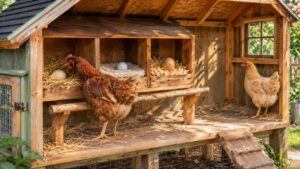
Ask experienced chicken keepers how many chickens a beginner should start with, and you may hear three, four, six, ten, or simply “as many as your coop can hold.” 🐔 Those answers sound contradictory because people are often solving different problems: one person has a tiny suburban run, another wants enough eggs for a large family, and another already owns a spacious predator-proof coop. For most first-time backyard keepers, thinking in three planning groups makes the decision easier: 3–4 hens for a small residential flock, 5–6 for a balanced household flock, and 7–10 for a larger commitment.
These numbers are not universal welfare limits, and a flock of six is not automatically better than a flock of four. Breed size, climate, local regulations, housing, yard or run space, budget, predator pressure, and daily management all affect how many birds a property can reasonably support. 🥚 The goal is to choose the smallest flock that satisfies your expectations while still giving every chicken appropriate housing and reliable daily care.
The Short Answer: Start With The Number You Can Properly House And Care For
For someone wanting a straightforward recommendation, four hens is an excellent starting point for many residential beginners. It creates a small flock without immediately committing you to the feed consumption, manure, coop capacity, water demand, and egg volume associated with ten birds. Four also gives you more flexibility than beginning with only two birds if one hen is lost or must temporarily be separated.
Five or six may make more sense when the household regularly uses eggs and the coop was deliberately built for that number. 🏡 Starting with seven to ten can work too, but at that point the infrastructure should already match the plan rather than being something you hope to upgrade later. Think of flock size as a housing decision first, egg decision second, and impulse-buying decision never.
Is 3 Chickens Enough For A Beginner?
Three hens can make a very manageable first flock, particularly for someone with limited residential space who mainly wants the experience of keeping chickens rather than maximum egg production. Feed, bedding, manure, cleaning, and equipment demands remain comparatively modest, and three birds are easier to observe individually while you learn what normal behavior looks like. 🌿 They can also be a practical choice where local ordinances impose strict limits on backyard poultry.
The drawback is that a three-hen flock has little numerical buffer when circumstances change. If one bird dies or must be isolated for an extended period, you suddenly have only two together, and introducing replacement chickens later requires planning because established flocks do not necessarily welcome newcomers immediately. For that reason, someone who comfortably has space and budget for four may prefer four over three, even though three can still be a perfectly workable small flock.
Why 4 Chickens Is A Practical Starting Point For Many Backyards
Four hens sit in a useful middle ground between “tiny flock” and “serious backyard operation.” 🐓 Daily chores remain manageable, equipment can stay relatively simple, and a properly planned residential coop does not need to become enormous just to accommodate the flock. Four hens can also produce a useful household supply of eggs during good laying periods without creating the same potential surplus that a much larger flock can generate.
There is another practical advantage: housing equipment scales neatly around a flock this size. Many poultry-management recommendations use roughly one nest box for every four to five laying hens, although hens may still decide they all prefer the same favorite nest. 😄 Starting with four also leaves room for carefully planned future additions if the coop and run were intentionally built with extra capacity.
When Starting With 6 Chickens Makes More Sense
Six hens become attractive when eggs are an important reason for keeping chickens and several people in the household regularly eat them. During productive periods, a flock of this size can provide substantially more eggs than three or four birds, although actual production varies by genetics, age, molt, season, daylight, nutrition, health, and environmental conditions. 🥚 Never calculate flock size by assuming one hen equals one egg every single day of the year.
The additional birds also increase routine consumption and waste more than beginners sometimes expect. A medium-sized laying hen may consume roughly several pounds of feed each week, so adding two birds is not merely adding two personalities—it means more feed storage, drinking water, manure, roost space, predator-proof housing, and ongoing cost. Six is therefore a strong balanced household flock when the infrastructure was sized for six from the beginning.
Should A Beginner Start With 10 Chickens?
Ten chickens are not automatically too many for a first-time keeper, particularly on a property with a large purpose-built coop, secure run, sufficient budget, and someone committed to daily care. The learning curve, however, becomes less forgiving because overcrowding, inadequate feeder access, wet bedding, water shortages, and predator vulnerabilities affect more animals when the system is poorly planned. 🛠️ Ten birds should therefore be the result of deliberate infrastructure planning rather than a bigger chick order because ten sounded almost as easy as six.
A flock of ten can also produce far more eggs than a small household actually consumes during productive periods. That may be welcome if eggs are shared with relatives or neighbors, but unnecessary surplus should be considered before purchasing chicks rather than after dozens of eggs begin accumulating. If your real requirement is a modest breakfast supply, starting smaller provides valuable experience and makes later expansion easier to justify.
Calculate Your Flock From Your Egg Needs
Start by estimating how many eggs your household genuinely uses in an average week rather than how many you imagine collecting from a picturesque nesting box. 🍳 A household using about a dozen eggs weekly may find a small flock satisfactory during normal production, while someone regularly using two or three dozen may prefer five or six productive hens. Larger egg needs can justify seven to ten birds, provided the property and care system comfortably support them.
Treat those numbers as planning estimates rather than production guarantees. Breed, age, seasonal daylight, heat, molt, broodiness, nutrition, stress, and individual variation can all change laying rates, and older hens commonly produce fewer eggs than they did at peak production. A good beginner flock should therefore satisfy your needs without requiring every hen to perform at maximum output every day.
Check These Five Limits Before Buying Chicks
First, check local laws and HOA rules, because some communities limit bird numbers, prohibit roosters, require setbacks, or regulate coop placement. 📋 Second, calculate actual coop capacity using an appropriate space recommendation for your breeds and management system, and third, make sure the outdoor run or yard arrangement provides enough usable room rather than trusting an optimistic number printed on a small prefabricated coop. Commercial coop labels can be misleading if they count every inch of attached space as though it were equally usable housing.
Fourth, calculate the budget for birds, feed, bedding, feeders, waterers, fencing, predator protection, healthcare contingencies, and replacement supplies. Fifth, consider your available care time, including mornings, evenings, vacations, bad weather, coop cleaning, frozen or overheated water, and unexpected problems. 🌦️ If one of these five limits supports four birds while the others support ten, your practical starting number is still four.
Leave Room For Future Chickens
Chicken keepers jokingly call unexpected flock expansion “chicken math” because four hens can somehow become six, then eight, remarkably quickly. 😄 The joke is harmless, but overcrowding is not, so building a coop exactly to your starting number can create problems when you later discover another breed you want to keep. A modest capacity buffer gives you options without obligating you to fill every available space.
Expansion also involves more than placing new birds beside the existing flock. New chickens may require quarantine considerations, gradual introductions, additional feeder or waterer access, and enough space to prevent excessive competition while the social order adjusts. Planning unused capacity today is therefore much easier than trying to redesign an undersized coop after new birds have already arrived.
Beginner Flock Size Decision Table
| Starting Size | Best Fit | Main Advantage | Main Trade-Off |
|---|---|---|---|
| 3 hens | Very small residential starter flock | Lower costs and simpler daily management | Little buffer if a bird is lost |
| 4 hens | Typical beginner backyard flock | Manageable size with useful egg potential | May be insufficient for heavy egg use |
| 5–6 hens | Household wanting a steadier egg supply | Good balance of eggs and manageable care | More feed, manure, space, and equipment |
| 7–10 hens | Larger households or spacious properties | Greater egg potential and larger flock | Meaningfully bigger infrastructure commitment |
The table is a decision framework, not a stocking rule. A spacious, professionally planned setup may handle ten hens more easily than a poorly designed suburban coop handles four, while large-bodied breeds may require different space planning from smaller chickens. 🏡 Always choose the flock number after measuring the real housing available rather than choosing the birds first and attempting to squeeze the housing around them.
For a first-time keeper who remains undecided, four is the strongest general starting point, with five or six being reasonable when egg demand and infrastructure justify them. Three works well when keeping the project deliberately small, while seven to ten makes sense when you have already planned for a larger operation. This gives beginners an actual answer without pretending one flock size fits every backyard.
What To Do Next
Once you know approximately how many chickens you want, plan the system around their entire life rather than only their first weeks as tiny chicks. 🐣 Learn the Starter → Grower → Layer Timeline, calculate nesting-box capacity, choose waterers that can reliably serve the full adult flock, and build enough secure housing before the birds outgrow the brooder. Chicks grow remarkably quickly, so “we will figure out the coop later” can turn into a stressful deadline.
It is also worth learning what normal laying patterns look like before expecting a basket full of eggs every morning. Understanding nesting behavior, seasonal laying changes, molt, nutrition, water requirements, and why chickens sometimes stop laying prevents normal flock changes from looking like emergencies. The best beginner flock is ultimately not the largest flock you can purchase—it is the number of chickens you can comfortably house, feed, protect, observe, and enjoy for years. 🐔