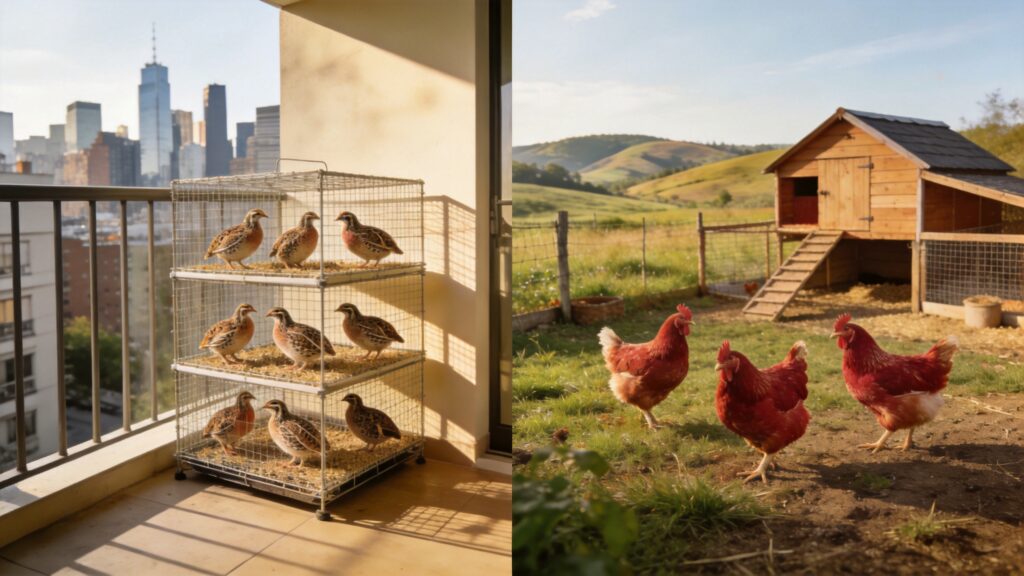
Deciding between raising quail or chickens in your backyard is a surprisingly nuanced choice. Both offer fresh eggs and the satisfaction of self-sufficiency, but they cater to vastly different lifestyles, space constraints, and local regulations. Whether you live in a downtown apartment with a tiny patio or a rural homestead with acres of pasture, understanding the trade-offs between these two birds will save you money, time, and future headaches. Let’s break down noise, space, maturity, costs, egg production, and real-world decision-making for American backyard keepers.
Noise Levels: The Silent vs The Vocal
The single biggest factor that determines whether your neighbors will love you or hate you is noise. Chickens, especially roosters, are famously loud. A rooster’s crow can reach 120 decibels—comparable to a rock concert—and they crow at dawn, midday, and often unpredictably. Even hens make a steady clucking and a distinctive “egg song” after laying, which can carry through walls. In suburban subdivisions with strict HOA rules, roosters are almost always banned, and even hens may cause complaints if kept too close to property lines.
Quail, on the other hand, are remarkably quiet. A coturnix quail’s call is a soft, high-pitched chirp that rarely exceeds 30–40 decibels. Their vocalizations are subtle enough that you can keep a small flock in a garage, on an apartment balcony, or even in a spare bedroom without anyone knowing. The male quail does make a gentle “crow” sound, but it’s more like a quick whistle than a rooster’s racket. For urban dwellers or anyone with noise-sensitive neighbors, quail are the clear winner.
“I’ve kept quail in a 2×3 foot cage inside my city apartment for two years. My next-door neighbor had no idea until I told her. Chickens? I’d have been evicted within a week.” — Maggie, Portland, OR
Space Requirements: Square Footage & Vertical Realty
Chickens need room to roam. A standard backyard flock of 3–4 hens requires at least 4 square feet per bird inside the coop and 10–15 square feet per bird in an outdoor run. They also require dust-bathing areas, perches, and enough height to stand fully upright. Without adequate space, chickens become aggressive, peck each other, and develop health problems. That means a minimum of 20–30 square feet for a small flock—plus fencing to keep predators out.
Quail live in a completely different dimension. Coturnix quail need only 1 square foot per bird in captivity, and they are often raised in stacked rabbit hutches or wire cages with a sloped floor for easy egg collection. Because they do not perch or fly well (and tend to panic if given too much height), a low-profile cage measuring 2 feet by 4 feet can comfortably house 8–10 quail. Their vertical space requirement is minimal—6 to 12 inches of height is plenty. This makes them ideal for city patios, small gardens, or even indoor setups with proper ventilation.
Key takeaway: If your usable outdoor space is less than 50 square feet, quail are the only practical option for fresh eggs.
Time to Maturity & Egg Production Cycles
Chickens are a long-term commitment. Typical heritage or hybrid laying breeds take 18–24 weeks to start laying eggs. Once they begin, a good layer produces about 250–300 eggs per year, with production tapering after 2–3 years. However, chickens have a defined laying season that is influenced by daylight hours (unless you add artificial lighting). They also stop laying during molting and can be broody (wanting to sit on eggs), which pauses production for weeks.
Quail are the sprinters of the poultry world. Coturnix quail reach maturity in 6–8 weeks and can begin laying as early as day 45. A single female quail will lay an egg almost daily (300–360 per year on average) and does not go broody, so production remains consistent year-round—even in winter, if temperature and light are managed. The trade-off? Quail live only about 2–3 years, and egg production declines after the first year. But because they mature so fast, you can stagger hatches to maintain a continuous supply.
| Attribute | Chickens | Quail |
|---|---|---|
| Age at first egg | 18–24 weeks | 6–8 weeks |
| Eggs per bird per year | 250–300 | 300–360 |
| Egg size | Large (50–70g) | Small (10–15g) |
| Lifespan | 5–10 years | 2–3 years |
| Broody behavior | Yes (common) | No |
For someone who wants eggs quickly and doesn’t want to wait half a year, quail have an undeniable speed advantage.
Costs & Egg Production: Breaking Down the Numbers
Initial Setup Costs
Starting with chickens can run from $300 to $800 for a basic coop, run, feeder, waterer, and 3–4 pullets. Quality coops from Tractor Supply or local builders are expensive, and cheap ones often fall apart. Quail require less infrastructure. A simple wire cage, a plastic egg tray, and a small feed dispenser can be assembled for $50 to $150. Even buying a pre-made quail cage (often used for rabbits) costs around $100. Chicks (hatchlings) are cheaper per bird: quail chicks run $0.50–$1.00 each, while chicken chicks (especially sexed pullets) are $3–$8 each.
Ongoing Feed Costs
Chickens are heavier and eat more. A laying hen consumes about 1/4 pound of feed per day (roughly $0.06–$0.08). A coturnix quail eats only 1/2 ounce per day—about one-eighth of a hen’s consumption. That means for the same feed budget, you can keep 8 quail for every 1 chicken. However, quail require a higher protein feed (20–24% protein for layers) compared to chickens (16–18%). Protein-rich feed costs slightly more but the volume difference still outweighs the price.
Egg Value Comparison
One large chicken egg equals about 5–6 quail eggs in volume. A dozen chicken eggs cost $4–$6 at the store; a dozen quail eggs often sell for $6–$12 at farmers markets. If you’re keeping birds for personal consumption, quail eggs are richer in yolks and have a higher yolk-to-white ratio, making them excellent for baking or gourmet cooking. But you’ll need to gather 5–6 tiny eggs to replace one chicken egg in a recipe. That means more handling and more shells to crack.
Practical math: To match the egg mass of a flock of 3 laying hens, you’d need about 15–18 quail. The quail’s lower space requirement and faster maturity can make that feasible even in small settings.
Decision Framework: Urban vs Rural Settings
Choosing between quail and chickens depends heavily on your environment and your personal tolerance for daily chores. Below is a practical guide for three common American scenarios:
- Urban (apartment, small condo, or townhouse with a patio/balcony): Quail are the only realistic choice. Their noise level is negligible, they require no outdoor run, and you can keep 6–10 birds in a 2×3 foot cage. Check local ordinances—some cities explicitly allow “small domestic fowl” but often ban chickens. Quail are rarely mentioned in urban codes, but always verify noise and odor regulations. Use a deep litter method or a cage with a pull-out tray for easy clean-up.
- Suburban (1/4 – 1/2 acre lot with backyard): You have room for a coop and run. Chickens can work if you have no roosters and are willing to deal with occasional clucking. However, if your neighbors are close, quail still offer peace of mind. Many suburbanites start with quail to “test the waters” before committing to chickens. A hybrid approach: raise 2–3 quail in a small cage while building a chicken coop slowly.
- Rural (1+ acres, no close neighbors): Chickens shine here. You can free-range, breed heritage breeds, and enjoy the full experience of a backyard flock. Roosters can roam safely, and you have space for larger coops and compost systems. Quail are still useful for supplemental eggs or as a “backup” flock, but they require more predator protection (ground-level cages attract snakes, raccoons, and rodents). Rural keepers often prefer chickens for meat production as well—a broiler chicken yields 4–6 pounds of meat, while a quail yields only 4–6 ounces.
Practical Case Studies: Two Real-World Examples
Case 1: The Urban Professional in Chicago
Sarah lives in a 700-square-foot apartment with a 4×6 foot balcony. She wanted fresh eggs but knew her building’s HOA forbids “livestock.” After researching, she purchased a 2×3 foot quail cage, a small heat lamp for winter, and six Coturnix quail. She uses a stainless steel tray with pine shavings that she changes weekly. The birds are silent—her neighbors never notice. Within 6 weeks, she was collecting 5–6 eggs daily. Her total setup cost: $120. She now makes quail egg scrambles every weekend and even sells excess eggs to coworkers at $5 per dozen. Quail allowed her to keep poultry in a place where chickens would have been impossible.
Case 2: The Suburban Family in Georgia
The Johnson family has a 0.3-acre lot with a fenced backyard. They wanted a homesteading experience for their two kids. They built a 6×8 foot chicken coop and run, bought four Rhode Island Red hens, and waited 5 months for the first egg. The kids loved feeding them, but the rooster they accidentally ended up with (despite buying “sexed” chicks) caused noise complaints from three neighbors. After rehoming the rooster, the hens laid reliably. Total setup cost: $650. Egg production: about 2–3 per day in peak season. The Johnsons are happy, but they admit the learning curve was steeper than expected. They now keep 4 quail in a small cage in their garage as a “cold weather backup” since the quail lay consistently even when the chickens slow down in winter.
These cases illustrate that quail are the low-stress entry point, while chickens require more space, patience, and tolerance for noise.
Actionable Recommendations for Beginners
- Start small: Buy 6–8 quail (or 2–3 chickens) to test your commitment before expanding. Quail are easier to rehome if you change your mind.
- Check local ordinances: Call your city zoning office or search your county’s “backyard poultry” regulations. Many cities allow up to 4 hens but prohibit roosters. Quail are often unregulated, but some areas classify them as “poultry” subject to same rules.
- Invest in predator-proof housing from day one: Quail cages should have 1/2-inch hardware cloth on all sides (not chicken wire). Chicken coops need locking latches because raccoons can open simple hooks.
- Plan for winter: Chickens need a heated waterer and well-insulated coop (but avoid direct heat sources to prevent fire). Quail need a dry, draft-free space and can tolerate cold as long as the temperature stays above 20°F; use a low-wattage heat plate for extreme weather.
- Choose the right breed: For quail, Coturnix (Japanese) are the best layers and most beginner-friendly. For chickens, consider Rhode Island Reds, Leghorns, or Wyandottes—reliable layers with good temperaments.
- Calculate your egg needs: If you eat eggs daily, a flock of 3 chickens gives you about 2 dozen per week. A flock of 10 quail gives you 2–2.5 dozen quail eggs per week (equivalent to about 4–5 chicken eggs in volume). Adjust numbers accordingly.
Conclusion
Quail and chickens each offer distinct advantages, but neither is universally “better.” Quail win for urban dwellers, noise-sensitive environments, small spaces, and anyone who wants eggs in under two months. Chickens provide larger eggs, more meat potential, and a classic homestead experience for those with land and patience. Assess your property, your neighbors, and your daily routine—then pick one flock to start. You can always add the other later, as many backyard keepers eventually do.