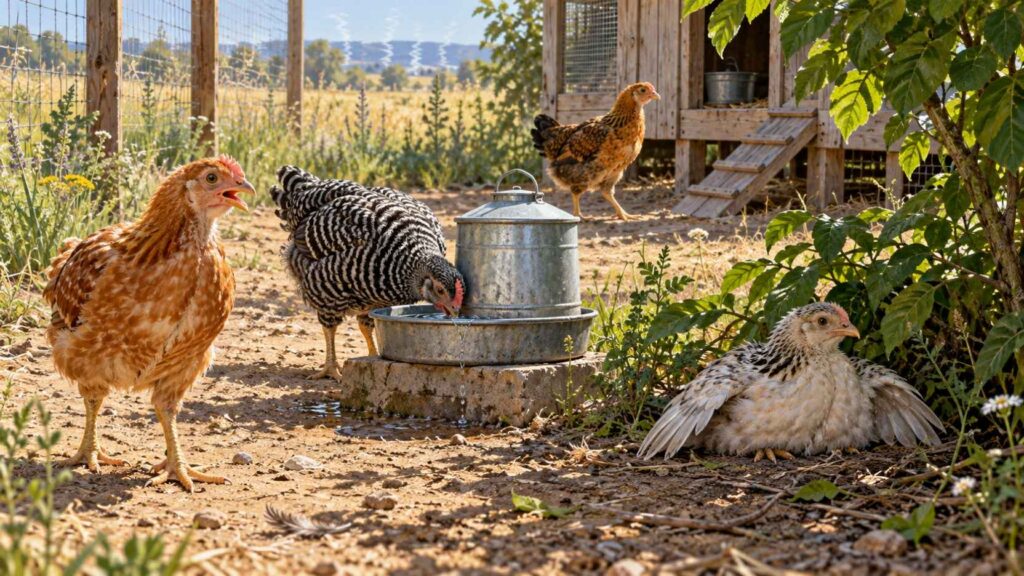
Seeing 10-week-old chickens panting with their beaks open can be unsettling, especially when yesterday they seemed completely comfortable. 🐔 Unlike people, chickens cannot cool themselves by sweating, so when environmental heat rises they increasingly depend on behaviors such as seeking shade, drinking more, holding their wings slightly away from their bodies, and panting to release heat through evaporation from the respiratory tract. Light panting on a hot afternoon can therefore be a normal cooling response, but it is also a signal that your young birds are working harder to control their body temperature.
For first-time chicken keepers, the important question is not simply “Are they panting?” but “What else are they doing while they pant?” A pullet that is alert, walking normally, drinking, responding to flockmates, and moving between shade and water deserves close monitoring, while a bird becoming weak, unresponsive, unsteady, or unable to settle despite cooling requires much faster intervention. 🌡️ Think of panting as the beginning of a conversation with your flock rather than an automatic emergency or something you should completely ignore.
Why Are My 10-Week-Old Chickens Panting With Their Mouths Open?
Chickens naturally run much warmer than humans, with normal body temperatures around 105°F to 109°F, and feathers that are excellent insulation during cooler conditions can make shedding excess heat more difficult when summer arrives. Because birds lack sweat glands that function like ours, they increase respiratory evaporation by breathing rapidly through an open beak. 💨 You may also see them loosen their feathers or extend their wings away from the body to expose less-feathered areas and release additional heat.
This is why young chickens panting in heat may suddenly look alarming even when they were happily scratching around earlier that morning. Light, relatively calm open-mouth breathing during warm conditions can occur before more serious heat distress develops, particularly if the birds remain active and responsive. The goal is not to panic at the first open beak but to make their environment cooler enough that they do not have to progress from mild heat-management behavior into dangerous overheating.
Is Panting Normal If My Chickens Are Still Eating, Drinking, And Walking?
Normal behavior is reassuring because chickens experiencing severe heat stress commonly become progressively less active, weak, crouched, or lethargic. If your chicken is panting but acting normal, watch whether she voluntarily drinks, walks without stumbling, reacts when another bird approaches, and chooses cooler areas of the run. 👀 A flock that is alert and moving normally is generally in a better position than birds lying down, struggling to breathe, or becoming unresponsive.
However, eating and walking do not prove that the temperature is safe, because heat stress exists on a spectrum and birds can initially compensate for rising temperatures. Observe the flock from a short distance instead of repeatedly catching and handling them, since unnecessary activity and restraint can generate additional body heat. Look across the entire group as well: if nearly every pullet is panting heavily despite shade and water, the environment itself needs attention even if no individual bird has collapsed.
What Makes A Young Chicken’s First Heatwave Different?
At around 10 weeks, most chickens are well feathered and have moved beyond the temperature requirements of tiny brooder chicks, but they are still growing pullets rather than mature laying hens. 🐥 Their exact heat tolerance cannot be predicted from age alone because breed, feathering, body size, health, acclimation, housing, airflow, direct sunlight, and humidity all influence how effectively a bird can lose heat. A heavy, densely feathered bird in humid still air may struggle sooner than a lighter bird standing in moving air at the same thermometer reading.
Humidity is especially important because panting cools a chicken partly through evaporation, and evaporation becomes less effective when the surrounding air already contains large amounts of moisture. That is why there is no single outdoor temperature that guarantees every chicken is safe or automatically means every bird is in danger. 🌤️ Instead of depending entirely on a weather-app number, combine temperature and humidity with what the birds are showing you in real time.
What Should I Do In The First 10 Minutes?
First, confirm that every bird can immediately escape direct sun and reach a genuinely shaded, ventilated area rather than a closed coop that has trapped afternoon heat. Increase safe airflow when necessary, make sure ventilation openings are unobstructed, and postpone unnecessary catching, chasing, coop maintenance, or other activities that make chickens exert themselves. 🌳 Air movement at bird level is particularly useful because it helps carry heat away from the body and reduces how heavily birds must depend on panting.
Second, check the water system rather than simply noticing that a waterer exists. Provide abundant fresh, cool drinking water, verify that nipples or cups are functioning, and make sure lower-ranking pullets are not being prevented from drinking by dominant flockmates. 💧 Chickens can substantially increase their water consumption during heat stress, so a waterer that works perfectly on a mild spring day may become inadequate during a severe hot spell.
Watch What Happens After You Improve The Environment
Once shade, airflow, and water are addressed, quietly watch whether the chickens become more comfortable rather than repeatedly disturbing them. A mildly hot bird may continue panting for a while, but you want to see alert behavior, drinking, normal balance, and preferably less intense respiratory effort as cooling conditions improve. 🌬️ Birds spreading themselves apart in the shade instead of piling together is also useful because body-to-body contact adds heat.
Pay special attention to individuals that look considerably worse than the rest of the flock. One pullet panting dramatically while every other bird appears comfortable could indicate more than environmental heat, especially if respiratory difficulty continues after she is moved somewhere cooler. Persistent open-mouth breathing in comfortable temperatures can have other causes, so unexplained breathing problems deserve veterinary evaluation rather than automatically being labeled heat stress.
When Should I Worry About A Panting Pullet?
Panting becomes more concerning when it grows increasingly forceful or is accompanied by wings held persistently away from the body, crouching, reluctance to move, poor coordination, weakness, or unusual lethargy. 🚨 Pale or discolored combs and wattles, collapse, inability to stand, extreme respiratory distress, or a bird that stops responding normally should be treated as urgent warning signs rather than ordinary summer panting. A chicken that continues deteriorating despite access to shade, airflow, and water needs immediate attention.
For a severely overheated bird, move her to a cooler shaded environment and begin active cooling while arranging veterinary help when necessary. Cool—not ice-cold—water can be used to help lower body temperature, and airflow can assist cooling, but avoid extreme temperature changes and never force water down a chicken’s throat because liquid can enter the airway. 🩺 If the bird collapses, cannot stand, becomes poorly responsive, develops significant breathing difficulty, or fails to improve with cooling, contact a veterinarian experienced with poultry as promptly as possible.
Don’t Forget The Coop After The Sun Goes Down
Your first hot day with chickens does not necessarily end when direct sunlight disappears. Coops can store daytime heat, and a poorly ventilated enclosed structure may remain warmer than the outdoor air well into the evening, particularly when several birds are producing additional body heat inside. 🌙 Check that nighttime ventilation provides substantial air exchange without compromising protection from predators.
You may notice the pullets settle rapidly once temperatures fall, which provides useful information about how strongly the day’s panting was connected with environmental heat. If heavy panting continues long after conditions have become comfortably cooler, examine the bird more carefully rather than assuming yesterday’s heat is still responsible. Respiratory disease and other problems can also cause abnormal breathing, making the relationship between breathing behavior and environmental temperature an important clue.
Printable First Hot Day: Young Chicken Observation Card
Use this card whenever your growing pullets experience an unfamiliar hot day, and evaluate changes over time rather than one isolated behavior. 📋 Start with the normal-activity column, move toward intervention as warning signs accumulate, and treat emergency signs seriously. Keeping a simple observation card near the coop also makes it easier for another family member to check the flock consistently when you are unavailable.
| ✅ Normal Or Reassuring | ⚠️ Early Warning | 🚨 Emergency |
|---|---|---|
| Alert and responsive | Panting becoming heavier | Collapse or inability to stand |
| Walking normally | Wings held away from body | Severe weakness or poor responsiveness |
| Drinking voluntarily | Spending most of the time crouched | Major breathing difficulty |
| Moving into shade | Noticeably reduced activity | Markedly pale or abnormal comb/wattle color |
| Light panting that improves with cooling | Most of flock panting heavily | Condition worsening despite cooling |
| Normal balance and coordination | Water consumption rising sharply | Unable or unwilling to drink |
| Interacting with flockmates | One bird noticeably worse than others | Staggering or loss of coordination |
Keep in mind that the columns describe a progression rather than a diagnostic test. A chicken does not need to display every warning sign before you improve shade, water, or ventilation, and you should not wait for collapse before responding to obvious worsening. The safest habit is to make small environmental corrections early while continuing to observe how the flock responds.
What Your Pullets Need From You On Their First Hot Day
The first heatwave is useful because it reveals weaknesses in your setup before summer becomes routine. ☀️ You may discover that afternoon shade disappears earlier than expected, one waterer is too small, the coop does not move enough air, or a particular bird handles heat less comfortably than her flockmates. Fixing those problems now gives your growing chickens a more reliable cooling system for every hot day that follows.
So, are 10-week-old chickens panting on a hot day automatically in danger? No—light panting can be part of normal temperature regulation, especially when pullets remain alert, mobile, drinking, and responsive, but panting also tells you it is time to check the environment rather than dismiss the behavior. 🐔 Provide shade, ventilation, plentiful cool water, minimal unnecessary handling, and close observation, then respond immediately if panting progresses into weakness, abnormal behavior, respiratory distress, or collapse.