Introduction
A secure chicken coop is one of the most important investments you can make in backyard poultry keeping. Chickens face risks from predators such as raccoons, rats, snakes, foxes, and dogs, depending on where you live. Even a sturdy-looking coop can have weak points around windows, vents, doors, and the outdoor run.
One practical solution is hardware cloth, a strong wire mesh commonly used to reinforce poultry enclosures. When correctly selected and installed, it can help keep predators out while allowing fresh air to circulate.
However, not all wire mesh offers the same protection. Chicken wire, for example, is primarily designed to contain poultry, not reliably stop determined predators.
Here is how to choose, install, and maintain hardware cloth to make your chicken coop more secure without creating unnecessary expense. 🏡
1. What Is Hardware Cloth?
<AsyncImageGroup query={[“galvanized welded hardware cloth wire mesh close up small square openings”,”hardware cloth installed over chicken coop ventilation window”,”galvanized hardware cloth chicken run exterior”]} aspectRatio=”5:4″ layout=”bento” />
Hardware cloth is a welded wire mesh available in different opening sizes, wire gauges, and finishes. Despite its name, it is usually made from metal wire rather than fabric.
For chicken coops, it is commonly used to cover:
- Windows and ventilation openings
- Gaps around the coop structure
- Outdoor run walls
- Openings beneath raised coops
- Areas vulnerable to digging predators
Its effectiveness depends on the mesh’s opening size, wire strength, installation quality, and the type of predator in your area.
2. Choose the Right Mesh Size and Strength
The opening size matters because small predators can squeeze through surprisingly narrow gaps, while larger animals may bend or tear weak mesh.
For many backyard coops, 1/2-inch galvanized welded hardware cloth is a useful starting point for exposed openings. Smaller openings may be appropriate where very small predators, including mice, are a concern.
Consider these general guidelines:
| Feature | What to look for |
|---|---|
| Opening size | Around 1/2 inch for many vulnerable openings |
| Construction | Welded wire mesh rather than lightweight poultry netting |
| Wire strength | Sturdy enough to resist bending and the likely predators |
| Finish | Galvanized or another corrosion-resistant finish suitable for outdoor use |
| Quality | Consistent welds, no broken wires, and no sharp damaged edges |
Wire gauge numbering can be confusing because a lower gauge number generally indicates thicker wire. Compare actual wire thickness and product specifications rather than relying on the gauge number alone.
No single mesh specification guarantees protection against every predator. Large dogs, bears, and other powerful animals may require substantially stronger structural barriers.
3. Reinforce Windows and Ventilation Openings 🌬️
Ventilation is essential for chicken health. It helps remove moisture, heat, and airborne contaminants from the coop.
However, an open window or vent can become an entry point for predators.
To secure these openings:
- Measure the full opening, including the area needed for attachment.
- Cut hardware cloth with suitable wire cutters.
- Remove or cover sharp cut ends.
- Position the mesh so it overlaps the surrounding frame.
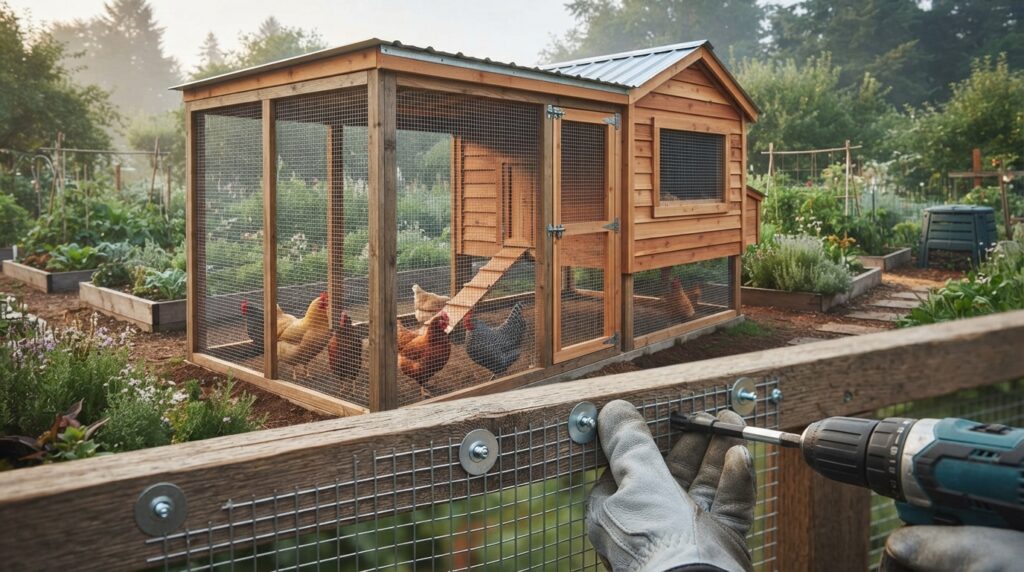
- Fasten it securely with screws and washers, sturdy staples appropriate for the structure, or a suitable metal frame.
- Check that the mesh cannot be pulled away easily at the edges.
For important openings, screws and washers or a secure framed installation are generally more dependable than a few staples alone.
Do not cover vents so tightly that airflow is reduced. In hot climates, maintain adequate ventilation and shade while keeping vulnerable openings protected.
4. Protect the Chicken Run From Climbing and Reaching Predators
A chicken run allows birds to scratch, dust-bathe, and explore. Unfortunately, its open sides can leave chickens exposed to predators.
Hardware cloth can strengthen the run walls, especially around the lower sections and other vulnerable areas.
Pay attention to the following:
- Attach mesh to solid framing rather than unsupported edges.
- Overlap adjoining pieces sufficiently and fasten them securely.
- Reinforce corners, door frames, and junctions between walls and the roof.
- Secure gates so there are no gaps around the latch or bottom edge.
- Inspect the entire perimeter for loose fasteners and bent mesh.
A secure top or roof may also be needed to reduce access by climbing predators and protect against some aerial threats. Hardware cloth should be selected and supported according to the span and expected loads.
Important: Hardware cloth is not a substitute for a sound frame. Strong mesh attached to weak wood can still be pulled loose.
5. Stop Digging Predators With an Apron or Buried Barrier
Some predators dig beneath fences to reach poultry. A barrier at ground level can make this more difficult.
Two common approaches are a buried mesh barrier and a horizontal hardware-cloth apron.
<AsyncImageGroup query={[“chicken coop predator apron hardware cloth laid horizontally around run base before soil covering”,”buried hardware cloth predator barrier chicken run construction detail”]} aspectRatio=”5:4″ layout=”carousel” />
Option A: Horizontal apron
Extend hardware cloth outward from the base of the run and secure it to the structure. The mesh is then covered with soil, gravel, or another suitable surface.
A horizontal apron often extends roughly 18–24 inches outward, but the appropriate width depends on the site and the digging behavior of local predators.
Option B: Buried vertical barrier
Install mesh downward along the perimeter and secure it to the run structure. The depth required depends on soil conditions and the animals you are trying to exclude.
Installation tips
- Secure the mesh firmly to the run’s lower frame.
- Overlap and fasten mesh joints so predators cannot exploit seams.
- Avoid leaving exposed sharp wire where chickens or people can get injured.
- Check for erosion, digging, and gaps after heavy rain.
Neither method is completely predator-proof, but a well-installed barrier can make digging into the enclosure more difficult.
6. Install Hardware Cloth Without Creating Injury Risks
Hardware cloth has sharp cut edges, and poorly installed mesh can injure chickens or people.
Follow these precautions:
- Wear gloves and eye protection when cutting or handling the mesh.
- Use tools designed for cutting wire.
- Bend or cover exposed cut ends.
- Keep sharp edges away from areas where chickens perch, roost, or move through narrow passages.
- Check that fasteners do not protrude into the enclosure.
- Avoid leaving loose wire loops or torn sections.
If you use treated or coated metal products, follow the manufacturer’s instructions for their intended use and environmental suitability.
A neat installation is not only more attractive. It also makes future inspections and repairs easier.
7. Avoid Common Hardware Cloth Mistakes
Even good materials can fail when installation is rushed.
Mistake 1: Using chicken wire as the only predator barrier. Chicken wire is useful for containing birds, but it may be too weak to stop determined predators.
Mistake 2: Choosing mesh with openings that are too large. Small predators may squeeze through openings that seem insignificant.
Mistake 3: Attaching mesh only with a few staples. Edges can pull loose under pressure. Use an attachment method appropriate for the frame and expected forces.
Mistake 4: Forgetting the roof and corners. Predators may climb, reach through gaps, or exploit poorly joined sections.
Mistake 5: Blocking ventilation. Secure the opening while preserving the airflow chickens need.
Mistake 6: Ignoring corrosion. Rusted mesh, broken welds, and deteriorating fasteners can weaken the barrier over time.
Mistake 7: Assuming hardware cloth makes the coop completely predator-proof. Doors, latches, roofing, the floor, and the surrounding structure all matter.
8. Maintain the Barrier With Regular Inspections 🔧
Predator protection requires ongoing maintenance. Weather, soil movement, corrosion, and repeated use can weaken even a well-built enclosure.
Use this simple inspection checklist:
- Check mesh for rust, broken welds, and bent sections.
- Test whether edges can be pulled away from the frame.
- Inspect door hinges, latches, and gaps.
- Look for digging or disturbed soil around the perimeter.
- Check corners, roof connections, and ventilation covers.
- Replace damaged fasteners and repair sharp or loose wire.
- Reinspect after storms or any suspected predator attempt.
If you find signs of an attempted entry, look beyond the obvious damage. The predator may have identified another weak point nearby.
Final Thoughts 🐓
Hardware cloth is a practical way to strengthen a backyard chicken coop, especially around vents, windows, run walls, and ground-level openings. The best results come from combining suitable mesh with strong framing, secure fasteners, protected edges, and a well-designed perimeter.
Start by identifying the most vulnerable areas of your coop, then reinforce them systematically. Choose materials based on the predators in your area, preserve good ventilation, and inspect the enclosure regularly.
A safer chicken coop is built through layers of protection, not one piece of wire. With careful installation and routine maintenance, hardware cloth can become an important part of a reliable predator-resistant setup.