If you live in a New York studio, a San Francisco micro-apartment, or a Denver high-rise, you might think raising your own protein is impossible. But thousands of urban Americans are discovering a surprising solution: quail. These tiny birds produce fresh eggs daily, require barely any space, and make almost no noise. With the right setup, you can build a complete mini-farm on a bookshelf. This guide walks you through choosing quiet breeds, managing apartment-specific challenges, and creating a closed-loop system that your neighbors—and your landlord—will never complain about.
Selecting the Quietest Breeds and the Right Cage
Not all quail are created equal when it comes to apartment living. The standard Coturnix japonica (Japanese quail) is the gold standard for indoor urban farming. Within this species, specific strains such as Texas A&M (also called Jumbo Brown) and English White are known for their calm demeanor and nearly silent vocalization. Avoid Bobwhite quail—they are louder, more flighty, and require different light cycles.
Cage Considerations for Small Spaces
Your quail’s home needs to balance airflow, ease of cleaning, and a small footprint. The most popular options are:
- Commercial rabbit cages with ½-inch wire mesh flooring – affordable and stackable. The wire allows droppings to fall through, reducing odor and keeping birds clean.
- DIY PVC or wooden frame cages with plastic trays – great for customizing height to fit under a desk or into an IKEA bookshelf.
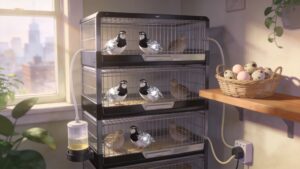
- Three-tier or four-tier metal stacking systems – ideal if you want to keep 6–12 birds in a 2×2-foot footprint. Brands like Yitee or PawHut sell budget-friendly versions on Amazon.
Minimum space requirement: 1 square foot per quail for the cage floor, and at least 12 inches of height so they can stand upright. More room reduces stress and feather pecking.
| Cage Type | Pros | Cons | Best For |
|---|---|---|---|
| Rabbit cage (single level) | Ready to use, good ventilation | Limited height; often too tall for quail | 1–3 birds, beginners |
| DIY PVC / wood frame | Customizable, cheap materials | Requires tools and skill; must seal wood | Experienced DIYers with exact space needs |
| Commercial stacker (3–4 tiers) | High density, easy cleaning trays | Higher upfront cost ($150–$300) | 4–12 birds, serious egg production |
Keeping Noise, Odor, and Neighbors Under Control
Your biggest worry in an apartment is a complaint. Unlike chickens, quail are naturally quiet—hens make soft trills, and even males produce a low croak that rarely travels through walls. However, a single male can create a repetitive croak-croak-croak that may annoy nearby walls. The simplest fix: keep only females. A group of three to six hens will lay eggs without a rooster. If you want to breed, maintain a ratio of one male to three females, and place the cage away from shared bedroom walls.
Soundproofing Without Renovation
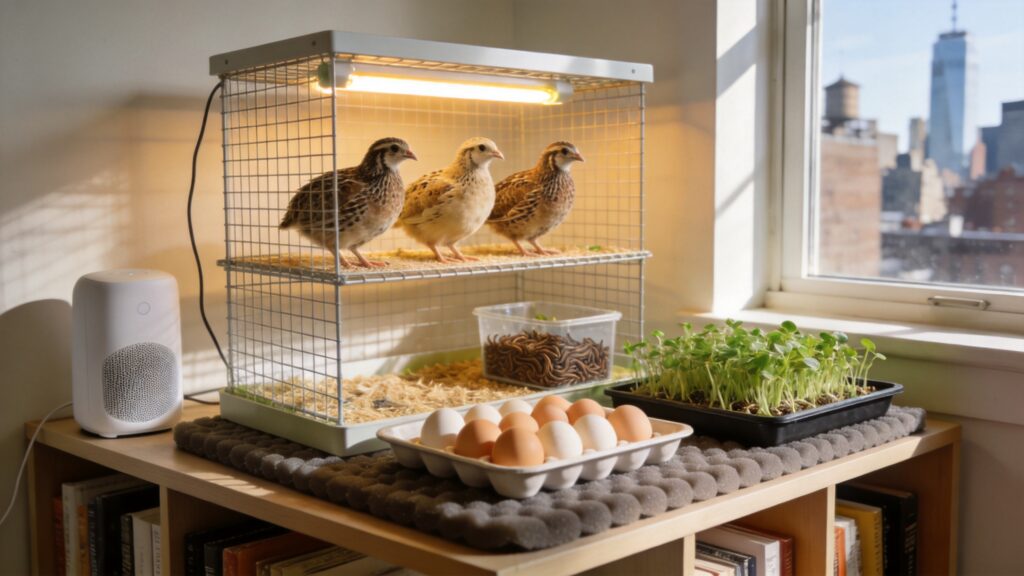
Place the cage on a thick foam mat or rubber stall mat to absorb vibrations. Drape a heavy moving blanket or thick acoustic panels over three sides of the cage (leave the front open for ventilation). A white noise machine or a small fan running in the same room will mask the subtle sounds. One urban quail keeper in Chicago told me:
“I was terrified my downstairs neighbor would hear the quail. I put the cage on a rug, covered the back with an old comforter, and ran a humidifier nearby. After three months, she asked me if I had gotten a cat—even she couldn’t believe I had birds.”
— Maya R., Logan Square, Chicago
Odor Management That Works
The real culprit is not the quail themselves but their droppings. Quail manure is dry but can develop ammonia if wet. Use a deep-litter method with pine shavings (not cedar, which is toxic) or hemp bedding (highly absorbent and low-dust). Change the tray completely every three to five days. Sprinkle a thin layer of sweet PDZ (a zeolite powder) over the bedding to lock in ammonia—this is the same product horse barns use, and it’s safe for birds. A carbon filter air purifier placed near the cage will polish the air and also reduce dust from feathers and feed.
Building a Sustainable, Closed-Loop Indoor System
True urban sustainability means turning waste into resources. Quail are perfect for a circular approach because they produce high-nitrogen manure, fresh eggs, and occasional spent birds (if you process them—but for most apartment dwellers, eggs are the goal).
- Set up a worm bin. Red wiggler worms thrive on quail manure if you mix it with shredded cardboard and vegetable scraps. The resulting castings are a potent fertilizer for your houseplants or a balcony herb garden.
- Grow microgreens or wheatgrass on a shallow tray next to the quail cage. They sprout in 7–10 days, require only sunlight or a cheap LED grow light, and provide fresh greens that reduce layer feed consumption by about 10%.
- Recycle eggshells. Wash, dry, and crush eggshells. Bake at 200°F for 10 minutes, then grind to a powder. Mix this into the quail’s feed as a calcium supplement—closing the loop.
- Consider black soldier fly larvae. A small bin of BSF larvae can process kitchen scraps and produce high-protein feed for your quail. Yes, it’s possible to keep a fly larvae bin in a closet with no odor (when managed properly).
A sustainable system doesn’t require fancy equipment. Even a simple two-bin approach—worm castings on one side, microgreens on the other—turns your quail hobby into a genuine mini-ecosystem. A 2-square-foot setup can produce enough fertilizer for a small container garden and enough greens to supplement your birds’ diet year-round.
Feed and Water for the Long Haul
To minimize trips to the feed store, buy a 50-pound bag of organic game bird layer crumble (20–24% protein) and store it in a sealed metal can. Use a water nipple system instead of open bowls: nipple drinkers attach to a PVC pipe or a commercial watering unit and prevent spillage that would raise humidity and cause mold. A 5-gallon bucket fitted with a lid and nipples can supply four quail for two weeks without refilling.
Daily Care, Health Monitoring, and Lighting
Your daily routine takes about five minutes, but consistency matters. First, check the water nipples—if a single air bubble forms, the line may stop flowing. Collect eggs every morning; quail lay at 5–6 a.m. if you use a timer light. Observe each bird’s stance: healthy quail stand upright with bright eyes; a hunched posture or drooping wings means possible illness.
- Lighting: For consistent egg production, provide 14–16 hours of light per day. Use a simple outlet timer and an LED bulb (cool white, 5000K). No heat lamp needed in a temperature-controlled apartment—quail are comfortable between 60°F and 85°F.
- Common health issues: Egg binding is the #1 killer. Prevention: ensure a consistent calcium source (crushed oyster shell or recycled eggshell powder). Respiratory problems come from poor ventilation—your cage must have cross airflow without a direct draft.
- Biosecurity in an apartment: Never wear outdoor shoes into the quail area. Quail are susceptible to viruses carried on shoes. A simple pair of slippers that stay in the bird room is enough.
Hands-On Case Study: A 6-Bird System in a 350-Square-Foot Studio
Becky, a graphic designer in Portland, Oregon, keeps six female Texas A&M quail in a 2-tier rabbit cage on her desk. She uses bamboo trays with hemp bedding changed every four days. Her neighbor is a fellow apartment dweller with a dog—no complaints in a year. She grows basil and mint in a hydroponic tower next to the cage, irrigated with diluted worm tea from the worm bin. Total initial investment: $220. Eggs per month: ~120, saving her about $40 on store-bought pastured eggs. “It’s not just about the eggs,” she says. “It’s the feeling of independence in a tiny space.”
Start Small, Scale Smart
Begin with three or four hens in a single-level cage. Master the cleaning routine and odor control before expanding. Most cities do not restrict quail—check your local municipal code (they often fall under “small pets” unless you have a rooster). A single quail lays an egg almost daily, so four birds give your household a steady stream of fresh protein. The compact footprint means you can mount the cage on a wall or tuck it into a closet with a ventilation fan.
Urban quail farming is not a hobby—it’s a quiet revolution in food sovereignty. By choosing a quiet breed, engineering your environment, and closing the waste loop, you can produce food year-round in a space smaller than a bathtub. Your neighbors won’t know unless you show them the eggs.