
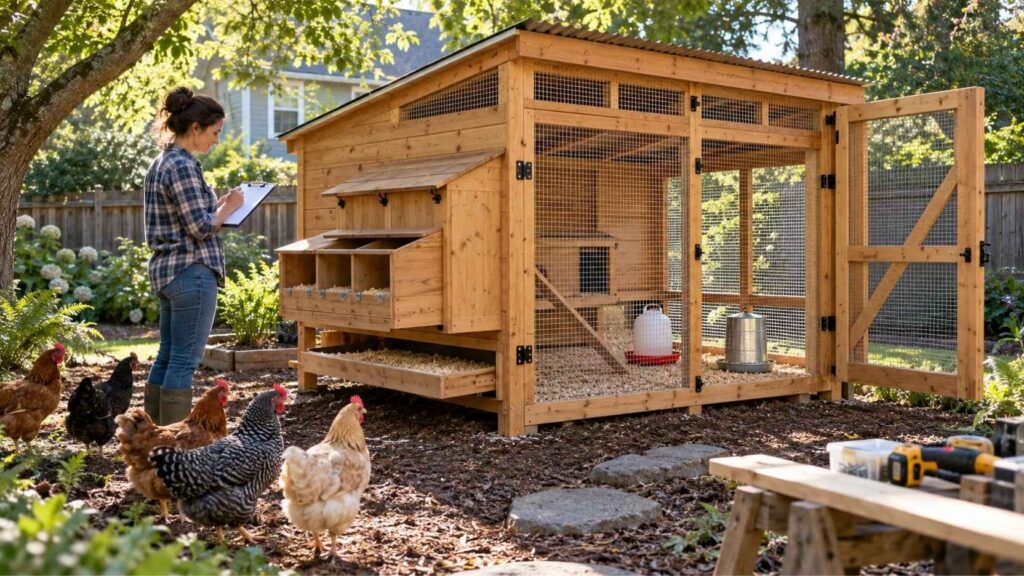
A chicken coop can look perfectly sensible while it is empty and become frustrating almost immediately after chickens move inside. 🐔 Many beginner chicken coop mistakes are not obvious construction failures, but small design decisions that make feeding, cleaning, egg collection, predator protection, and flock expansion harder every day. The best time to discover those problems is before the first bag of bedding reaches the floor.
That is why planning a coop should involve more than asking how many chickens technically fit inside it. Think about the keeper carrying water during rain, gathering eggs after work, cleaning corners filled with manure, and locking every opening after dark. 🔨 These are the things many keepers wish they knew before raising chickens, and fixing them on paper is much cheaper than rebuilding later.
Mistake #1: Buying Chickens Before Finishing The Coop
Baby chicks can make the coop deadline feel distant because they begin life in a brooder. The weeks pass quickly, however, and growing birds soon produce more dust, noise, waste, and escape attempts. ⏰ Beginners then rush construction because the chickens need outdoor housing before the building is actually ready.
Finish the major structure, ventilation, predator barriers, doors, roosts, and basic feeding arrangement first. Walk around the completed enclosure looking for sharp edges, gaps, unstable panels, and places predators could exploit. Chickens should move into a functioning system rather than become the deadline forcing you to finish one.
Mistake #2: Building For Today’s Flock Only
Four tiny chicks do not make a four-chicken flock feel crowded, so a small coop may initially seem generous. Adult birds require substantially more usable space, and feeders, waterers, roosts, nest boxes, and doors consume some of that space. 📏 Crowding becomes especially noticeable when weather keeps chickens indoors longer than usual.
Design around adult chickens and real usable floor space, not the size of birds when you purchase them. Consider whether larger breeds, temporary separation, new additions, or an injured bird could change your space requirements. A modest amount of extra room is usually easier to manage than a structure that begins at maximum capacity.
Mistake #3: Trusting The Coop’s Advertised Capacity
Prefab coop listings often advertise a chicken capacity that sounds surprisingly generous for the footprint. That number may not reflect your breeds, climate, available run space, roost arrangement, or the room occupied by equipment. 🏠 A coop technically capable of containing eight birds may not provide a comfortable working layout for eight birds.
Measure the actual interior and examine how chickens will move between roosts, doors, nests, food, and water. Look for bottlenecks where birds could crowd each other or block access to important resources. Treat advertised capacity as a starting claim to evaluate rather than a guaranteed stocking recommendation.
Mistake #4: Designing For Chickens But Forgetting The Human
Beginners understandably focus on whether chickens can enter the coop, reach a perch, and access nest boxes. Unfortunately, the keeper is the one who must scrape manure, replace bedding, retrieve eggs, repair hardware, and catch a sick bird. 🧹 A charming miniature doorway stops being charming when you need to crawl through it every weekend.
Make doors large enough for comfortable access and ensure important components can be reached without dismantling the coop. Ask whether bedding can be removed easily, feeders can be refilled during bad weather, and every corner can be inspected. If maintenance is awkward while the structure is empty, chickens and dirty bedding will make it worse.
Mistake #5: Putting The Coop In The Wrong Part Of The Yard
The easiest construction site is not always the best long-term coop location. Low areas can collect water, full sun can create summer heat problems, and excessive distance from the house makes routine checks inconvenient. 🌦️ Placement can also affect neighbors through noise, odor, visibility, flies, or unexpected rooster crowing.
Study drainage after rain and observe how shade and sunlight move across the yard. Consider prevailing weather, electrical access if needed, hose distance, walking conditions, and reasonable separation from neighboring properties. Moving an occupied coop later is far harder than spending another day choosing its location now.
Mistake #6: Treating Predator Protection As An Upgrade
Predator resistance should be part of the first design rather than something added after an animal discovers your flock. Chickens become especially vulnerable after entering the coop at night because they depend entirely on the enclosure around them. 🦝 Small gaps, weak latches, loose roof edges, and poorly protected openings can become access points.
Inspect the structure as though you were an animal trying to enter rather than a chicken trying to remain inside. Secure doors with reliable hardware and protect vulnerable openings with materials appropriate for predator exclusion. Check the perimeter regularly because soil movement, weather, chewing, and repeated use can create new weaknesses.
Mistake #7: Thinking Chicken Wire Means Predator-Proof
Chicken wire is useful for containing chickens in many situations, which makes its name somewhat misleading for beginners planning security. Its relatively light construction should not automatically be treated as a strong barrier against determined predators. 🔒 A run can therefore look completely enclosed while still having vulnerable sides, corners, or openings.
Use stronger welded wire or hardware cloth where real predator resistance is needed, selecting an appropriate mesh and installation method for local threats. Secure it firmly rather than attaching it loosely to decorative framing. Pay particular attention around vents, windows, doors, roof transitions, and lower edges where weaknesses are often overlooked.
Mistake #8: Sealing The Coop Too Tightly
A cold-weather instinct is to close every crack because keepers worry that moving air will make chickens uncomfortable. Chickens also produce moisture through breathing and manure, however, and stale humid air should not be trapped inside the coop. 💨 Good ventilation helps remove moisture, ammonia, heat, and airborne contaminants.
Provide intentional ventilation rather than relying on random cracks around poorly fitted doors. High vents can exchange air while thoughtful placement helps prevent strong drafts blowing directly across roosting birds. Vent openings also need predator-resistant screening because ventilation should not create a convenient nighttime entrance.
Mistake #9: Making Cleaning Harder Than Necessary
Complicated interiors can look impressive until droppings begin collecting behind permanent fixtures and beneath inaccessible corners. Rough surfaces, narrow spaces, fixed equipment, and badly positioned roosts can transform a simple maintenance job into an unpleasant project. 🧽 Difficult cleaning also encourages keepers to postpone work they would otherwise complete quickly.
Favor surfaces and layouts that can be swept, scraped, inspected, and dried without special gymnastics. Removable components can simplify deeper cleaning when they are strong enough to remain stable during normal use. Design manure management before choosing decorative details because daily practicality matters far more after the novelty wears off.
Mistake #10: Forgetting How Feed And Water Will Work
A coop plan is incomplete until you know exactly where feed and water will be stored, carried, and offered. Containers placed in poor locations can collect bedding, become wet, spill repeatedly, or force the keeper into awkward daily movements. 💧 Outdoor systems also need protection from weather without becoming difficult for chickens to reach.
Picture yourself carrying a full waterer and feed container through every gate and doorway. Decide where supplies will remain dry, where spilled feed can be noticed, and how water can be refreshed conveniently. The best setup makes Daily Care & Eggs routines boringly simple rather than turning feeding into an obstacle course.
Mistake #11: Ignoring Future Nest-Box Needs
Nest boxes sometimes receive excessive attention before hens begin laying and too little thought about how they will actually be used. Hens commonly share preferred boxes, but poorly located nests can become dirty, difficult to access, or attractive as sleeping areas. 🥚 Egg collection becomes frustrating when boxes are positioned where the keeper cannot comfortably inspect them.
Place nests somewhere hens can access while allowing straightforward collection and cleaning. Avoid designing an elaborate box system that consumes valuable floor space without improving function. Think about whether additional boxes could be added later if the flock expands or existing boxes become difficult to manage.
Mistake #12: Forgetting That Your Flock May Grow
Many keepers begin with a strict number of chickens and later discover another breed, rescue, hatching project, or replacement pullet they want. 🐣 Even without intentional expansion, purchasing young birds can occasionally produce surprises such as an incorrectly sexed bird. A coop with absolutely no flexibility makes every flock change become a construction problem.
This does not mean building an enormous barn for four hens. Instead, leave sensible expansion options such as an extendable run, accessible framing, or space for another feeding station. Also check local rules before increasing flock size or keeping roosters because property restrictions can matter just as much as physical capacity.
Walk Through Your Coop Before The Chickens Do
Perform a complete imaginary chicken day before declaring the project finished. 🌅 Walk outside in the morning, open the appropriate door, check water, refill feed, inspect birds, collect eggs, and imagine doing everything again during rain or darkness. Then simulate the evening routine, including counting birds, checking the run, and securely closing every access point.
Next, imagine weekly cleaning while the coop contains bedding, feathers, manure, feeders, and chickens that refuse to stand where convenient. Try reaching every corner and removing equipment through the openings you built. If one step already feels irritating in an empty coop, redesigning it now can prevent years of repeated frustration.
Before Chickens Arrive: 25-Point Coop Inspection Checklist
Use this checklist after construction but before the flock moves inside. ✅ Walk through every item physically rather than answering from memory, because many problems only become obvious when you operate the doors, carry equipment, and inspect corners. A ten-minute inspection can catch surprisingly expensive chicken coop mistakes before chickens make repairs more complicated.
- ☐ Coop size matches the expected adult flock, not chick size.
- ☐ The run provides practical usable space rather than crowded leftover areas.
- ☐ Every chicken can reach appropriate roosting space.
- ☐ Roost placement does not encourage birds to sleep inside nest boxes.
- ☐ Nest boxes can be reached easily for egg collection.
- ☐ Main doors allow comfortable human access.
- ☐ Every interior corner can be inspected.
- ☐ Bedding can be removed without dismantling permanent structures.
- ☐ Interior surfaces can be scraped or cleaned practically.
- ☐ Ventilation openings provide meaningful airflow.
- ☐ Airflow does not create an obvious strong draft across roosts.
- ☐ Vent openings have predator-resistant protection.
- ☐ Door hardware closes securely and cannot easily be pushed open.
- ☐ Windows and openings are appropriately protected.
- ☐ Predator protection extends to vulnerable lower edges and gaps.
- ☐ The roof has no obvious weak openings or water leaks.
- ☐ Rain drains away rather than collecting beneath the coop.
- ☐ The location receives useful shade during hot periods.
- ☐ Feed can be stored somewhere dry and secure.
- ☐ Feeders are easy to refill without excessive waste.
- ☐ Waterers are easy to remove, clean, refill, and inspect.
- ☐ Chickens can reach feed and water without crowding.
- ☐ The keeper can complete morning chores conveniently.
- ☐ The keeper can lock the flock securely after dark.
- ☐ The layout leaves at least some flexibility for future changes.
Build For The Chores, Not Just The Chickens
The most expensive coop mistakes are often not dramatic structural disasters but small inconveniences repeated hundreds of times. A badly positioned door, inaccessible nest box, difficult water route, or poorly planned cleaning area becomes part of your routine every single day. 🛠️ Designing around those repetitive jobs makes chicken keeping easier long after the excitement of building the coop has passed.
Think of the coop as a small operating system rather than simply a shelter with a roof. Protect the birds, provide appropriate ventilation and usable space, and then design every routine around easy access, easy inspection, easy cleaning, and easy security. When those pieces work together, both the chickens and the person caring for them benefit.




