Understanding the Space Demands of Growing Quail
When you first bring home a brooder full of day-old quail chicks, the tiny peepers seem to occupy almost no space at all. A standard 18×18-inch brooder can easily house 30 chicks for the first week. But as those fuzzy bodies transform into sleek, feathered adolescents, their spatial requirements skyrocket. Mistaking juvenile space needs for adult requirements is the single most common cause of stress, feather picking, and even mortality in home quail flocks.
Quail are ground-dwelling birds with a strong instinct for personal space. Unlike chickens, they don’t tolerate crowding well. The minimum recommended floor space for adult Coturnix quail is 1 square foot per bird — but that’s for fully mature, non-breeding stock. For growing quail, the equation changes week by week.
Week-by-Week Space Guidelines
The table below offers a practical framework based on common Coturnix breeds. Use it as a starting point, then adjust based on your flock’s behavior.
| Age | Square Feet per Bird | Example: 10 Birds | Key Consideration |
|---|---|---|---|
| 1–7 days | 0.2–0.3 | 2–3 sq ft (e.g., 18×18 in) | Heat lamps reduce usable space; keep waterers accessible |
| 2–3 weeks | 0.4–0.5 | 4–5 sq ft | Feathers start emerging; perching attempts increase |
| 4–5 weeks | 0.7–0.8 | 7–8 sq ft | Juvenile molt begins; hierarchy formation ramps up |
| 6+ weeks (sub-adults) | 1.0+ | 10+ sq ft | Sexual maturity approaching; males may fight |
Note: These figures assume a well-ventilated, dry environment. High humidity or poor ventilation can effectively reduce usable space because birds will huddle away from drafts, creating localized crowding.
A real-world example: Sarah, a backyard quail keeper in Oregon, raised 12 chicks in a 2×2-foot brooder for the first two weeks. At week three, she noticed the birds constantly bumping into each other while trying to reach the feeder. She expanded to a 3×2-foot enclosure, and the aggressive pecking stopped within 24 hours. “It was like they could finally breathe,” she told me. “I wish I’d doubled the space sooner.”
The takeaway: Space is the cheapest stress reducer you can provide. Don’t wait for visible problems — measure your birds’ density against the table above and preemptively upgrade.
Recognizing the Signs: When to Split the Covey
Even with adequate floor space, a single covey of mixed-age or mixed-sex quail will eventually need to be divided. The signals are not always dramatic; often they’re subtle behavioral changes that build over days. Learning to read these cues prevents injuries and reproductive issues.
Five Telltale Signs It’s Time to Separate
- Feather picking behind the head and neck. This is the number one indicator of overcrowding or social imbalance. If you see missing feathers on the back of the neck, especially in a few targeted birds, split the group immediately.
- Excessive mounting or chasing. In mixed-sex groups, sexually mature males may harass females to exhaustion. In all-male groups, mounting is a dominance display that escalates into torn wattles and broken toes.
- Uneven weight gain. Weigh a random sample of three birds weekly. If the lightest bird is more than 20% smaller than the heaviest, lower-ranking individuals are being excluded from feeders.
- Shy or cowering behavior. A bird that spends most of its time pressed against a wall or hiding under the waterer is stressed. It may not show injuries yet, but its immune system is compromised.
- Decreased egg production in females. Laying quail can pause production due to social stress, even if food and light are optimal. A sudden drop often correlates with new aggression in the pen.
“I used to think splitting the covey was only necessary when I saw blood. Now I know that by then, I’m already two weeks late. The moment I see persistent feather ruffling or a bird standing alone in a corner, I set up a new pen.” — Mark, quail breeder in Texas
Once you’ve identified the need, the next question is what kind of split? For most backyard setups, the most practical approach is to separate by sex and age. Males that reach sexual maturity at 6–7 weeks should be moved to a separate bachelor pen if they’re not being used for breeding. Females can stay together in larger groups, but watch for bullying among the dominant hens. If you’re raising for meat, separate by size: heavy birds and lighter birds grow at different rates, and feeding them together leads to wasted feed and stressed runts.
Best Practices for Minimizing Transition Stress
Splitting a covey isn’t just about physically moving birds — it’s about managing the emotional and physiological shock of a new environment. Quail are prey animals wired to detect danger in every change. A poorly executed transition can set them back two weeks in growth or egg production. Here’s how to do it right.
The Two‑Hour Rule
When you move a quail to a new enclosure, its stress hormones spike for approximately two hours. During that window, the bird is hypervigilant and may refuse to eat or drink. To counteract this, transfer familiar elements — not just the bird. Move over the same feeder and waterer, even if they’re dirty, and place them in the exact same orientation (left side, back corner) as in the original pen. The visual cues of “my water is here” help the brain override the “I’m in danger” response.
Introducing New Birds Gradually
If you’re adding a separated bird to an existing group (e.g., moving a sub-adult male into a bachelor pen), never toss it in cold. Instead, use the “see but don’t touch” method:
- Place the new bird in a wire cage or mesh divider inside the target pen for 48 hours. The residents can see and smell the newcomer without physical contact.
- Swap a handful of bedding from each side daily to mix scents.
- On the third day, release the newcomer at dusk (when quail naturally settle down). Turn off the lights for 15 minutes before and after release.
This protocol reduces aggressive pecking by 70% compared to direct introductions, according to a small-scale trial by the North American Quail Association.
Environmental Enrichment as a Buffer
Stress during transitions is amplified by barren enclosures. A quail that can hide or perch recovers faster. Add two or three simple items before the move:
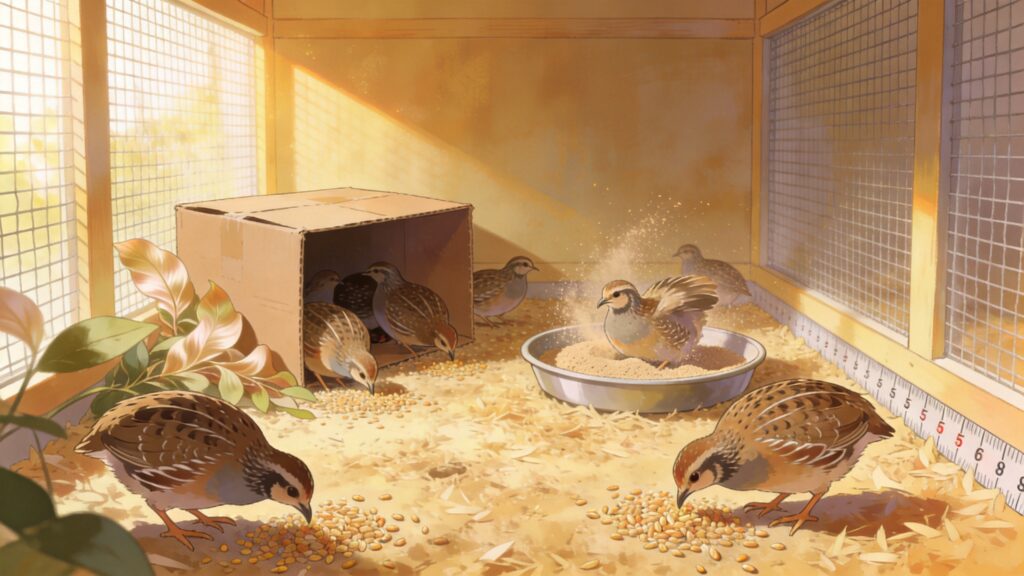
- Hiding structures
- Cardboard boxes with entrance holes, PVC pipe sections, or fake plants (silk foliage). Place them in corners so birds have an escape route from aggressive peers.
- Dust baths
- A shallow pan of clean sand mixed with a little diatomaceous earth. Dust bathing is a natural calming behavior — quail will engage in it within minutes of settling in a new pen.
- Foraging distractions
- Scatter a handful of scratch grains in the bedding rather than offering all feed in a trough. The act of pecking and searching redirects nervous energy and establishes new feeding territories without conflict.
Case Study: A Smooth Split at 6 Weeks
Jenny runs a small quail operation in Illinois and documented her transition of 20 quail from a single brooder into two adult pens at six weeks of age. She followed the two-hour rule, moving ten birds (five males, five females) into a new 4×4-foot pen with exactly the same feeder model and waterer. She left the remaining birds in the original pen. To her surprise, none of the moved birds exhibited feather ruffling or food refusal. “I think the key was duplicating the feeder layout — they just walked up and started eating like nothing happened,” she said. Nine days later, the moved group laid their first eggs, only two days behind the control group that hadn’t been moved. The control group, meanwhile, had stopped aggressive pecking after the split because the density dropped from 1.2 sq ft per bird to 2.0 sq ft.
Common Pitfalls to Avoid
- Moving birds during mid‑day heat. Quail are most stressed by temperature extremes. Perform transitions early in the morning or late in the evening when temperatures are stable.
- Cleaning the new pen too thoroughly. A sterile environment smells like “nothing” to a quail, which is just as alarming as a predator scent. Leave a thin layer of old bedding or a handful of manure from the original pen to provide familiar olfactory markers.
- Adding visual inspection right after the move. Resist the urge to check on them every ten minutes. Constant human presence keeps them in a state of alarm. Wait at least three hours, then observe quietly from a distance.
Conclusion
Transitioning growing quail through different life stages is not complicated, but it demands observation and proactive planning. By providing adequate square footage per bird, reading behavioral cues for when to split the covey, and minimizing stress with familiar elements and gradual introductions, you’ll raise healthier, more productive birds. The payoff is simple: fewer injuries, more eggs, and a quieter coop. Start measuring your pen space today, and your flock will thank you tomorrow.