As American cities swell and concrete spreads, the dream of fresh, local food often feels out of reach. Yet a quiet revolution is hatching in backyards, basements, and even living rooms—powered by an unlikely hero: the quail. These compact, virtually silent birds produce protein with astonishing efficiency, offering a practical path toward urban food resilience. In this deep dive, we explore how quail farming is poised to become a cornerstone of tomorrow’s sustainable food system.
The Urban Food Challenge: Why Local Matters More Than Ever
By 2050, nearly 70% of the world’s population will live in cities, and the United States is no exception. Urban sprawl has severed the connection between people and their plate. The average American meal travels over 1,500 miles from farm to fork, guzzling fossil fuels and shedding nutrients along the way. Meanwhile, supply chain disruptions—from pandemics to climate extremes—have exposed the fragility of centralized food production.
Local food isn’t just a trendy buzzword; it’s a resilience strategy. But traditional livestock like chickens or rabbits face real barriers in dense urban environments: noise complaints, space constraints, and regulatory pushback. Enter the quail—a bird that thrives where others falter.
“Quail are the unsung heroes of urban agriculture. They require 80% less space than chickens, produce negligible noise, and convert feed into protein at a ratio that rivals industrial poultry.” — Dr. Sarah Lin, Urban Livestock Researcher, Cornell University
Why Quail? The Efficiency Factor
When we talk about sustainable food, efficiency is king. Quail outperform nearly every other domesticated bird in key metrics:
| Metric | Chicken (Laying Hen) | Quail (Coturnix) |
|---|---|---|
| Days to first egg | 18–24 weeks | 6–8 weeks |
| Feed-to-egg conversion (lbs) | 4 lbs feed per dozen | 2.2 lbs feed per dozen |
| Space per bird (sq ft) | 2–3 sq ft | 0.25–0.5 sq ft |
| Noise level (dB) | 60–70 (crow often louder) | 20–30 (soft chirps) |
This isn’t just data—it’s a game-changer for urban dwellers. A single square foot of vertical space can house two to three quail, producing up to 300 eggs per year. Their quick maturation means you can cycle through generations rapidly, turning spare corners into productive microfarms.
Adaptability Across Climates
Whether you’re in a sweltering Phoenix apartment or a drafty Brooklyn brownstone, quail adapt. Their small bodies release less heat, reducing ventilation demands, and they tolerate temperature swings from 40°F to 90°F with proper care. Unlike chickens, they don’t need outdoor runs—stackable cages indoors work perfectly.
Innovations in Quail Housing: From Basements to Vertical Farms
The future of urban quail farming lies in smart design. Traditional wire cages are being replaced by purpose-built systems that maximize space while minimizing labor and smell.
Vertical Stacking Systems
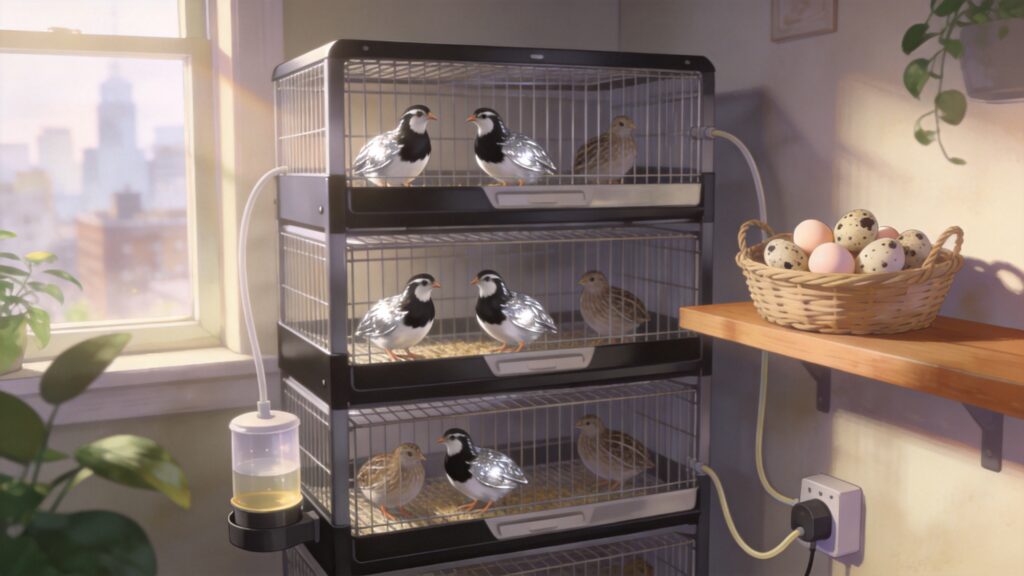
Companies like Urban Quail Co. and Micro-Poultry Systems now offer modular towers that fit in a 2×2 foot footprint. Each tier holds six to eight quail, with sloped trays that funnel waste into a single collection pan. “You can produce the equivalent of a dozen eggs a day from a unit that looks like a bookshelf,” says Jake Harper, founder of City Quail in Portland. “Add an automatic water line and a timed feeder, and you’re looking at 10 minutes of maintenance daily.”
Smell and Noise Mitigation
One of the biggest hurdles to urban livestock is odor. Advanced housing uses deep-litter composting with pine shavings and biofilters—layers of activated charcoal and peat moss—that neutralize ammonia. For noise, breeders have selected for ultra-quiet strains—some quail emit only a soft trill, quieter than a refrigerator hum.
“We installed a 30-bird quail system in a Chicago condo’s laundry room. After six months, the landlord never noticed—and the tenant saved $800 on eggs.” — Urban Agriculture Journal, 2024 Case Study
Automation and IoT Integration
Smart sensors now monitor temperature, humidity, and even egg count via Wi-Fi. A growing number of urban farmers use Raspberry Pi–based controllers that adjust lighting and feeding schedules. One open-source project, QuailOS, logs daily feed intake and predicts optimal culling times—taking the guesswork out of small-scale production.
Breeding Innovations: Tailoring Quail for the City
Selective breeding is accelerating the urban quail movement. Whereas traditional Coturnix japonica were bred for game farms or laboratory research, new lines prioritize traits that matter for apartment dwellers.
Compact Body Size and Egg Output
The Jumbo White Coturnix lays 300+ eggs per year while weighing only 8–10 ounces. Meanwhile, the Golden Italian strain has been developed for creamy, rich yolks that rival duck eggs. Both strains have been selected for calm temperaments—less fluttering, easier handling in tight quarters.
Disease Resistance and Hardiness
Urban environments bring unique pathogens. Breeders at the Quail Genetics Lab, University of Arkansas have identified a gene variant (Q-MHC) that boosts resistance to coccidiosis and avian influenza. “We’re aiming for a bird that can thrive with minimal veterinary intervention,” says lead researcher Dr. Mark Henson. “This is crucial for beginners who can’t easily access a poultry vet.”
Color Varieties for Aesthetic Appeal
Surprisingly, aesthetics matter. Urban farmers often showcase their quail in living spaces. Tuxedo, Silver, and Tuxedo-Scarlet varieties are gaining popularity—not just for eggs but as quiet, beautiful pets with a practical payoff. Social media influencers have turned quail-keeping into an aesthetic movement, normalizing the practice for apartment renters.
Practical Steps to Start Your Urban Quail Operation
Ready to join the quail revolution? Here’s a actionable roadmap tailored for American urban dwellers:
- Check Local Laws: Most cities permit quail under “small animal” ordinances, but some require permits. Check your municipal code or call animal control. Quail are often exempt from rooster bans because they don’t crow.
- Choose Your Strain: For beginners, start with Coturnix japonica (Japanese quail) in a layer breed like Jumbo White. Avoid meat breeds for first-timers—they grow fast but require more precise feeding.
- Set Up Housing: Buy or build a stackable cage system with at least 0.25 sq ft per bird. Use a shallow litter tray (1–2 inches of pine shavings) and a wire floor to keep eggs clean. Place in a quiet corner away from drafts.
- Source Quality Feed: Game bird layer feed with 20–24% protein is essential. Supplement with calcium (oyster shell) for strong eggshells. Many urban farmers buy feed in bulk from co-ops or online suppliers like Mazuri or Purina Game Bird.
- Manage Daily Care: Check water and feed daily; clean the waste tray every 2–3 days. Quail need 14–16 hours of light for consistent laying—a simple timer on a LED strip works wonders.
- Harvest and Scale: Eggs can be collected daily. For meat, cull males at 8–10 weeks (they’re ready at 6–7 ounces). Freeze or share with neighbors. As confidence grows, expand vertically—add another tier, not another footprint.
Real Case: A Brooklyn Studio Apartment Farm
Maya K., a graphic designer in Brooklyn, turned a 3×4 foot closet into a quail microfarm. With a three-tier custom cage, 14 quail, and an automatic feeder, she produces 10–12 eggs daily—enough for her family and to trade with neighbors for vegetables. “My rent is $2,400, but I save $200 a month on organic eggs,” she says. “And the chirping is actually calming. It’s like having a little piece of the countryside in the city.”
Why Quail Are More Than a Niche—They’re a Movement
Urbanization isn’t slowing down, but neither is human ingenuity. Quail embody the principles of a regenerative food system: low input, high output, minimal waste, and maximum accessibility. They enable anyone—from a studio renter to a rooftop co-op—to reclaim a sliver of food sovereignty.
As cities rewrite zoning codes and as climate pressures mount, the humble quail offers a quiet answer. It doesn’t crow, it doesn’t stink, and it turns a handful of feed into a nutrient-dense meal. The future of urban food isn’t some high-tech lab—it’s already here, nesting in a cage smaller than a microwave. All it takes is one person, a little space, and the courage to start.