When you hear “Japanese quail are domesticated and fine in small cages,” it sounds reassuring—but what does the science actually say? For decades, the Coturnix japonica has been held up as a model of adaptability, yet the truth about their behavioral needs and the realities of captivity tells a more complex story. This article unpacks the history, genetics, space requirements, and practical trade-offs every keeper should understand.
How Centuries of Domestication Shaped the Japanese Quail
The domestication of the Japanese quail (Coturnix japonica) is not a recent phenomenon. Historical records from 11th-century Japan describe quail kept for their song and later for egg and meat production. By the 16th century, selective breeding was underway, and the modern “Coturnix” lines we see today emerged from intense artificial selection in the 20th century—first in Japan, then globally for laboratory and agricultural use.
Genetic Changes Under Domestication
Over roughly 400–500 years, the Japanese quail underwent measurable genetic shifts compared to their wild ancestors. Key changes include:
- Reduced fear response: Domestic quail show lower corticosterone levels and less escape behavior when handled.
- Increased egg production: Wild quail lay 6–12 eggs per clutch; selected lines can lay 250–300 eggs per year.
- Body size and growth rate: Domestic lines grow faster and reach heavier weights, often at the cost of skeletal strength.
- Reduced territorial aggression: Males in captivity are less likely to fight when housed in groups—but aggression still peaks in overcrowded conditions.
These adaptations make the Japanese quail undeniably more tolerant of confined spaces than a wild bobwhite or California quail. However, tolerance is not the same as thriving.
Space Requirements: Minimum Square Footage Per Bird
Different sources recommend wildly different space allowances. The table below summarizes recommendations from university extension programs, commercial breeders, and welfare research.
| Source | Minimum sq. ft. per bird | Context |
|---|---|---|
| University of California Extension | 0.5–0.7 sq. ft. | Commercial egg production (floor pens) |
| American Poultry Association (backyard) | 1.0–1.5 sq. ft. | Small flock with enrichment |
| Welfare research (e.g., Jones & Waddington, 1993) | 1.5–2.0 sq. ft. | Reduced aggression and normal movement |
| EU organic standards (poultry analogy) | 2.0+ sq. ft. | Outdoor access, perches, dust bath |
“Quail kept at densities below 0.5 sq. ft. per bird show significantly higher rates of feather pecking, cannibalism, and foot lesions—even if they are ‘domesticated.'” – Welfare of Laying Hens and Quail, 2019 Review
In practice, the often-cited “they’re fine in small cages” argument typically references commercial battery cages that provide 0.3–0.4 sq. ft. per bird—far below any welfare threshold. While the quail survive and lay eggs, the cost is chronic stress and behavioral deprivation.
Behavioral Needs vs. Practical Constraints in Captivity
Domestication has dampened some wild behaviors, but it has not erased them. Understanding what a quail needs versus what a keeper can provide is the central tension in quail husbandry.
What the Science Says About Key Behaviors
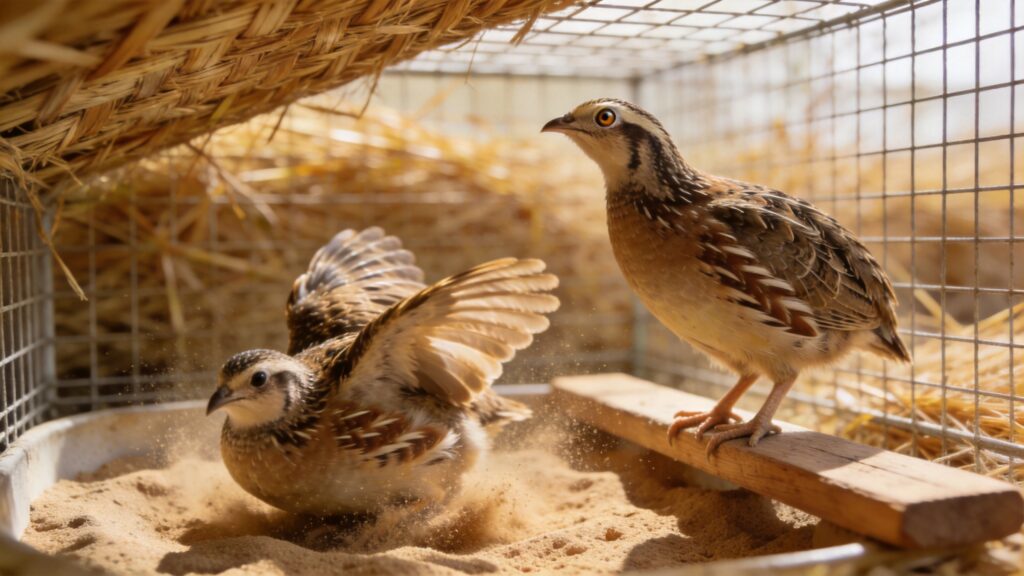
- Dust bathing
- Quail will dust-bathe daily if given access to dry sand or fine soil. Without it, they preen excessively and develop skin irritation. Minimum: a shallow tray of sand for every 6 birds.
- Cover and fear zones
- Even tame quail freeze or flush when exposed to overhead threats. Providing visual barriers (fake plants, cardboard strips, or partial covers) reduces stress-induced egg loss.
- Perching and vertical space
- Unlike chickens, quail do not perch high, but they do use low platforms (2–4 inches off the ground). Vertical space of at least 12 inches allows them to stand upright without touching the cage top.
- Social structure
- Quail are social but not endlessly tolerant. Groups of 4–8 birds per square foot of floor space often work; above that, aggression peaks. Males should not exceed a 1:3 ratio with females to avoid over-mating injuries.
Practical Compromises That Work
When space is limited, these adjustments can improve welfare without expanding your footprint:
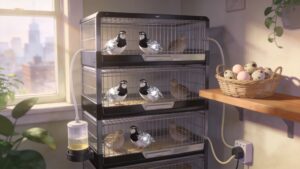
- Use multi-level cages with ramps or low ledges to increase usable space without increasing floor area. Ensure the height per level is at least 8 inches to prevent head rubbing.
- Rotate enrichment items weekly: a small mirror, a handful of sprouted seeds, a shallow water dish for paddling—all occupy natural foraging instincts.
- Provide a separate dust bath box that can be removed and refilled. It doubles as a behavioral outlet and a visual break.
- Employ a “half-roof” cover over part of the cage. This gives birds a choice between exposed and sheltered space, reducing overall fear.
A Real-World Case: From Battery to Enriched Floor Pen
One small-scale keeper I worked with kept 20 quail in a 4 ft × 2 ft cage (0.4 sq. ft. per bird) for two years. Egg production was steady, but feather loss and toe injuries were constant. After switching to a 6 ft × 4 ft floor pen with straw, sand baths, and low perches (1.0 sq. ft. per bird), mortality dropped by 40%, and egg shells became visibly thicker within three weeks. The keeper remarked: “I thought they were fine before. Now I see they were just surviving.”
What “Fine in Small Cages” Actually Means
The phrase “Japanese quail have been domesticated for centuries and adapt to small cages” contains a truth—but it is a partial truth. Domestication did reduce stress reactivity, but it did not eliminate the need for space to perform species-typical behaviors. A quail can survive in 0.3 sq. ft., but it cannot thrive. The distinction matters because surviving quail often mask mild chronic stress through reduced activity—a sign that is easy to misinterpret as contentment.
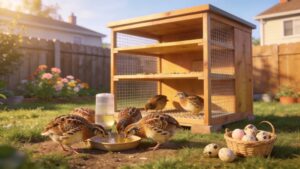
For the American backyard keeper or small farmer, the actionable takeaway is this: aim for at least 1.0 sq. ft. per bird as a baseline, and provide enrichment that mimics the three pillars of quail well-being—dust bathing, cover, and social choice. Even a small cage can be made far more livable with thoughtful design.
Conclusion
The enduring appeal of the Japanese quail lies in its resilience, but resilience is not a license for neglect. Respecting a century of domestication means acknowledging both the genetic adaptations and the remaining wild instincts. By providing adequate space and behavioral outlets, we don’t just keep quail—we let them live as quail.