Few things make a new chicken keeper panic faster than seeing red in a chick’s droppings.
The immediate thought is usually:
“Coccidiosis!”
And coccidiosis absolutely belongs on the list of possibilities. Some Eimeria species can cause intestinal damage and bleeding, and serious infections can lead to diarrhea, weight loss, weakness, dehydration, and death.
But here’s the important part:
Blood in a dropping does not prove that a chick has coccidiosis.
The color and appearance of chicken droppings can vary for several reasons, and other intestinal diseases, parasites, nutritional problems, and management issues can produce similar digestive signs.
So what should a beginner do?
Don’t panic.
Don’t diagnose from one dropping.
Instead, look at the chick, the droppings, the flock, and the environment together.
Here’s how. 🐔
🔴 First: Confirm That You’re Actually Seeing Blood
Before assuming the worst, look carefully.
Chicken droppings can contain different colors and textures depending on what the bird has eaten and what is happening in the digestive tract.
Some normal or relatively normal variations can look alarming to an inexperienced keeper.
What matters is whether you’re seeing persistent or clearly abnormal red material, especially when it occurs together with other signs of illness.
If you’re unsure, take a clear photograph for your records and observe the chick rather than relying on color alone.
The question isn’t simply:
“Is this red?”
It’s:
“Is this chick showing other signs of illness at the same time?”
🦠 Why Coccidiosis Is High on the List
Coccidiosis is caused by microscopic protozoan parasites, primarily Eimeria species in chickens.
These organisms multiply inside intestinal cells.
Some species cause relatively mild disease, while others can produce substantial intestinal injury and bleeding. Eimeria tenella, for example, affects the ceca and can cause hemorrhagic lesions.
Clinical coccidiosis is particularly important in young poultry.
Affected chickens may develop:
- Reduced feed consumption
- Lethargy
- Weight loss
- Ruffled feathers
- Severe diarrhea
- Watery or mucoid feces
- Bloody feces in some infections
Severe disease can be fatal.
That makes bloody droppings something worth taking seriously.
But it still doesn’t make them a diagnosis.
🐥 Look at the Chick, Not Just the Poop
This is one of the most useful habits a beginner can develop.
If you see a questionable dropping, immediately look at the chick.
Is the chick active?
Healthy chicks normally move around, eat, drink, explore, and rest.
A chick that suddenly spends much more time sitting deserves closer observation.
Is it eating?
Reduced feed consumption is a recognized sign of coccidiosis.
Is it drinking?
Make sure the chick can reach clean water.
Is it growing?
Poor growth or rapid weight loss is concerning.
Is it standing normally?
A weak chick that struggles to stand needs more urgent attention.
Are the feathers ruffled?
Ruffled feathers can accompany illness, including coccidiosis, but they aren’t specific to it.
The more abnormalities you see together, the more seriously you should take the situation.
💩 One Bloody Dropping vs. a Pattern
A single unusual dropping is different from repeated bloody diarrhea.
Think of the situation in three levels.
🟢 One questionable dropping
The chick is active, eating, drinking, growing, and behaving normally.
Don’t diagnose immediately.
Observe more closely and check subsequent droppings.
🟡 Repeated abnormal droppings
The chick has ongoing diarrhea, mucus, unusual feces, or repeated red material.
Increase monitoring and investigate.
Look at the chick’s behavior, appetite, weight, litter, water, and other birds.
🔴 Blood plus obvious illness
The chick is weak, eating poorly, losing weight, dehydrated, depressed, or repeatedly passing bloody feces.
Contact a veterinarian promptly.
The severity of the bird’s condition matters more than trying to win a guessing game about the exact disease.
⚖️ Weight Can Tell You What Your Eyes Can’t
Chicks can hide gradual weight loss surprisingly well.
Feathers can make a declining chick look more normal than it actually is.
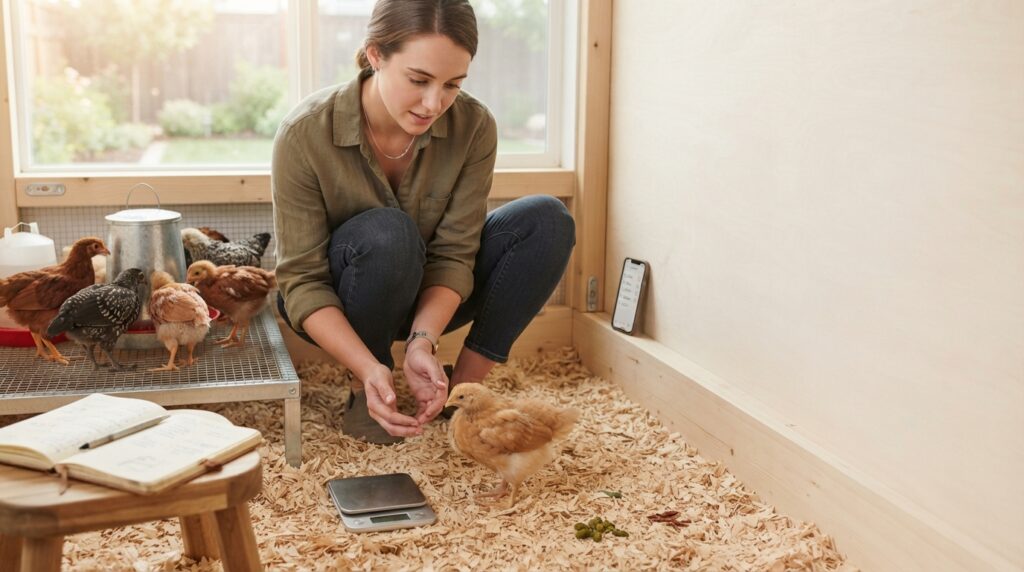
If you are worried about intestinal disease, regular weighing can provide useful information.
Keep a simple record:
| Date | Chick 1 | Chick 2 | Chick 3 |
|---|---|---|---|
| Monday | ___ g | ___ g | ___ g |
| Wednesday | ___ g | ___ g | ___ g |
| Friday | ___ g | ___ g | ___ g |
The numbers here are only a recording example.
Different breeds and ages have different expected weights.
The important thing is the trend.
A chick that is failing to gain weight or losing weight deserves more attention than one that is continuing to grow normally.
Rapid weight loss is one of the clinical signs associated with coccidiosis.
🌧️ Check the Litter
If coccidiosis is a possibility, walk straight over to the brooder or coop.
Look at the litter.
Is it:
- Wet?
- Heavily soiled?
- Packed down?
- Contaminated around the drinker?
- Becoming difficult to keep dry?
Coccidia are spread through fecal contamination.
Infective oocysts can contaminate litter, soil, feed, water, equipment, and other surfaces. Under favorable conditions, they can become infective in the environment.
Moist, heavily contaminated litter can increase exposure.
This doesn’t mean you need a sterile brooder.
It means that wet litter and accumulated fecal contamination are worth correcting.
💧 Check the Waterer
A waterer is one of the easiest places to investigate because every chick uses it.
Ask:
Is the water clean?
Is the drinker leaking?
Are chicks walking through it?
Is litter getting inside?
Is the waterer positioned so it becomes contaminated quickly?
If the water is dirty, replace it with clean water and address the source of contamination.
But don’t assume dirty water automatically caused the bloody droppings.
You’re investigating the environment, not assigning blame.
🌾 Check the Feed Too
Take a close look at the feed.
Ask whether there has been:
- A recent feed change
- Wet or spoiled feed
- Mold contamination
- Rodent access
- Unusual treats
- Access to something inappropriate
- A change in how the feed is stored
Nutrition and feeding problems can cause digestive abnormalities, and veterinary references specifically include nutritional deficiencies and feeding or management faults among the conditions that can resemble coccidiosis.
Again, you’re looking for clues.
You are not proving that feed caused the problem.
🐔 Check the Other Chicks
This is critical.
If one chick has abnormal droppings but the others are thriving, the situation is different from a brooder where five chicks suddenly become quiet and stop eating.
Coccidiosis can affect multiple young birds because infected chickens shed oocysts in their feces, contaminating their shared environment.
Ask:
How many chicks are affected?
Did they become sick at the same time?
Are they all showing digestive signs?
Are some losing weight?
Are any becoming weak?
If several chicks are showing similar symptoms, think flock-level problem, not just an individual bird.
🔍 What Else Can Cause Bloody or Abnormal Droppings?
This is where the title of the article really matters.
Coccidiosis is not the only possibility.
Veterinary references list other potential causes of diarrhea in young animals, including bacterial infections, viral infections, other protozoal parasites, intestinal worms, nutritional problems, and feeding or management issues.
In poultry, additional intestinal diseases can also overlap with coccidiosis.
For example, necrotic enteritis is a bacterial intestinal disease that can occur in chickens and may be associated with coccidial infections. It can cause depression, diarrhea, and serious intestinal damage.
That is why the same symptom can lead to very different diagnoses.
Blood is a clue.
It isn’t a laboratory test.
🪱 What About Worms?
Internal parasites are another reason not to diagnose coccidiosis from droppings alone.
Poultry can be affected by gastrointestinal worms, including nematodes and cestodes. Clinical signs vary, and diagnosis may involve identifying parasite eggs in feces or examining recovered parasites.
Worms aren’t automatically the explanation for bloody poop either.
The point is simply that “red dropping = coccidia” is too simplistic.
🩺 Can a Vet Actually Confirm Coccidiosis?
Yes, diagnosis can involve laboratory and postmortem methods.
Fecal flotation can be used to detect coccidial oocysts.
In some cases, examination of intestinal tissue after death provides important information about the location and severity of lesions and the species involved.
But there’s an important complication:
Finding coccidial oocysts doesn’t automatically prove that coccidiosis is causing the illness.
Coccidia are common in poultry environments, and birds can shed oocysts without showing severe clinical disease.
Merck notes that diagnosis should consider fecal findings alongside clinical signs, flock history, management, and, when applicable, intestinal lesions.
That’s why a veterinarian may ask much more than:
“Did you see blood?”
They may want to know:
- Age of the chicks
- Number affected
- Duration of illness
- Feed intake
- Growth
- Mortality
- Housing
- Litter condition
- Previous disease
- Preventive program
- Recent changes
The bigger picture matters.
🚨 When Bloody Droppings Need Urgent Attention
Don’t spend hours trying to identify the exact disease from photographs if the chick is clearly deteriorating.
Seek veterinary help promptly if you see:
🔴 Repeated bloody droppings
🔴 Severe or persistent diarrhea
🔴 Marked weakness
🔴 Rapid weight loss
🔴 Dehydration
🔴 A chick unable to stand normally
🔴 Several chicks becoming sick
🔴 Sudden deaths
🔴 Rapidly increasing illness
Coccidiosis can have a relatively rapid course in poultry, and severe disease can cause significant intestinal damage and mortality.
USDA also recommends paying attention to sudden or significant changes in energy, appetite, breathing, movement, and mortality as signs of potentially serious disease.
🧼 What You Can Do While You Investigate
There are useful steps you can take without trying to diagnose the chick yourself.
Keep clean water available
Make sure weak chicks can reach it.
Keep appropriate feed accessible
A sick chick shouldn’t have to compete with stronger birds.
Keep the environment dry
Fix leaking drinkers and remove excessively wet bedding.
Reduce unnecessary contamination
Keep feeders and drinkers as clean as practical.
Monitor the entire group
Don’t focus exclusively on the chick that produced the bloody dropping.
Record changes
Write down when the problem started and which birds are affected.
These steps support good flock management, but they do not replace diagnosis or treatment when a chick is seriously ill.
💊 Don’t Use Blood as a Reason to Automatically Medicate
A common internet mistake is:
“Bloody poop = coccidiosis = give a coccidiostat.”
The first step should be determining whether coccidiosis is actually the likely problem and what treatment is appropriate.
Anticoccidial drugs are used in poultry, but products, approved uses, doses, and withdrawal requirements can vary. Drug resistance is also an established concern in coccidia.
If chickens are producing eggs or meat for human consumption, medication choices also have food-safety implications.
Don’t use leftover medication or someone else’s dosing instructions simply because the droppings look similar.
📱 Take Photos and Keep a Timeline
This is one of the easiest things a beginner can do.
If you see an unusual dropping, photograph it.
Then record:
Date: __________
Age of chick: __________
Appetite: Normal / Reduced
Activity: Normal / Reduced
Water: Normal / Reduced
Weight: __________
Droppings: __________
Number of chicks affected: __________
Recent changes: __________
This gives you something much more useful than:
“My chick had weird poop yesterday.”
A timeline can also help a veterinarian understand how quickly the problem developed.
🧠 A Simple “Don’t Guess” Rule
When you see blood, work through these five questions:
1. Is the chick acting sick?
If yes, increase concern.
2. Is the abnormal stool recurring?
Repeated changes matter more than one questionable dropping.
3. Are there other symptoms?
Appetite, weight, activity, hydration, posture, and diarrhea all matter.
4. Are other chicks affected?
Multiple sick chicks point toward a shared or flock-level problem.
5. Is the bird getting worse?
Deterioration is more important than winning an internet diagnosis.
This approach keeps you focused on evidence rather than assumptions.
❤️ The Biggest Beginner Mistake to Avoid
The biggest mistake isn’t failing to recognize coccidiosis.
It’s becoming so focused on one possible diagnosis that you stop looking at the actual chicken.
A chick with bloody feces might have coccidiosis.
It might have another intestinal problem.
It might have a parasite.
It might have a nutritional or management issue.
It might have more than one problem at the same time.
And sometimes the cause cannot be determined confidently without diagnostic testing.
The goal isn’t to become a poultry veterinarian overnight.
The goal is to know when something is abnormal and when that abnormality deserves professional attention.
🌿 Final Thoughts
Bloody poop in a chick is worth paying attention to, but it shouldn’t automatically trigger the words “definitely coccidiosis.”
Coccidiosis is an important possibility, especially when bloody or abnormal droppings occur alongside lethargy, reduced appetite, weight loss, diarrhea, and other signs in young birds.
But other intestinal, parasitic, nutritional, infectious, and management-related problems can look similar.
So when you see red:
Don’t panic.
Don’t ignore it.
Don’t diagnose from one dropping.
Instead:
🐥 Look at the chick.
💩 Watch the droppings.
⚖️ Monitor weight.
🐔 Check the other chicks.
🌧️ Inspect the environment.
📝 Record what changes.
🩺 Get veterinary help when the bird is sick, the signs persist, or multiple chicks are affected.
The best beginner skill isn’t knowing every disease by sight.
It’s knowing when the evidence says:
“Something is wrong, and I need to investigate.” ❤️