Introduction
Coccidiosis is one of those chicken-health problems that can make new keepers nervous because the parasite is common, the symptoms can become serious, and young birds are particularly vulnerable.
The good news is that prevention does not have to mean turning your brooder into a laboratory.
For backyard chicken keepers, some of the most useful prevention steps are surprisingly simple:
Keep litter appropriately dry. Keep drinkers clean. Reduce fecal contamination. Avoid overcrowding. Watch the chicks every day.
Coccidia are microscopic protozoan parasites, mainly Eimeria species in chickens. Their oocysts are shed in feces and can contaminate litter, soil, feed, water, equipment, shoes, and other surfaces. Under suitable conditions, the oocysts become infective.
You cannot realistically create a completely coccidia-free backyard brooder.
Instead, think of prevention as exposure management.
Here’s how to build a brooder that makes it easier to keep exposure under control. 🐔
🦠 First, Understand What You’re Trying to Prevent
Coccidiosis happens when susceptible chickens ingest enough infective coccidial oocysts to cause disease.
That distinction matters.
The presence of coccidia does not automatically mean every bird will become seriously ill. Merck notes that coccidia are widespread in poultry environments, while clinical disease is associated with ingestion of relatively large numbers of infective oocysts by susceptible birds.
The practical takeaway is:
You are not trying to create a sterile brooder. You are trying to prevent heavy contamination and excessive exposure.
That changes how you clean.
You don’t need to obsessively disinfect every surface every hour.
You do need to notice when the drinker is turning the bedding into mud.
💧 1. Make Moisture Control Your Top Priority
If you only remember one prevention principle, make it this:
Keep the brooder dry.
Coccidial oocysts require moisture and oxygen to sporulate and become infective. Merck reports that under favorable conditions, including adequate moisture and temperatures around 21–32°C, sporulation can occur within about 1–2 days.
That makes wet, contaminated litter particularly important.
Common moisture sources include:
- Leaking drinkers
- Spilled water
- Poorly positioned waterers
- Wet bedding beneath drinkers
- Condensation
- Excessive humidity
- Chicks tracking water into bedding
A brooder doesn’t have to look perfectly dry everywhere.
Instead, watch for persistently wet areas, especially directly beneath or around the waterer.
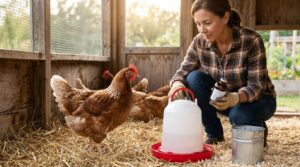
🚰 2. Position the Drinker Carefully
The drinker can become the wettest part of the brooder.
And because chicks constantly walk around it, they can spread moisture and fecal contamination through the surrounding litter.
Place the drinker somewhere that makes spills easier to manage.
Check it several times a day when necessary.
Ask:
Is it leaking?
Is bedding getting inside?
Are chicks standing in it?
Is the surrounding litter becoming caked?
If the answer is yes, fix the setup rather than simply replacing wet bedding over and over.
Good poultry management includes protecting feed and water from fecal contamination.
🪵 3. Use Appropriate Litter
The litter is not just decoration.
It affects moisture, cleanliness, odor, dust, and how much fecal material remains in contact with the birds.
For commercial brooding, Merck recommends clean litter that absorbs moisture without caking, is free of mold, is nontoxic, and is large enough to discourage chicks from consuming it.
For a backyard brooder, the exact material may vary according to what is safely available in your area.
The important characteristics are:
Clean
Dry
Absorbent
Not moldy
Appropriate for chicks
Avoid choosing litter simply because it is cheap.
A material that stays wet or becomes heavily caked around the drinker can create more management problems.
🧹 4. Remove Wet and Caked Areas Promptly
You don’t necessarily need to empty the entire brooder every time one small patch becomes damp.
Instead, inspect the litter regularly.
Remove:
- Wet patches
- Heavily caked material
- Material contaminated by spilled water
- Areas with excessive fecal buildup
Then replace them with clean, dry litter.
Merck specifically notes that litter can become very wet around drinkers and that proper removal of caked litter is important in backyard poultry management.
This is one of those small jobs that takes a few minutes but can prevent a much bigger cleanup later.
🐥 5. Don’t Overcrowd the Brooder
A crowded brooder creates several problems at once.
More birds in a small space means:
- More droppings
- More competition for resources
- Faster litter contamination
- More moisture accumulation
- More contact with contaminated material
Merck identifies high bird density as one factor associated with coccidiosis problems in backyard poultry.
The exact space requirement depends on chick age, breed or strain, housing design, ventilation, and management.
So don’t rely on a single universal number found on social media.
Instead, plan for the chicks to have enough room to move comfortably between heat, food, and water without constantly piling on top of one another.
And remember:
The space requirement changes as chicks grow.
A brooder that looks spacious on day one can become crowded surprisingly quickly.
🌬️ 6. Keep the Brooder Well Ventilated
Ventilation isn’t just about smell.
It helps manage moisture and air quality.
Poor ventilation can contribute to excessive humidity and ammonia accumulation, while excessively dry, dusty conditions can create respiratory irritation. Merck recommends ventilation as part of good poultry management and notes that wet litter and high ammonia concentrations can cause serious welfare problems.
The goal is balance.
You want:
Fresh air without drafts directly chilling the chicks.
This is particularly important in small indoor brooders where people may be tempted to close everything tightly to retain heat.
A warm brooder still needs appropriate ventilation.
🍽️ 7. Keep Feed Away From Fecal Contamination
Chicks scratch.
They walk.
They poop.
Then they walk somewhere else.
That means feed can become contaminated surprisingly easily.
Keep feeders positioned so chicks can eat comfortably without constantly kicking litter and feces into the feed.
Check the feeder regularly.
If feed becomes visibly contaminated or wet, don’t simply mix the dirty material into fresh feed.
Good feeding practices are part of general coccidiosis prevention because reducing fecal contamination helps reduce opportunities for birds to ingest infective oocysts.
🧼 8. Keep Waterers and Feeders Clean
Cleaning doesn’t mean sterilizing them every few minutes.
It means preventing obvious buildup of:
- Feces
- Slime
- Old feed
- Wet litter
- Algae or other visible contamination
USDA biosecurity guidance emphasizes routine cleaning and reducing opportunities for pathogens to spread through poultry housing, equipment, clothing, footwear, and other materials.
A simple routine is easier to maintain than an elaborate one.
Check → clean → refill → reposition.
Repeat as needed.
👟 9. Don’t Carry Contamination Into the Brooder
Coccidial oocysts can move beyond the litter.
Merck notes that contaminated equipment and personnel, including shoes, can contribute to transmission.
That makes basic biosecurity worthwhile even for a tiny backyard flock.
Try to avoid:
- Walking from a dirty chicken area directly into the brooder
- Using visibly contaminated equipment between groups
- Allowing unnecessary visitors to handle chicks
- Sharing dirty equipment between separate bird groups
USDA recommends controlling what comes into poultry areas and paying attention to clothing, shoes, equipment, visitors, and other potential routes of disease introduction.
You don’t need a commercial farm security system.
You need consistent habits.
🐔 10. Keep New or Sick Birds From Mixing Casually
If you have multiple groups of birds, avoid moving birds or equipment between them without considering disease transmission.
This becomes particularly important when one group is showing diarrhea, weakness, poor growth, or other signs of illness.
A sick bird should not simply be returned to a healthy group because it “looks a little better.”
When disease is suspected, isolation and veterinary guidance can help protect the rest of the flock.
Remember that coccidia are spread through fecal contamination, so moving contaminated bedding, equipment, footwear, or birds can potentially spread exposure.
👀 11. Watch the Chicks Every Day
Prevention isn’t only about cleaning.
Your chicks are part of your monitoring system.
Spend a few minutes watching them when everything is quiet.
Healthy chicks should generally be:
- Moving around normally
- Eating
- Drinking
- Growing
- Resting comfortably
- Responding normally to their environment
Pay attention to changes such as:
- Several chicks becoming unusually quiet
- Reduced appetite
- Weight loss or failure to grow
- Persistent diarrhea
- Bloody droppings
- Ruffled feathers
- Weakness
- Chicks sitting apart from the group
These signs do not automatically prove coccidiosis.
They tell you that something may be wrong and deserves investigation.
Coccidiosis can cause diarrhea, weight loss, decreased production, and, in severe cases, death.
⚖️ 12. Track Growth Instead of Relying Only on Appearance
A chick can look reasonably normal while gradually failing to gain weight.
A small digital kitchen or poultry scale can become one of the most useful tools in a backyard brooder.
You can keep a simple record:
| Date | Chick | Weight | Appetite | Activity |
|---|---|---|---|---|
| Day 1 | A | ___ g | Normal | Normal |
| Day 4 | A | ___ g | Normal | Normal |
| Day 7 | A | ___ g | Normal | Normal |
You don’t need to obsess over a single number.
Look for trends.
A chick that isn’t growing as expected, especially when other symptoms are present, deserves closer attention.
🧽 13. Clean Between Broods
If you reuse the same brooder for another group of chicks, don’t simply remove the obvious dirty bedding and immediately put new chicks inside.
The enclosure and equipment should be cleaned appropriately between groups.
USDA recommends emptying an enclosure before thorough cleaning and disinfecting and using appropriate protective clothing or footwear when caring for poultry.
However, coccidial oocysts can be resistant to many common disinfectants.
That means:
“I sprayed disinfectant” does not automatically equal “the brooder is free of coccidia.”
Physical removal of contaminated organic material, appropriate cleaning, drying, and good litter management remain important.
💊 14. Don’t Automatically Medicate Every Chick
This is one of the most important modern backyard-poultry lessons.
You may see recommendations online to automatically give chicks medication “just in case.”
But prevention programs are not one-size-fits-all.
Coccidiosis control can involve anticoccidial medications, vaccination, or combinations of approaches depending on the production system and circumstances. Merck notes that anticoccidial programs and vaccines are established prevention tools.
If you are considering medicated feed, water medication, or vaccination, follow the product instructions and consult a veterinarian or poultry professional familiar with your flock and local regulations.
This is particularly important if birds will eventually provide eggs or meat for human consumption.
Don’t improvise doses from social-media comments.
🧪 15. Remember That “Coccidia Present” Does Not Automatically Mean Disease
This is a subtle point that can save beginners a lot of confusion.
Coccidia are common in poultry environments.
A diagnostic test may detect oocysts, but that finding has to be interpreted alongside the bird’s age, symptoms, flock history, management, and other evidence.
Merck notes that diagnosis of coccidiosis can involve fecal examination and, when appropriate, characteristic intestinal lesions.
So don’t think:
Oocysts found = severe coccidiosis confirmed.
Instead think:
Oocysts found + clinical signs + flock history + appropriate examination = a much more meaningful picture.
🟢 Your Simple Daily Brooder Check
You don’t need a complicated spreadsheet.
Try this five-minute routine:
💧 Water
Is it clean, accessible, and not leaking?
🍽️ Feed
Is it dry and reasonably clean?
🪵 Litter
Are there wet or caked areas?
🐥 Chicks
Are they active, eating, drinking, and behaving normally?
🌬️ Air
Is the brooder adequately ventilated without chilling the chicks?
👀 Droppings
Are there persistent abnormal droppings or blood?
📏 Growth
Are the chicks gaining weight appropriately?
This tiny routine can catch problems before they become much harder to manage.
🚨 When Prevention Is No Longer Enough
If chicks are already showing signs of serious illness, the goal changes from prevention to investigation and treatment.
Contact a veterinarian promptly if you see:
🔴 Repeated bloody droppings
🔴 Severe or persistent diarrhea
🔴 Marked weakness
🔴 Rapid weight loss
🔴 Dehydration
🔴 Several chicks becoming sick
🔴 Sudden deaths
🔴 Rapid deterioration
Don’t wait for the entire brooder to become sick before taking action.
Coccidiosis can progress rapidly, with the disease course described by Merck as approximately 4–7 days in poultry.
📋 The Modern Backyard Brooder Checklist
Save this as your quick-reference list:
Every day
☐ Check water
☐ Check feed
☐ Inspect litter around the drinker
☐ Remove wet or caked litter
☐ Observe chick behavior
☐ Look at droppings
☐ Check for weak or isolated chicks
Every few days
☐ Review weight or growth records
☐ Inspect the whole brooder for moisture problems
☐ Check ventilation
☐ Inspect feeders and drinkers thoroughly
Between broods
☐ Remove birds
☐ Remove contaminated bedding
☐ Clean the enclosure and equipment
☐ Allow appropriate drying
☐ Prepare fresh, suitable litter
☐ Review what went wrong during the previous brood
That last step is underrated.
If the litter repeatedly becomes wet under the drinker, don’t just clean it again.
Change the setup.
🌿 Final Thoughts
You don’t prevent coccidiosis by making a backyard brooder perfectly sterile.
You reduce risk by controlling the things you actually can control.
Keep the litter appropriately dry.
Prevent drinker leaks.
Reduce fecal contamination of feed and water.
Avoid overcrowding.
Maintain sensible ventilation.
Practice basic biosecurity.
Watch the chicks every day.
And take persistent illness seriously.
Coccidia are common in poultry environments, so the goal is not necessarily to eliminate every organism. The practical goal is to reduce heavy exposure and prevent conditions that favor clinical disease.
For a new chicken keeper, the most useful mindset is simple:
Clean enough. Dry enough. Space enough. Observe often. Act early. 🐥❤️
A few minutes of routine brooder care each day can be far more useful than panic-cleaning everything after a chick becomes seriously ill.