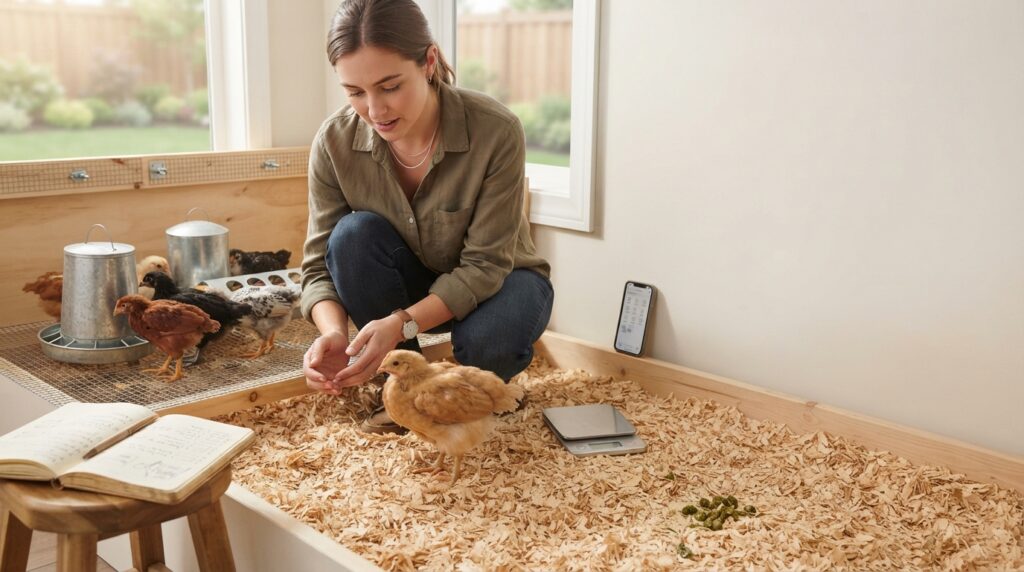
Coccidiosis is one of those chicken-health problems that every chick keeper should understand.
The challenge is that the early signs aren’t always dramatic.
A chick may simply become quieter than its flockmates. It may spend more time sitting, eat less, grow more slowly, or produce unusual droppings.
Then, in more severe cases, the situation can change quickly.
The mistake is to look at one symptom and immediately conclude:
“That’s coccidiosis.”
The better approach is to recognize a pattern, consider the chick’s age and environment, and know when professional testing or veterinary advice is needed.
Coccidiosis is caused by microscopic Eimeria parasites that multiply in the intestinal tract. Different species affect different areas of the intestine, so the signs and severity can vary. Young chickens are particularly susceptible to clinical disease.
Here’s how to recognize the warning signs without turning every abnormal dropping into an internet diagnosis. 🐔
🦠 First, Understand What You’re Looking For
Coccidia are microscopic organisms that chickens can acquire by ingesting infective oocysts from contaminated surroundings.
Those oocysts can be present in:
- Litter
- Soil
- Feeders
- Drinkers
- Shoes
- Equipment
- Other contaminated surfaces
After ingestion, the parasites multiply in intestinal cells. This can damage the intestinal lining and, depending on the species and severity, interfere with digestion, nutrient absorption, and normal intestinal function.
That explains why coccidiosis can produce a combination of:
Digestive changes + reduced appetite + poor growth + weakness
rather than one single unmistakable symptom.
👀 Start With Behavior
Before checking droppings, watch the chick.
Healthy chicks generally spend their time moving between eating, drinking, exploring, resting, and interacting with the group.
A chick that suddenly behaves differently deserves attention.
Look for:
- Sitting for unusually long periods
- Reduced activity
- Staying away from the group
- Less interest in exploring
- A generally tired appearance
- Difficulty keeping up with flockmates
Lethargy and depression are recognized signs of clinical coccidiosis.
But here’s the important part:
Lethargy does not equal coccidiosis.
A chick can become quiet because of temperature problems, injury, nutritional problems, other infections, parasites, stress, or many other conditions.
Think:
“This chick is different.”
Not:
“I know exactly what disease this is.”
That distinction prevents a lot of bad decisions.
🍽️ Watch the Feeder
Chicks grow rapidly, so changes in feeding behavior are worth noticing.
A chick that normally rushes toward the feeder may suddenly:
- Eat less
- Peck without consuming much
- Remain away from the feeder
- Lose interest in food
- Become noticeably smaller than its flockmates
Decreased appetite and reduced growth can occur with coccidiosis.
If several chicks suddenly stop eating normally, don’t focus on just one bird.
Check the whole brooder or growing area.
Ask:
Are multiple chicks affected?
Did something change recently?
Is the feed fresh and appropriate?
Can every chick easily reach the feeder?
Is the environment too hot or too cold?
This turns a symptom into useful information.
💧 Check Drinking and Hydration
Digestive illness can lead to dehydration, particularly when diarrhea is significant.
A weak chick may also have difficulty reaching the drinker.
Check that:
- Fresh water is available
- The drinker is functioning
- Chicks can easily reach it
- The container is stable
- The water isn’t heavily contaminated with litter or droppings
Don’t assume that a full waterer means every chick is drinking enough.
Observe the birds themselves.
A chick that is weak, increasingly depressed, or unable to reach food and water needs prompt attention.
💩 Learn to Observe Droppings Without Panicking
This is where many new chicken keepers get nervous.
They see an unusual dropping and immediately search for a disease.
Chicken droppings naturally vary, however.
One unusual dropping does not establish a diagnosis.
With coccidiosis, affected birds can develop abnormal feces, including diarrhea, watery or mucoid droppings, and, in some forms of the disease, bloody feces.
Instead of photographing one dropping and declaring an emergency, look for a pattern.
Ask:
Is the change persistent?
One unusual dropping is different from repeated abnormal droppings.
Is the chick also acting sick?
Digestive changes combined with lethargy and reduced appetite are more concerning.
Are other chicks affected?
Multiple birds showing similar signs changes the situation.
Is there blood?
Repeated bloody feces deserve prompt veterinary attention.
🩸 Don’t Ignore Blood
Blood in the droppings can occur with serious coccidiosis.
One important species, Eimeria tenella, damages the ceca and can cause hemorrhagic disease. Other Eimeria species can affect different intestinal regions and produce different clinical patterns.
But blood doesn’t automatically mean:
“This is definitely coccidiosis.”
Other problems can also produce abnormal feces.
So treat significant or repeated blood as a warning sign, not as a home diagnosis.
If a chick is weak, losing weight, not eating, or repeatedly passing bloody droppings, contact a veterinarian promptly.
🪶 Look at the Feathers and Posture
A sick chick may look different even before the digestive signs become obvious.
Watch for:
- Fluffed or ruffled feathers
- Hunched posture
- Reduced movement
- Sitting instead of standing
- Closed or partially closed eyes
- Less interaction with other chicks
Ruffled feathers and depression are among the clinical signs reported with coccidiosis.
Again, these are general illness signs.
Their value comes from combining them with other observations.
For example:
Fluffed feathers alone
→ observe closely.
Fluffed feathers + reduced appetite + diarrhea
→ concern increases.
Fluffed feathers + diarrhea + blood + weakness
→ seek veterinary help promptly.
⚖️ Weigh Chicks Instead of Relying Only on Appearance
One of the easiest ways to improve your chick-health monitoring is to use a scale.
A chick can lose condition without the change being obvious beneath its feathers.
Regular weighing allows you to identify:
- Failure to gain weight
- Unexpected weight loss
- A chick falling behind its flockmates
- Changes occurring over several days
Create a simple record:
| Date | Chick A | Chick B | Chick C |
|---|---|---|---|
| Monday | ___ g | ___ g | ___ g |
| Wednesday | ___ g | ___ g | ___ g |
| Friday | ___ g | ___ g | ___ g |
These numbers are for monitoring, not universal target weights.
Different breeds, ages, and growth rates can vary.
The useful information is the trend.
🐥 Consider the Chick’s Age
Age matters.
Clinical coccidiosis is particularly important in young chickens. Merck notes that chickens generally become susceptible to coccidial infection after roughly 10–14 days of age, with clinical disease commonly occurring in young birds.
That doesn’t mean:
“Every chick older than two weeks with diarrhea has coccidiosis.”
It means age helps you interpret risk.
A young chick with digestive signs deserves careful observation, particularly when environmental contamination or multiple affected birds are involved.
🌧️ Look at the Litter
Don’t investigate only the chick.
Investigate the environment.
Coccidia are transmitted through fecal contamination, and environmental conditions can strongly influence exposure.
Look for:
- Wet litter
- Leaking drinkers
- Damp corners
- Heavy fecal buildup
- Crowded conditions
- Contaminated feeders
- Contaminated drinkers
- Poor drainage around outdoor areas
Moisture is important to the development of infective coccidial oocysts. Heavy environmental contamination can increase exposure pressure.
This doesn’t mean your brooder needs to be sterile.
It means excess moisture and accumulated contamination are problems worth addressing.
🔍 Look for the Pattern, Not the Perfect Symptom
Here’s a simple way to think about the process.
🟢 One mild change
A chick is slightly quieter than usual but is eating, drinking, growing, and interacting normally.
Monitor closely.
🟡 Several changes
A chick is quieter, eating less, sitting more, and producing noticeably abnormal droppings.
Increase monitoring and investigate the environment. Consider contacting a veterinarian.
🔴 Severe or rapidly worsening signs
A chick is extremely weak, unable to stand normally, dehydrated, rapidly losing weight, or repeatedly passing bloody feces.
Seek veterinary attention promptly.
This isn’t a coccidiosis diagnostic chart.
It’s a response framework.
🐔 If More Than One Chick Is Sick, Think Flock-Level
Several sick chicks change the question.
Instead of:
“What’s wrong with this chick?”
ask:
“What are these chicks sharing?”
They share:
- Litter
- Feed
- Water
- Air
- Equipment
- Space
- Environment
If multiple birds become sick around the same time, investigate shared environmental and infectious causes.
Coccidiosis can spread through fecal contamination because infected birds shed oocysts in their droppings.
Don’t automatically assume every affected chick has the same disease, but don’t treat multiple sick birds as unrelated problems without investigating.
🔬 Can You Confirm Coccidiosis at Home?
Not reliably.
A microscope or fecal examination may detect coccidial oocysts, but interpreting the result isn’t always as simple as:
Oocysts present = sick with coccidiosis.
Chickens can carry coccidia, and the significance of an oocyst finding depends on factors such as the species involved, number of oocysts, clinical signs, age, and intestinal lesions.
Veterinarians may use fecal examination alongside the bird’s history and clinical findings.
In severe cases or after death, examination of intestinal tissues can provide additional information.
So the goal isn’t to become a backyard laboratory.
It’s to recognize when the evidence is strong enough to stop guessing and ask for professional help.
💊 Don’t Diagnose by Medication Response
Another common trap is:
“I gave a coccidiosis medicine and the chick improved, so it must have been coccidiosis.”
That’s not reliable diagnostic reasoning.
A sick chick may improve for several reasons, and some treatments or supportive measures can affect overlapping symptoms.
Likewise, failure to improve doesn’t necessarily rule out coccidiosis.
Medication should be selected and used appropriately, especially in poultry raised for eggs or meat.
Follow veterinary guidance, product labeling, and applicable local regulations regarding treatment and withdrawal periods.
🧼 Improve the Environment While You Investigate
There are useful management steps you can take without pretending they diagnose the disease.
Keep litter appropriately dry
Address leaking drinkers and damp areas.
Keep feeders clean
Reduce contamination with feces and wet litter.
Keep drinkers clean
Replace contaminated water promptly.
Avoid unnecessary overcrowding
Crowding increases environmental contamination.
Monitor all chicks
Don’t watch only the sickest bird.
Practice good hygiene
Clean hands, footwear, and equipment when moving between poultry groups.
Good management can reduce exposure and reinfection pressure, although ordinary cleaning cannot make a poultry environment completely free of coccidia.
🚨 Know When “Wait and See” Is Not Enough
Coccidiosis can become severe.
Seek veterinary assistance promptly when you see:
🔴 Repeated bloody droppings
🔴 Severe diarrhea
🔴 Marked weakness
🔴 A chick unable to stand normally
🔴 Rapid weight loss
🔴 Severe dehydration
🔴 Multiple chicks becoming sick
🔴 Unexpected deaths
🔴 Rapid deterioration
Severe coccidiosis can cause substantial intestinal damage and mortality, particularly in susceptible young birds.
Don’t wait for a chick to display every textbook symptom.
📱 Use a “No Guessing” Chick Check
A simple daily routine can make recognition much easier.
Morning ☀️
Behavior: Is everyone active?
Appetite: Is everyone reaching the feeder?
Water: Is everyone able to drink?
Droppings: Any persistent changes?
Posture: Anyone sitting unusually?
Weight: Any concerning trend?
Environment: Is the litter dry?
Evening 🌙
Ask the same questions again.
Then compare.
The goal isn’t to obsess over every dropping.
It’s to notice meaningful changes over time.
📝 Keep a Timeline
If a chick becomes seriously ill, a timeline can be more useful than a long list of internet searches.
Record:
Day 1: Slightly quieter
Day 2: Eating less
Day 3: Abnormal droppings
Day 3: Weight decreased
Day 4: Second chick affected
Day 4: Bloody feces observed
This gives a veterinarian useful information about how quickly the problem developed and whether it appears to be affecting multiple birds.
Also record recent changes involving:
- Feed
- Water
- Bedding
- Housing
- New birds
- Medication
- Outdoor access
- Cleaning products
- Pesticides or rodenticides
❤️ The Biggest Beginner Lesson
You don’t need to recognize a perfect “coccidiosis look.”
In fact, there isn’t one.
You need to become good at recognizing changes from normal.
A healthy chick that suddenly becomes quiet is worth watching.
A quiet chick that stops eating deserves more attention.
A chick with reduced appetite, diarrhea, weight loss, and weakness needs prompt assessment.
A chick with severe weakness or repeated bloody droppings should not be left to deteriorate while you continue searching the internet.
That’s the difference between observation and guessing.
🌿 Final Thoughts
Recognizing coccidiosis in chicks isn’t about memorizing one magical symptom.
It’s about connecting the dots.
🐥 Behavior
🍽️ Appetite
💧 Hydration
💩 Droppings
⚖️ Weight
🪶 Posture and feathers
🌧️ Litter and environment
🐔 How many chicks are affected
When several of these change together, your concern should increase.
But don’t turn those signs into an automatic diagnosis. Coccidiosis can resemble other poultry problems, and confirmation may require veterinary examination and diagnostic testing.
The most useful beginner habit is simple:
Notice → record → investigate → respond.
That’s how you protect a chick without pretending you know more than the evidence actually tells you. 🐔🌱