Introduction
A chicken that suddenly sits alone, stops eating, keeps her eyes closed, or looks unusually fluffed up can be worrying.
The difficult part is that chickens often hide illness until they are already quite sick. A hen that looks only “a little off” may deserve closer attention than her appearance suggests. Changes in appetite, drinking, activity, posture, droppings, and egg production can all provide useful clues.
That doesn’t mean you need to diagnose the disease yourself.
A better first step is triage.
In roughly 10 minutes, you can determine:
- Whether the hen needs immediate veterinary attention
- Whether she should be separated from the flock
- What signs you should record
- Whether other chickens may also be affected
- What information to give your veterinarian
Here’s a simple backyard-poultry triage routine. 🩺🐔
Minute 1: Watch Her Before Touching Her 👀
Start with observation.
Don’t immediately catch the hen.
Watch her from a short distance and compare her behavior with the rest of the flock.
Ask:
- Is she standing normally?
- Is she walking normally?
- Is she alert?
- Is she interested in food?
- Is she drinking?
- Is she interacting with the flock?
- Is she sitting apart?
- Are her eyes open?
- Is she unusually fluffed up?
- Is she holding her head or wings differently?
A healthy bird should generally be alert, active, eating normally, and interacting with the flock. Sick poultry may become withdrawn, decrease food and water intake, and sit with a droopy posture.
🚨 Stop the routine if you see an emergency
Severe breathing difficulty, seizures or other neurological signs, extreme weakness, major bleeding, open fractures, or serious trauma warrant urgent veterinary attention rather than a prolonged home examination.
Minute 2: Check Her Breathing 🫁
Respiratory problems deserve particular attention.
Watch the hen while she is calm.
Look for:
- Open-mouth breathing
- Obvious difficulty breathing
- Tail bobbing with respiration
- Very rapid or labored breathing
- Wheezing or other abnormal respiratory sounds
- Nasal discharge
- Coughing or sneezing
Merck Veterinary Manual lists increased respiratory effort, tail bobbing, abnormal respiratory sounds, and nasal discharge among signs that can indicate respiratory disease in birds.
Don’t assume every sneeze means a serious infection. Sneezing can have multiple causes, including irritation.
The bigger concern is breathing difficulty, especially when accompanied by weakness or other abnormal signs.
If the hen appears to be struggling to breathe, minimize handling and seek veterinary care promptly.
Minute 3: Look at Her Head and Face
Now take a closer look.
Check:
Eyes
Are they:
- Clear?
- Open normally?
- Swollen?
- Cloudy?
- Producing discharge?
Nostrils
Look for:
- Discharge
- Crusting
- Blockage
Comb and wattles
Look for unusual:
- Swelling
- Lesions
- Scabs
- Color changes
Beak and mouth
If it can be done safely, look for obvious abnormalities or lesions.
A veterinary physical examination of backyard poultry includes assessment of the head, eyes, nostrils, mouth, and comb.
You are collecting observations, not trying to identify a disease from one symptom.
Minute 4: Check Her Posture and Movement 🐔
Ask her to take a few steps if she is willing.
Don’t force her to walk if she appears weak or injured.
Look for:
- Limping
- Difficulty standing
- Weakness
- Loss of balance
- Tremors
- Circling
- Head tilt
- Drooping wings
- Inability to use a leg or wing
Neurological signs such as seizures, severe loss of coordination, paralysis, or abnormal head positioning are especially concerning.
A bird that cannot stand or is lying down and unable to rise needs prompt veterinary attention.
Minute 5: Check Food and Water Intake 🍽️💧
A change in appetite can be one of the earliest clues that something isn’t right.
Ask:
Did she eat today?
Did she drink?
Is she approaching the feeder but not actually eating?
Is she being pushed away from food or water by other birds?
Reduced food and water intake are recognized signs of illness in poultry.
If possible, observe her at the feeder rather than assuming she has eaten because food is available.
A sick hen may have access to feed but simply lack the energy or appetite to consume enough.
Minute 6: Look at the Droppings 💩
Droppings can change for many reasons, so don’t diagnose a disease based on one abnormal dropping.
Instead, look for a pattern.
Notice:
- Watery droppings
- Unusual color
- Excessive mucus
- Blood
- A major change from her normal droppings
- Very reduced or absent droppings
Also consider the bigger picture.
A changed dropping combined with lethargy, poor appetite, weight loss, or respiratory or neurological signs is more concerning than an isolated unusual dropping.
If possible, take a photograph for your veterinarian.
Minute 7: Check for Injury or External Problems 🩹
Look carefully at the hen without unnecessarily stressing her.
Check for:
- Active bleeding
- Wounds
- Swelling
- Broken feathers around an injury
- Leg or foot problems
- Visible parasites
- Injuries around the vent
- Evidence of pecking
If there is active bleeding, severe trauma, or an obvious fracture, this is no longer a simple “watch and wait” situation.
Veterinary guidance identifies ongoing bleeding, major wounds, and serious injuries as reasons for prompt veterinary attention.
Minute 8: Think About Eggs and Reproductive Changes 🥚
For a laying hen, note whether her normal egg production has changed.
Ask:
- Has she stopped laying?
- Are the eggs suddenly abnormal?
- Has egg production dropped noticeably?
- Is she spending unusual amounts of time in the nesting area?
- Does she appear weak or distressed?
A reduction or cessation of egg production can occur with illness, although it can also have other causes.
For example, changes in laying can occur with disease, stress, environmental changes, age, or normal reproductive cycles.
So again, one sign isn’t a diagnosis.
Record the change and combine it with the rest of your observations.
Minute 9: Check the Rest of the Flock 🐔🐔🐔
This step is easy to overlook.
Don’t focus exclusively on the sick-looking hen.
Stand back and watch the other chickens.
Ask:
- Is another bird also quiet?
- Are multiple birds sneezing or coughing?
- Has egg production dropped across the flock?
- Are several birds eating less?
- Are multiple birds producing abnormal droppings?
- Has there been an unexpected death?
This matters because some poultry diseases can affect multiple birds.
For example, avian influenza can cause combinations of respiratory, digestive, and neurological signs, while Newcastle disease can produce respiratory, digestive, or neurological signs. Clinical signs alone cannot reliably identify either disease.
If multiple birds become sick or deaths occur suddenly, contact a veterinarian or the appropriate animal-health authority rather than trying to diagnose the flock yourself.
Minute 10: Decide What Happens Next 🚨
At the end of the 10 minutes, put the hen into one of three practical categories.
🔴 Category 1: Emergency
Seek urgent veterinary help if she has signs such as:
- Severe breathing difficulty
- Seizures
- Severe neurological abnormalities
- Extreme weakness
- Major trauma
- Open fracture
- Significant active bleeding
- Collapse or inability to stand
These signs warrant immediate attention rather than prolonged home observation.
🟠 Category 2: Sick and Needs Prompt Evaluation
Examples include:
- Persistent lethargy
- Not eating or drinking normally
- Significant weight loss
- Abnormal droppings that persist
- Eye or nasal discharge
- Repeated coughing or sneezing
- Limping
- Major changes in egg production
- Unusual posture
- Progressive weakness
Birds can deteriorate quickly, so don’t allow a clearly abnormal bird to remain untreated simply because she isn’t showing an obvious emergency.
🟢 Category 3: Mild Change, But Monitor Closely
Sometimes a hen may simply behave differently for a short period.
For example, she might be temporarily quieter after a stressful event or environmental change.
If she is still:
- Alert
- Eating
- Drinking
- Walking normally
- Breathing normally
- Interacting normally
you can continue close observation while documenting changes.
If the abnormal behavior persists, worsens, or additional symptoms appear, contact a veterinarian.
Should You Isolate the Hen?
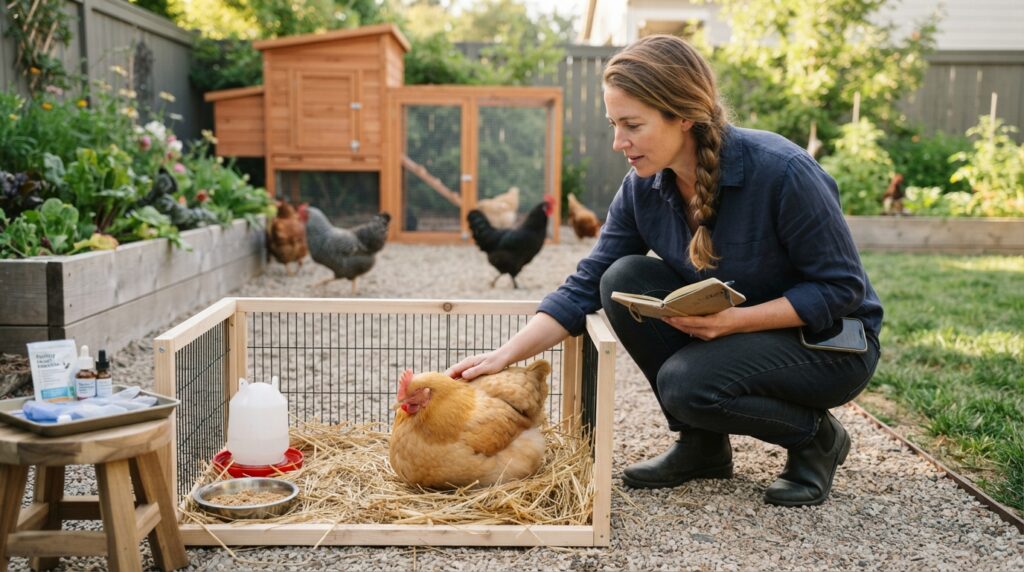
When a bird appears sick, separating her from the flock can help you monitor food and water intake, droppings, and behavior more closely.
It can also reduce the opportunity for flock mates to bully a weak bird.
However, isolation does not tell you what caused the illness.
Use a clean, quiet, appropriately ventilated area and make food and water easy to access.
Don’t make the environment excessively hot.
Supportive care can help a sick bird conserve energy, but supportive care does not replace diagnosis or treatment of the underlying problem.
If you suspect a contagious disease, follow veterinary and local animal-health guidance regarding isolation, cleaning, movement of birds, and reporting.
What NOT to Do ❌
A quick triage is useful because it tells you what to do next.
It shouldn’t become an experiment.
Avoid:
❌ Giving random antibiotics
Different diseases require different approaches, and inappropriate medication can delay proper diagnosis.
❌ Mixing several medications “just in case”
More treatment isn’t necessarily better treatment.
❌ Forcing food or water into a weak bird
Improper oral administration can cause aspiration or additional stress.
❌ Squeezing the bird’s chest
Birds need normal chest movement to breathe. Veterinary guidance specifically warns against compressing the breast during restraint.
❌ Turning the bird upside down
This can increase stress and the risk of regurgitation and injury.
❌ Waiting several days when the bird is clearly deteriorating
Birds may mask illness until they are significantly affected.
Make a “Sick Hen” Checklist 📋
Keep a simple poultry health note on your phone.
Record:
Date and time:
Hen:
Age:
Eating: Normal / Reduced / None
Drinking: Normal / Reduced / Unknown
Droppings: Normal / Changed
Breathing: Normal / Abnormal
Activity: Normal / Reduced
Walking: Normal / Abnormal
Eyes/nose: Normal / Discharge
Comb/wattles: Normal / Changed
Egg production: Normal / Reduced / None
Other flock members affected: Yes / No
Recent changes: New birds, feed, weather, housing, injury, etc.
This information can be much more useful to a veterinarian than simply saying, “She looks sick.”
The 10-Minute Rule Is About Triage, Not Diagnosis 🩺
The goal of this routine isn’t to figure out whether your hen has a respiratory infection, parasite, reproductive problem, nutritional issue, poisoning, or another condition.
Many different diseases can produce overlapping signs.
Instead, your job is to answer three questions:
How sick does she appear?
Could this affect the rest of the flock?
How quickly does she need professional attention?
That is a much safer goal for a backyard chicken keeper.
Final Thoughts 🌱🐔
When a hen looks sick, the most useful first response isn’t panic and it isn’t guessing.
It’s observation.
In about 10 minutes, you can check her behavior, breathing, face, movement, appetite, droppings, injuries, laying pattern, and the condition of the rest of the flock. Those observations can help you recognize emergencies and give a veterinarian much better information.
Remember that chickens can hide illness, so a quiet bird deserves attention even when there isn’t an obvious dramatic symptom.
And if you see severe breathing difficulty, neurological signs, major trauma, significant bleeding, extreme weakness, sudden deaths, or multiple sick birds, don’t wait for your 10-minute checklist to become a diagnosis.
Triage first. Document what you see. Get professional help when the signs warrant it. 🐔❤️