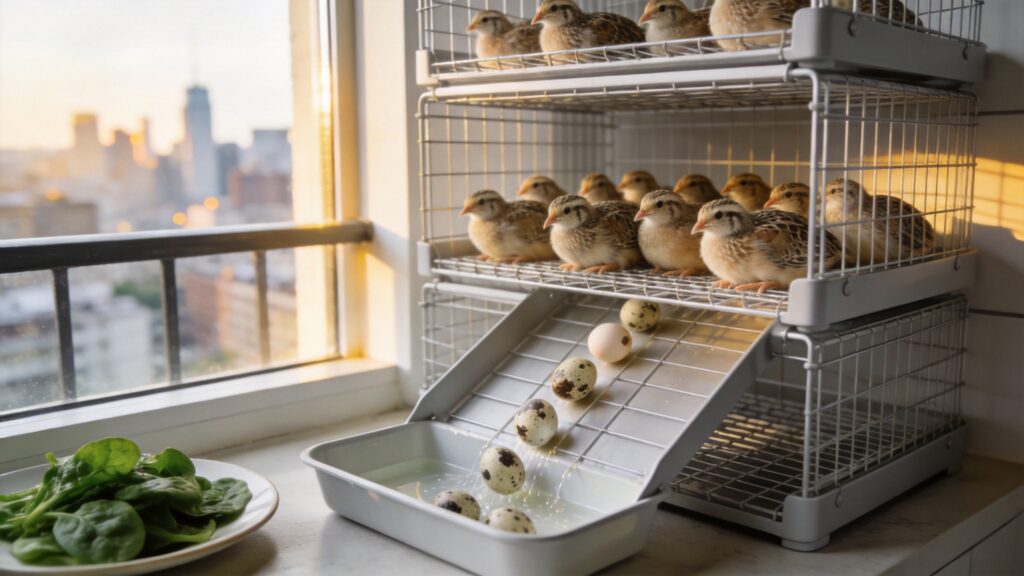
Forget the backyard chicken craze. If you live in an apartment, condo, or tiny urban house with limited outdoor space, there’s a far better secret for fresh, homegrown eggs: quail. These pint-sized poultry are quiet, efficient, and surprisingly easy to keep—even on a balcony or in a spare room. In this guide, I’ll compare quail to chickens and ducks, break down their nutritional edge, and show you exactly how to start your own mini flock without breaking local noise or space ordinances.
Why Quail? The Urban Egg Revolution
Chickens are loud, ducks are messy, and both require significant outdoor runs. Quail, on the other hand, have been quietly transforming urban homesteading for decades. A single Coturnix quail hen weighs only about 150 grams—roughly one-tenth the size of a standard chicken—yet she can lay 300 eggs per year. That’s an astonishing 90% lay rate under optimal conditions. They don’t need a coop; a stacked wire cage in a corner of your living room or on a shaded balcony works perfectly. And because quail are ground-dwelling birds that rarely fly, they adapt to confinement without stress. For city dwellers who want ultra-fresh eggs without the noise, smell, or legal headaches of larger fowl, quail are the clear winner.
Quick Comparison: Quail vs. Chicken vs. Duck
| Factor | Quail | Chicken | Duck |
|---|---|---|---|
| Space per bird | 0.5 sq ft (cage) | 4–6 sq ft (coop + run) | 4–6 sq ft (plus water area) |
| Noise level | Very low (soft calls) | Moderate–loud (crowing) | Loud (quacking) |
| Eggs per year | 280–300 | 250–300 (breed-dependent) | 200–280 |
| Mess / odor | Minimal (dry droppings) | Moderate (wet spots) | High (very wet) |
| Startup cost | Low ($50–$100 for setup) | Moderate ($200–$500) | Moderate–high ($300+) |
Size Matters: Quail Eggs vs. Chicken Eggs – A Nutritional Showdown
Don’t let the tiny size fool you. Three quail eggs equal roughly one large chicken egg in volume, but the nutrient density tells a different story. Quail eggs are packed with vitamin B12, iron, and selenium, and they contain significantly more lecithin—a fat that helps lower cholesterol absorption. While a chicken egg has about 186 mg of cholesterol, three quail eggs (equivalent weight) provide only about 152 mg. That’s a 20% reduction. Plus, quail eggs are richer in antioxidants like lutein and zeaxanthin, which support eye health. For urbanites watching their cholesterol or seeking a nutrient boost, swapping chicken eggs for quail eggs is a smart move.
“I switched to quail eggs two years ago after my doctor flagged my cholesterol. Three quail eggs scrambled with spinach—I actually prefer the creamier texture. My numbers improved, and my tiny apartment balcony now produces all the protein I need.” – Sarah L., urban homesteader in Chicago
Nutritional Comparison (per 100 g of egg)
| Nutrient | Quail Egg | Chicken Egg |
|---|---|---|
| Calories | 158 | 155 |
| Protein (g) | 13.1 | 12.6 |
| Fat (g) | 11.1 | 10.6 |
| Cholesterol (mg) | 844 | 373 |
| Iron (mg) | 3.6 | 1.2 |
| Vitamin B12 (mcg) | 1.58 | 0.89 |
| Note: Values from USDA FoodData Central. For equal weight (100 g), quail eggs have about 2.3x more iron and 1.8x more B12. | ||
Space-Saving Cage Setups and the Quiet Nature of Quail
If you’ve ever heard a rooster crow at 5 a.m., you know why urban neighbors hate chickens. Quail, by contrast, communicate with soft, melodic “bob-white” calls that barely carry through a closed window. Female quail are especially quiet; the only vocalization is a gentle trill when laying. Males do crow, but at a decibel level comparable to a cat’s meow—not a rooster’s blast. This makes them ideal for apartments where noise restrictions are strict.
Stacked Cages: The Urban Solution
The most popular setup uses a multi-tier wire cage system, often called a “quail rack.” A typical 3-tier cage (24” x 24” per tier) can house 12–18 quail comfortably, fitting on a small shelf or a dedicated stand. Key features include:
- Sloped wire floors that allow eggs to roll out of reach—reducing pecking and keeping eggs clean.
- Removable trays underneath for quick cleaning; a weekly scrape takes 10 minutes.
- Water nipples or small cups to minimize spills, crucial for indoor setups.
- Automatic egg collection (optional): a simple ramp at the front of each tier channels eggs into a waiting tray.
Real-world example: In a 400 sq ft studio in San Francisco, a single 2-tier cage under the kitchen counter provides three dozen eggs a week. The owner, a software engineer, built a plywood enclosure with ventilation holes and a small LED light on a timer. The quail are silent enough that they don’t disturb Zoom calls.
DIY vs. Ready-Made
You can build a custom cage from hardware cloth and wood for under $50, or buy a pre-made quail rack (e.g., the “Q-Rack 240”) for about $150. Either way, the footprint is smaller than a single desk chair.
Lifespan and Egg Production Cycle of Quail
Coturnix quail (the most common domesticated variety) have a short but prolific life. They reach sexual maturity in just 6–8 weeks—compared to 18–24 weeks for chickens. Peak egg production begins around week 8 and continues for 12–16 months, then gradually declines. In a well-managed urban setup, you can expect:
- Years 1–2: 280–300 eggs per hen per year (70% from natural daylight + supplemental light to 16 hours).
- Year 3: Production drops to about 50% (150 eggs). Many keepers replace the entire flock at this point to maintain maximum output.
- Total lifespan: Typically 2–3 years; a few can reach 4 years with excellent care.
Important contrast: A good laying chicken might produce for 2–3 years before declining, but quail do it in half the time and much smaller space. Ducks, meanwhile, peak later (around 6 months) and have a longer overall lifespan (5–8 years), but their mess and noise make them poor urban candidates.
How to Extend the Productive Window
To keep your quail laying longer, use these evidence-based strategies:
- Light management: Provide 14–16 hours of light daily. Use a simple timer and a cool-white LED bulb (no need for heat unless ambient temp drops below 60°F).
- High-protein feed: Feed a game bird starter (24–30% protein) during lay, not chicken feed. Supplement with calcium (crushed oyster shell) and a bit of greens.
- Minimize stress: Avoid frequent handling, loud noises, or sudden cage moves. Stressed quail often stop laying for 10–14 days.
- Annual molt cycles: Quail typically molt in late fall. You can trigger a reset by reducing light to 8 hours for 2 weeks, then increasing to 16 hours. This often restarts a strong lay cycle.
Practical Tips for Starting Your Own Quail Flock
Ready to dive in? Here’s a step-by-step checklist for absolute beginners. Remember: Check your local municipal code first—quail are often classified differently than chickens (many cities allow up to 6 quail without a permit).
Essential Shopping List
- 6–8 juvenile Coturnix quail (sexed females preferred, unless you want to hatch; a 1:5 male-to-female ratio works well).
- Cage system (minimum 1 sq ft per 2 quail, but 0.5 sq ft per bird is acceptable in stacked setups).
- Feeder and waterer (choose models that attach outside the cage to reduce spillage).
- Game bird feed (starter/grower for first 6 weeks, then layer formula).
- Bedding/liner (pine shavings, paper towels, or newspaper—avoid cedar due to respiratory issues).
- Grit and oyster shell (fine grit for digestion, shell for calcium).
Common Pitfalls (And How to Avoid Them)
- Overcrowding
- More than 2–3 quail per sq ft leads to feather pecking, stress, and reduced egg production. Stick to 1 quail per 0.5 sq ft as a maximum in commercial-style cages.
- Poor ventilation
- Quail produce ammonia from droppings. In a closed apartment, use a small exhaust fan or place the cage near an open window (but out of drafts).
- Ignoring roosting needs
- Unlike chickens, quail prefer to sleep on the floor. Provide a small corner with soft bedding or a low platform (1 inch high) for them to rest.
A Sample Weekly Routine
- Daily: Check for eggs (twice a day in hot weather), refill feed/water, remove any soiled bedding.
- Weekly: Clean cage tray and wash waterers with hot water + vinegar; check for mites or injuries.
- Monthly: Deep clean the entire cage with diluted bleach solution (rinse thoroughly), replace all bedding.
Conclusion
Quail offer a practical, space-efficient, and remarkably quiet solution for urban egg production. They outperform chickens in size per egg yield, surpass ducks in noise and mess factors, and provide a nutrient-dense egg that rivals any store-bought option. With a minimal investment and a few square feet, you can enjoy fresh eggs year-round—right from your apartment. The secret is out: for city dwellers, quail aren’t just an alternative; they’re the superior choice.