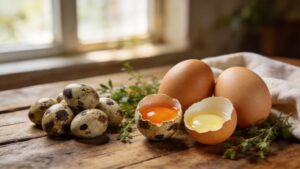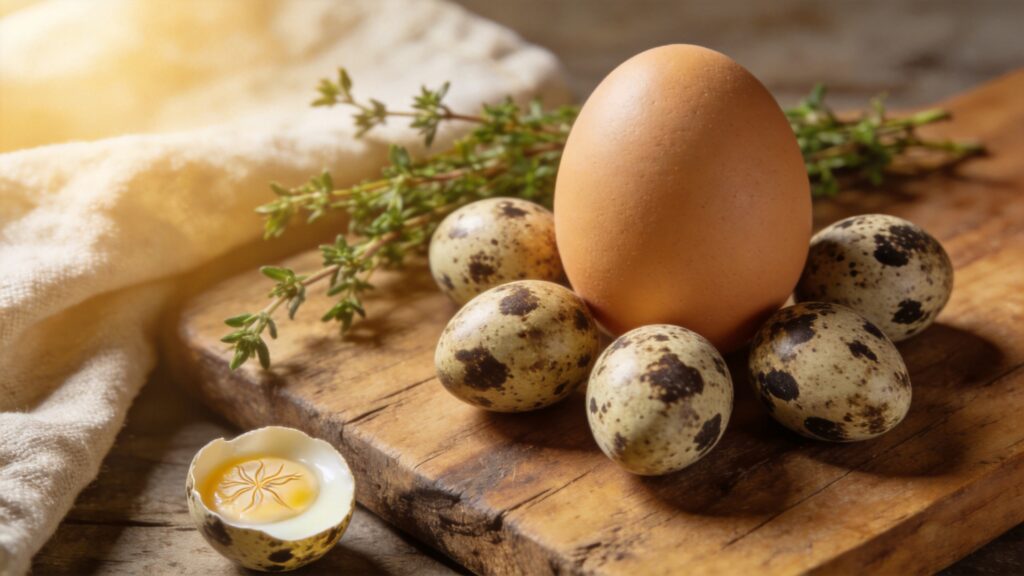
When you stroll down the egg aisle, chicken eggs dominate the landscape. But tucked away in specialty sections or farmers’ markets, a tiny contender—the quail egg—offers a rich, nutrient‑dense alternative. Are these miniature speckled gems worth the extra cost? This guide breaks down the nutritional nuances, taste profiles, cooking strategies, and economic realities of quail eggs versus chicken eggs, so you can decide which belongs in your cart.
Nutritional Showdown: Protein, Vitamins, and Cholesterol
At first glance, a single quail egg looks dwarfed by a chicken egg—about one‑fifth the weight. Yet when you compare them per gram, quail eggs pack a surprising punch. Below is a side‑by‑side nutrient comparison (approximate values based on USDA data for a large chicken egg and a typical quail egg, each around 9 g).
| Nutrient | Chicken Egg (1 large, ~50g) | Quail Egg (1 egg, ~9g) | Quail Egg (per 100g) |
|---|---|---|---|
| Calories | 72 | 14 | 158 |
| Protein | 6.3 g | 1.2 g | 13 g |
| Fat | 4.8 g | 1.0 g | 11 g |
| Cholesterol | 186 mg | 76 mg | 844 mg |
| Vitamin B12 | 0.6 µg | 0.2 µg | 2.2 µg |
| Iron | 0.9 mg | 0.4 mg | 4.4 mg |
| Selenium | 15.4 µg | 3.2 µg | 35.6 µg |
Key takeaways:
- Protein density: Per gram, quail eggs actually contain slightly more protein (13 g per 100 g) than chicken eggs (12.6 g per 100 g). Since quail eggs are smaller, you’d need about 5–6 quail eggs to match the protein of one large chicken egg.
- Cholesterol concern: Quail eggs have a higher concentration of cholesterol—844 mg per 100 g vs. 372 mg for chicken eggs. However, a single quail egg delivers 76 mg, which is less than half the cholesterol of one chicken egg. If you restrict total cholesterol intake, consider that quail eggs are often eaten in multiples (e.g., 3–5 as a serving), which can quickly add up.
- Micronutrient edge: Quail eggs boast significantly more iron (4.4 mg vs. 1.8 mg per 100 g), plus higher levels of vitamin B12 and selenium. For anyone looking to boost iron absorption—such as athletes or those with mild deficiencies—quail eggs are an excellent addition.
“While quail eggs shouldn’t be feared for their cholesterol content, they aren’t a ‘free food.’ The real advantage lies in their dense micronutrient profile—especially iron and B12—which can complement a balanced diet when used in moderation.” — Dr. Laura Hernandez, registered dietitian
Taste and Texture: What Sets Them Apart?
Both eggs are unmistakably eggy, but the differences become obvious when you taste them side by side. Quail eggs have a richer, creamier yolk relative to their white, and the white itself is thinner and more delicate. Many describe quail egg yolks as buttery with a slightly gamey undertone—a subtle earthiness that chicken eggs lack.
Texture nuances:
- Boiled: A hard‑boiled quail egg has a tender, almost custard‑like white that doesn’t get rubbery. The yolk retains a moist, velvety mouthfeel.
- Fried: Sunny‑side‑up quail eggs produce a yolk that stays liquid longer due to the higher yolk‑to‑white ratio. The white sets quickly but remains fragile—perfect for a delicate topping.
- Raw: In Japanese cuisine (tamago kake gohan), raw quail egg is prized for its creaminess and mild sweetness, often preferred over chicken egg for its less pronounced “egg‑white‑slime” texture.
For comparison, chicken eggs offer a more neutral, familiar flavor and a firmer white that holds up better in scrambles and omelets. If you’re substituting quail eggs for chicken eggs in a recipe, expect a taste that’s slightly more luxurious but also more assertive—not ideal for every dish.
Culinary Applications: From Breakfast to Gourmet
Because of their size and delicate nature, quail eggs shine in contexts where visual appearance and bite‑sized elegance matter. Chicken eggs, meanwhile, remain the workhorse of the kitchen.
When to Reach for Quail Eggs
- Appetizers and Garnishes: A single halved soft‑boiled quail egg on a crostini with prosciutto or smoked salmon creates an instant canapé. The tiny size makes portion control easy, and the rich yolk acts as a natural sauce.
- Ramen and Noodle Bowls: Marinated ramen eggs (ajitsuke tamago) made with quail eggs reduce cooking time—just 2–2.5 minutes for a jammy yolk—and look striking floating in broth.
- Bento and Lunchboxes: Quail eggs are naturally portioned for children or dieters. Add a couple of pickled quail eggs for a protein hit without overwhelming the meal.
- Fine Dining Flourishes: Chefs use quail egg yolk as a sauce thickener or as a plating accent—for example, a single yolk atop a steak tartare or vegetable purée.
When Chicken Eggs Win
- Baking: The consistent size, binding power, and emulsification properties of chicken eggs are irreplaceable in cakes, cookies, and custards. Substituting quail eggs would require roughly 5 per chicken egg and complicate recipe ratios.
- Large‑Scale Cookery: Need a dozen eggs for a family frittata? Quail eggs mean you’re cracking 60+ shells—tedious and time‑consuming.
- Budget‑Conscious Meals: For everyday breakfast scrambles or egg sandwiches, chicken eggs provide more volume per dollar.
Practical tip: The easiest way to experiment is to replace one chicken egg with 3 quail eggs in dishes where the egg is the star—think deviled eggs, egg salad, or poached eggs on toast. For baking, stick with chicken.
Cost Analysis and Production Efficiency
Here’s where the conversation gets pragmatic. In the United States, chicken eggs are commodities—a dozen large eggs often costs $3–$5, while quail eggs can run $5–$10 per dozen from specialty grocery stores or online retailers. That’s a premium of 100–200%.
But wait—there’s more to the economics.
- Production efficiency
- Quail reach laying age at 6–8 weeks (vs. 18–20 weeks for chickens), and they lay more eggs relative to body weight—up to 300 eggs per year per bird. However, each egg weighs only 9 g, so total egg mass per bird is lower than a chicken’s (about 2.7 kg vs. 18 kg annually).
- Feed conversion
- Quail are more efficient: they require roughly 2.2 kg of feed to produce 1 kg of egg mass, while chickens need 2.5 kg. But because their eggs are smaller, handling, cleaning, and packaging costs are higher per weight.
- Scalability
- Large‑scale chicken operations benefit from decades of automation. Quail farming is still a niche market in the U.S., which keeps prices elevated.
Bottom line for American shoppers: If you buy pre‑peeled, pickled, or cooked quail eggs, expect a luxury price tag. Buying fresh and boiling yourself saves about 30%. Even then, they remain an occasional splurge rather than a staple. For the same money, you can buy pasture‑raised chicken eggs with equally impressive nutrition.
Common Questions Answered
Are quail eggs healthier than chicken eggs?
Not categorically. They offer more iron, B12, and selenium per gram, but also more cholesterol per gram. For someone who eats only 1–2 chicken eggs per day, swapping to quail eggs (e.g., 4–6 eggs) raises cholesterol intake significantly. The healthiest choice depends on your overall dietary pattern.
Can I eat quail eggs if I have an egg allergy?
Some people with chicken egg allergies can tolerate quail eggs, but it’s not guaranteed. The proteins (ovomucoid, ovalbumin) are similar enough that cross‑reactivity is common. Always consult an allergist before testing.
How do I cook quail eggs efficiently?
Boiling is easiest: bring water to a boil, gently add eggs (use a slotted spoon), boil for exactly 2 minutes for soft‑boiled or 3.5 minutes for hard‑boiled, then transfer to ice water. For peeling, roll them between your palms to crack the shell all over, then start at the large end (there’s often an air pocket).
Do quail eggs taste like chicken eggs?
They taste similar but richer and slightly more “gamey.” Think of it like the difference between supermarket chicken and a pasture‑raised bird—the flavor is more pronounced. Most people find them a pleasant upgrade in recipes where eggs take center stage.
Conclusion
Quail and chicken eggs each have their strengths. Chicken eggs win on affordability, versatility, and volume—they’re the everyday workhorse. Quail eggs, with their creamy yolk, higher iron content, and elegant mini size, excel in gourmet applications and nutrient‑dense snacks. Rather than choosing one over the other, consider keeping both in rotation: quail for special brunches, appetizers, and quick boosts of B12; chicken for baking, breakfast scrambles, and budget‑friendly meals. That way, you enjoy the best of both shells.