
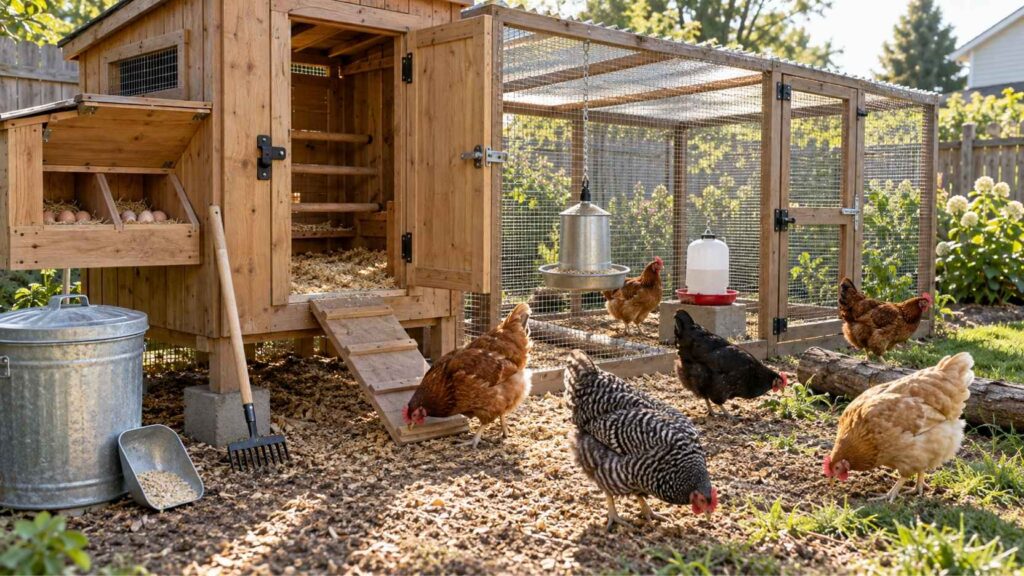
Bringing home your first chickens can produce a strange combination of excitement and immediate uncertainty: the coop is finished, the feeder is full, the hens are walking around, and suddenly you are wondering, “Am I supposed to be doing something else?” 🐔 The good news is that healthy adult chickens generally do not require constant intervention when they have appropriate housing, complete feed, clean water, protection from predators, and someone paying attention to their condition. Your biggest job during the first week with chickens is therefore not to create more chores, but to establish reliable routines while learning what normal looks like for your particular flock.
That distinction matters because beginners sometimes react to uncertainty by cleaning constantly, picking birds up repeatedly, changing feeds, adding supplements, or worrying about every odd-looking dropping or feather movement. A better new chicken owner checklist starts with consistency: keep their environment safe, make essential resources easy to find, and observe changes instead of trying to control every moment. 🌿 By the end of seven days, you should have a basic picture of who eats first, where everyone sleeps, which birds are confident or cautious, how quickly water disappears, and what a normal morning and evening look like.
Before Night One: Make Sure the Basics Actually Work
Before worrying about advanced chicken care, verify that the infrastructure your flock depends on actually functions under real conditions. Your chickens need an appropriately ventilated but weather-protected coop, enough roosting space, accessible nest boxes for laying hens, clean water, and a nutritionally complete poultry feed appropriate for their age and stage. 🔐 Walk around the enclosure from the perspective of a determined predator and inspect doors, corners, gaps, fencing connections, roofing, and latches rather than assuming something is secure simply because it looks enclosed.
Check that every bird can reach the feeder and waterer without being trapped in a corner or constantly pushed away by higher-ranking flock members. Adult laying hens generally receive most of their nutrition from a complete layer ration, while insoluble grit is relevant when chickens eat foods requiring grinding beyond suitable commercial feed, and laying hens benefit from access to a separate calcium source such as oyster shell when appropriate. Do not mix handfuls of random supplements into feed simply because they appear on chicken-care shopping lists; the goal is to make the balanced diet easier to consume, not accidentally dilute it with unnecessary extras.
Day 1: Observe More Than You Interfere
Your first full day should function more like an observation shift than a training session. 👀 Watch whether every chicken finds the water, approaches the feed, walks normally, explores the enclosure, and interacts with the others without prolonged harassment or isolation. Some birds may be cautious after transportation or a major environment change, so quiet behavior by itself does not automatically indicate that something is wrong.
Pay particular attention to birds that remain separated from the group, appear unable to stand normally, refuse both food and water, breathe with obvious difficulty, or show injuries that other chickens are pecking. At the same time, resist the temptation to interpret every pause, wing stretch, dirt scratch, feather shake, or nap as a medical mystery because chickens have many behaviors that may look unfamiliar to a first-time owner. 🐓 Your goal on Day 1 is to establish a baseline, because changes become much easier to recognize once you know how each bird normally acts.
Days 2–3: Establish Your Morning And Evening Routine
By the second and third days, begin turning chicken care into a predictable routine that fits your actual work and home schedule. A useful morning sequence is simple: headcount, open the secure coop if necessary, check water, check feed, observe the flock, inspect for obvious damage, and collect any eggs that are ready. ☀️ You do not need to spend an hour completing these tasks when everything is functioning properly, but consistency helps you notice an empty waterer, damaged latch, feed spill, injured bird, or missing hen before a minor issue becomes serious.
Your evening routine should place security at the top of the list because nighttime removes many of the flock’s daytime defenses. Confirm that all birds have returned, check that no hen has accidentally remained outside or hidden somewhere unusual, secure doors and latches, and make sure the enclosure has not developed a new weakness. 🌙 Once the system becomes familiar, these morning and evening checks can feel less like “chicken chores” and more like quickly checking that a small living system is operating normally.
Days 4–7: Learn What “Normal” Looks Like
The second half of your first week is when individual chickens often become easier to recognize by personality and routine. You may notice one hen racing to the feeder first, another spending more time scratching, a cautious bird waiting before approaching you, or certain flock members consistently choosing particular spots on the roost. These observations are useful because flock behavior is your early-warning system—a sudden change from an individual’s usual habits can sometimes be more informative than one isolated strange-looking behavior.
You will also encounter behaviors that initially look dramatic but can be completely ordinary, including dust bathing, sunbathing, vigorous feather preening, stretching a wing and leg, scratching backward through bedding, or briefly flattening themselves into loose soil. 🪶 Droppings can also vary in appearance during the day depending on digestive processes and what birds have consumed, which is why one unusual dropping is less informative than persistent abnormality accompanied by changes in appetite, energy, posture, or behavior. Learning these normal variations prevents you from spending your first month believing that every chicken quirk represents an emergency.
Things You Do Not Need To Constantly Do
You generally do not need to deep-clean the entire coop every day, particularly if bedding remains appropriately managed, surfaces are reasonably dry, ventilation is good, and obvious wet or heavily soiled areas are removed when needed. 💧 Daily attention is better directed toward water cleanliness, food availability, security, obvious moisture problems, and rapidly accumulating manure in places where birds spend significant time. Your full cleaning frequency will depend on flock size, coop dimensions, bedding system, climate, and how quickly waste accumulates, so an arbitrary calendar is less useful than monitoring actual conditions.
You also do not need to handle every chicken every day simply to prove that you are taking proper care of them. Calm, positive handling can make future examinations easier, but repeatedly chasing nervous birds around the run may create stress rather than trust. Likewise, avoid continually changing food, treats, supplements, bedding products, or management methods during the first week unless there is a genuine problem—stable basics usually teach you more than constant experimentation.
Your First Weekly Inspection
At the end of the first week, conduct a slightly more deliberate inspection of both the flock and its environment. Look at each chicken’s general posture and movement, inspect feet for injuries or swelling, notice whether feathers around the vent are reasonably clean, and use gentle handling when practical to become familiar with the bird’s overall body condition beneath its feathers. 🔎 Feathers can visually hide weight changes, which is one reason simply looking at a chicken from across the yard does not tell you everything about its physical condition.
Then inspect the system supporting the birds: examine the coop for new gaps or damaged hardware, test doors and latches, look for moisture or excessive ammonia-like odor, wash or refresh dirty water equipment, and check whether feeders are staying clean and dry. If you use an automatic coop door, do not assume automation eliminates supervision; verify that it opens and closes correctly and that every bird has actually entered before nighttime security is considered complete. This weekly check transforms chicken keeping from reacting to problems into preventive observation, which is one of the most useful habits a beginner can develop.
When Something Actually Deserves Attention
An important chicken-care skill is learning to distinguish normal adjustment, something worth watching, and something requiring prompt action. Mild caution in a new environment, temporary uncertainty about unfamiliar equipment, or small changes in social positioning may simply require observation, while persistent isolation, repeated bullying, reduced appetite, unusual weakness, limping, visible injury, or continuing abnormal behavior deserves closer investigation. 🚨 Difficulty breathing, inability to stand, uncontrolled bleeding, severe injury, neurological-looking symptoms, or a bird that appears seriously ill warrants timely professional veterinary guidance where poultry veterinary care is available.
Do not wait until you can identify a disease by name before responding to a clearly declining chicken, but also avoid diagnosing illnesses from a single symptom found online. Many poultry conditions can produce overlapping signs, and improper treatment can delay appropriate care or expose birds to medications they did not need. Keeping basic notes about when the problem began, appetite, water intake, droppings, laying changes, breathing, movement, injuries, and flock behavior can make both your own assessment and any veterinary consultation considerably more useful.
Your First 7 Days With Chickens Printable Checklist
Use this simple checklist during your first week rather than trying to remember dozens of chicken-care rules at once. ✅ The purpose is to make essential care repeatable while gradually teaching you your flock’s individual patterns. Once these checks become automatic, chicken keeping usually begins to feel far less mysterious.
Every Morning
- ☐ Count the chickens
- ☐ Provide or confirm access to fresh, clean water
- ☐ Check complete feed supply
- ☐ Observe appetite and movement
- ☐ Look for obvious injuries or unusual isolation
- ☐ Inspect doors, fencing, and enclosure security
- ☐ Collect available eggs
Every Evening
- ☐ Confirm every chicken has returned
- ☐ Check the roost area
- ☐ Look for unusually withdrawn birds
- ☐ Secure the coop and run
- ☐ Test important latches
- ☐ Confirm automatic doors closed correctly, if used
- ☐ Make sure no bird is accidentally locked outside
By The End Of Week One
- ☐ Inspect feet
- ☐ Check the vent area
- ☐ Become familiar with each bird’s body condition
- ☐ Clean visibly dirty feeders and waterers
- ☐ Remove excessively wet or contaminated bedding
- ☐ Inspect the coop for damage or predator access
- ☐ Identify each chicken’s normal eating and social habits
- ☐ Note typical roosting positions
- ☐ Review whether your morning and evening routine works
Your chickens do not need you hovering over them every minute; they need you to make the important things reliable. 🐔 Food, water, shelter, appropriate nutrition, predator protection, sanitation, and attentive observation provide a stronger foundation than an exhausting collection of unnecessary chores. If you spend your first seven days learning the flock rather than constantly changing the flock, you will enter your second week with something every new keeper needs: a clear understanding of what normal looks like.




