Introduction
When a chicken becomes sick, it’s easy to focus on the obvious question:
“What’s wrong with her?”
But when you eventually speak with a veterinarian, another question becomes extremely important:
“What exactly have you noticed, and when did it happen?”
That can be surprisingly difficult to answer.
You may remember that your chicken was “acting weird” yesterday, but not whether she stopped eating before or after the breathing problem started. You might remember seeing a dirty vent, but not whether it was there for one day or several.
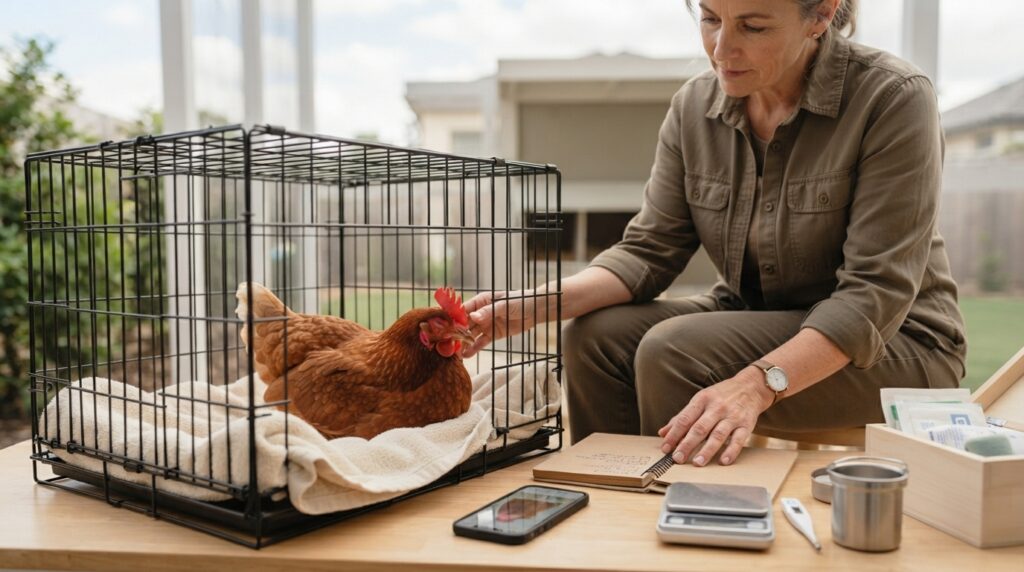
This is where a simple sick-chicken health log can make a big difference.
You don’t need medical terminology.
You don’t need to diagnose the disease.
You simply need to record what you can actually observe.
Think of your notes as a timeline:
Normal → First change → New symptoms → Changes over time → What you did → Veterinary advice
That information can give your veterinarian a much clearer picture of what happened. 🐔🔎
1. Start the Record as Soon as You Notice a Change
Don’t wait until the chicken looks seriously ill.
As soon as you notice something unusual, write it down.
For example:
Tuesday, 8:00 AM: Chicken sitting away from flock. Ate a small amount. Breathing appeared normal.
Then:
Tuesday, 4:00 PM: Still isolated. Appetite reduced. Noticed occasional sneezing.
That is much more useful than trying to remember everything two days later.
Your first note doesn’t have to be perfect.
Record first. Refine later.
2. Record What “Normal” Looks Like 🐔
A veterinarian needs to know what changed.
That means your baseline matters.
For your flock, learn the normal pattern of:
- Eating
- Drinking
- Activity
- Droppings
- Breathing
- Walking
- Social behavior
- Egg laying
- Body condition
You don’t need a detailed medical record for every healthy chicken.
But knowing each bird’s usual behavior makes unusual changes easier to recognize.
For example:
Normal: Jojo usually runs toward the feeder.
Today: Jojo stayed under the perch and didn’t approach the feeder.
That is a useful observation.
3. Write the Date and Time
This sounds obvious, but it is one of the most valuable details.
Always record:
Date
Approximate time
If you don’t know the exact time, write something like:
- Early morning
- Around lunchtime
- Late afternoon
- After returning home
- Before bedtime
A timeline helps show whether symptoms appeared suddenly or developed gradually.
For example:
| Time | Observation |
|---|---|
| 7:00 AM | Eating normally |
| 10:00 AM | Sitting alone |
| 1:00 PM | Reduced appetite |
| 4:00 PM | Abnormal breathing |
| 7:00 PM | Still weak |
That sequence is much easier to communicate than:
“She got sick sometime today.”
4. Describe What You See, Not What You Think It Means 👀
This is one of the most important rules.
Write:
“She is breathing with her beak open.”
Instead of:
“She has pneumonia.”
Write:
“There is clear discharge around the nostril.”
Instead of:
“She has a bacterial infection.”
Write:
“She is sitting with her eyes closed and is not moving toward the feeder.”
Instead of:
“She’s depressed.”
Your veterinarian can interpret the observations.
Your job is to document them accurately.
Think:
Observation, not diagnosis.
5. Record Appetite 🍽️
A change in eating behavior can be important.
Instead of simply writing:
“Not eating.”
Try to be more specific.
Record:
- Eating normally
- Eating less than usual
- Showing interest but not eating
- Eating only certain foods
- Refusing food
- Unable to reach the feeder
- Unable to swallow normally
If you know approximately how much the bird normally eats and what she has eaten today, include that information.
Don’t force food into a chicken that is severely ill or having difficulty swallowing without veterinary guidance.
6. Record Water Intake 💧
Do the same thing with drinking.
Write:
“Drinking normally.”
or:
“Drank once during observation.”
or:
“Not observed drinking since morning.”
If several chickens share one waterer, you may not be able to measure exactly how much an individual bird drinks.
That’s okay.
Don’t invent a number.
Simply record what you actually observed.
7. Record Droppings 💩
Droppings can provide useful information, but they can also vary naturally.
Record changes rather than trying to diagnose them.
You might note:
- Frequency
- Consistency
- Color
- Amount
- Presence of obvious blood
- Unusual material
- Whether the bird is producing droppings normally
For example:
“Droppings noticeably looser than usual three times this afternoon.”
is more useful than:
“She has a parasite.”
If you can safely take a photograph, it may help document what you observed.
8. Record Breathing Carefully 🫁
Respiratory symptoms deserve clear notes.
Record:
- Sneezing
- Coughing
- Clicking
- Wheezing
- Rattling
- Open-mouth breathing
- Rapid breathing
- Visible breathing effort
- Nasal discharge
- Eye discharge
- Tail movement associated with breathing
Also record when the behavior occurs.
For example:
“Open-mouth breathing observed while resting.”
is much more informative than:
“Breathing funny.”
If possible, take a short video.
A veterinarian may learn more from seeing the actual breathing pattern than from a written description.
9. Note Changes in the Comb and Face ❤️
If something looks different, document it.
You can record:
- Comb color
- Swelling
- Injury
- Scabs
- Facial swelling
- Eye swelling
- Nasal discharge
Don’t assume that a pale or dark comb automatically means a specific disease.
Instead write:
“Comb appears noticeably paler than yesterday.”
That gives the veterinarian an observation rather than an unsupported conclusion.
10. Check the Crop at the Right Time 🌾
If you’re monitoring the crop, record when you checked it.
For example:
6:00 PM: Crop felt full after evening feeding.
That is very different from:
Early morning before feeding: Crop still noticeably full.
Timing matters because a chicken’s crop naturally changes as food is consumed and moves through the digestive system.
If you notice an unusual crop finding, record:
- Date
- Time
- Whether the chicken recently ate
- General texture
- Whether it was unusually full
- Any other symptoms
Don’t repeatedly squeeze or manipulate the crop.
11. Record the Chicken’s Weight ⚖️
Weight can be particularly useful when monitoring a sick bird over time.
If possible, use the same scale.
Record:
| Date | Time | Weight |
|---|---|---|
| Monday | Morning | 1.82 kg |
| Tuesday | Morning | 1.76 kg |
| Wednesday | Morning | 1.69 kg |
These numbers are simply an example of how to record a trend.
The important point is consistency.
A single weight may not tell you much.
A series of measurements can show whether the chicken is maintaining, gaining, or losing weight.
12. Record Behavior and Activity 🐔
“Acting strange” isn’t specific enough.
Describe what the chicken actually does.
For example:
- Sitting alone
- Sleeping more than usual
- Walking normally
- Walking stiffly
- Falling
- Unable to stand
- Not responding normally
- Hiding
- Avoiding the flock
- Remaining in one location
- Not approaching food
- Holding a wing differently
Behavioral changes can be especially valuable when combined with physical symptoms.
13. Note Egg-Laying Changes 🥚
For laying hens, record meaningful changes in egg production.
You might note:
- Normal laying
- No egg observed
- Fewer eggs than usual
- Abnormal shell
- Soft-shelled egg
- Misshapen egg
- Blood or unusual material
Don’t automatically assume that a change in egg production means the same thing in every hen.
Age, reproductive stage, season, stress, illness, and other factors can affect laying.
The useful information is the change from that chicken’s usual pattern.
14. Record Other Sick Chickens
Always tell your veterinarian whether the problem is isolated.
Write:
One chicken affected
or:
Three chickens showing similar signs
or:
Several birds sneezing but eating normally
Also record when the other birds started showing symptoms.
A single sick bird and a rapidly spreading flock problem can require very different investigation.
15. Record Recent Changes in the Environment 🌱
Your veterinarian may want to know what changed around the chicken.
Write down relevant events such as:
- New chickens introduced
- New feed
- New bedding
- Coop cleaning
- Major weather change
- Heat exposure
- Smoke or chemical exposure
- Construction or dust
- New plants accessible to the flock
- Recent medication
- New equipment
- Contact with other poultry
Don’t assume that one of these caused the illness.
Simply record what happened.
16. Record What the Chicken Has Been Eating
If the bird is sick, your veterinarian may want to know about her recent diet.
Record:
- Main feed
- Treats
- Table scraps
- Supplements
- New foods
- Changes in feed brand
- Access to free-ranging areas
If possible, keep the packaging for commercial feeds and supplements.
A photograph of the ingredient and nutrition label can also be useful.
17. Record Every Product or Medication You Give 💊
This is extremely important.
If you give a chicken a medication, supplement, electrolyte product, dewormer, or other treatment, write down:
- Product name
- Active ingredient, if known
- Amount given
- Time given
- How it was administered
- Who recommended it
Don’t write:
“Gave some medicine.”
Write exactly what you know.
If you don’t know the amount, don’t invent it.
Bring the package or photograph of the label to the veterinarian when possible.
This information can affect how the veterinarian evaluates the chicken.
18. Keep the Packaging
When a chicken is sick, don’t immediately throw away the packaging for products you have been using.
Keep:
- Feed bags
- Supplements
- Medications
- Treat packages
- New bedding labels
- Cleaning products involved in an exposure
You don’t need to save every package forever.
But during an illness investigation, the exact product information can be useful.
19. Take Photos Without Stressing the Chicken 📸
Photos can document changes that are difficult to describe.
Useful photographs may include:
- Face
- Eyes
- Comb
- Vent
- Feet
- Skin
- Visible wounds
- Droppings
- Swelling
- Overall body condition
Take pictures in good lighting.
Try to take them from similar angles if you’re monitoring a change over several days.
Don’t repeatedly restrain a severely ill chicken simply to get a better photograph.
The chicken’s welfare comes first.
20. Record Short Videos for Unusual Behaviors
Some symptoms are difficult to describe.
Video can be particularly useful for:
- Breathing problems
- Walking abnormalities
- Tremors
- Seizure-like episodes
- Head or neck movements
- Coughing
- Sneezing
- Balance problems
Keep videos short and focused.
You don’t need a five-minute documentary.
A clear 20- to 30-second clip can be easier for a veterinarian to review.
21. Create a One-Page Sick Chicken Log 📝
You can keep your record simple.
SICK CHICKEN HEALTH LOG
Chicken: __________
Date symptoms first noticed: __________
Approximate time: __________
Main concern: __________
Appetite
☐ Normal
☐ Reduced
☐ Not eating
☐ Unknown
Water
☐ Normal
☐ Reduced
☐ Not observed drinking
☐ Unknown
Breathing
☐ Normal
☐ Sneezing
☐ Coughing
☐ Noisy
☐ Open-mouth
☐ Labored
Droppings
☐ Normal
☐ Changed
☐ Loose
☐ Other: __________
Behavior
☐ Normal
☐ Quiet
☐ Isolated
☐ Weak
☐ Difficulty walking
☐ Other: __________
Physical observations
Crop: __________
Comb: __________
Eyes: __________
Nose: __________
Vent: __________
Other: __________
Weight
Today: __________
Previous: __________
Other birds affected?
☐ No
☐ Yes — number: ______
Recent changes
Products/medications given
Photos/videos taken
☐ Yes
☐ No
22. Build a Timeline for Your Veterinarian ⏱️
Before your appointment or phone consultation, summarize the important events.
For example:
Monday morning: Normal behavior and appetite.
Monday evening: Sitting separately from flock.
Tuesday morning: Reduced appetite. Droppings changed.
Tuesday afternoon: Began sneezing.
Tuesday evening: Eye appeared watery.
Wednesday morning: Weight lower than previous measurement.
That timeline gives your veterinarian a much better starting point than a long list of disconnected symptoms.
23. Prepare Five Questions Before the Appointment
When you’re worried about a chicken, it is easy to forget what you wanted to ask.
Write your questions down.
For example:
- What signs should I monitor at home?
- Does this bird need to be isolated?
- What should I feed or provide while she recovers?
- What changes would mean I need to return or seek urgent care?
- Should the other chickens be examined or monitored differently?
If medications are prescribed, also ask about administration instructions and any applicable food or egg withdrawal requirements.
24. Know What Information to Bring
If you take the chicken to a veterinarian, consider bringing:
📋 Your health log
📸 Relevant photos
🎥 Short videos
⚖️ Weight records
💊 Medication and supplement information
🌾 Feed information
🧴 Product packaging when relevant
🐔 Information about other affected chickens
This can save time and reduce the chance of forgetting an important detail.
25. Don’t Hide Mistakes
If you accidentally gave the wrong amount of something, used a product incorrectly, or the chicken gained access to something potentially harmful, tell the veterinarian honestly.
Don’t be embarrassed.
The information may be medically important.
A veterinarian needs accurate information to make safe decisions.
The goal isn’t to prove that you handled everything perfectly.
The goal is to help the chicken.
26. Know When Notes Should Stop and Action Should Start 🚨
Documentation is useful.
But don’t let note-taking delay emergency care.
Seek urgent veterinary attention when a chicken has serious signs such as:
- Severe difficulty breathing
- Collapse
- Inability to stand
- Severe bleeding
- Major trauma
- Significant neurological abnormalities
- Severe weakness
- Suspected poisoning
- Rapid deterioration
If several birds suddenly become seriously ill or die unexpectedly, contact a veterinarian or appropriate animal-health authority promptly.
A perfect health log is never more important than getting a seriously ill chicken help.
27. Use Your Phone to Make This Easy 📱
You don’t need a special app.
A simple phone note can work.
Create a note titled:
Chicken Health — [Bird’s Name]
Then use:
DATE / TIME
OBSERVATION
ACTION
For example:
Sept. 4 — 7:30 AM
Sitting alone. Eating less. Breathing appears normal.
Action: Moved to observation area and provided fresh water.
Then update it throughout the day.
You can also create a separate photo album for the bird.
This makes it easier to compare changes over time.
28. Don’t Turn Your Notes Into an Internet Diagnosis
This is an easy trap.
You search:
“Chicken has watery eye + sneezing + pale comb.”
You find several possible diseases.
Then you start recording:
“Probably disease X.”
That’s not useful documentation.
Keep your record objective.
Instead write:
“Watery left eye, sneezing approximately five times during 20-minute observation, appetite reduced.”
That’s information a veterinarian can actually use.
29. Your Best Notes Answer Six Questions
A useful sick-chicken record should make these questions easy to answer:
1. When did it start?
Date and approximate time.
2. What changed first?
The earliest unusual observation.
3. What happened next?
A chronological timeline.
4. How is the chicken doing now?
Current condition.
5. What has changed in the flock or environment?
Other birds, feed, housing, weather, exposure, etc.
6. What have you already done?
Isolation, cleaning, medication, feeding changes, veterinary consultation, and other actions.
If your notes answer these six questions, you’ve already created a valuable record.
A Simple “Vet-Ready” Summary 🩺🐔
Before contacting your veterinarian, prepare a short summary:
Chicken: Name or identification
Age: If known
Main problem: One sentence
First noticed: Date/time
First symptom: What you observed
Current symptoms: What is happening now
Eating: Normal/reduced/not eating
Drinking: Normal/reduced/not observed
Droppings: Main change, if any
Breathing: Normal/abnormal
Weight: Current and previous, if available
Other chickens affected: Yes/no
Recent changes: Feed, flock, environment, exposure
Products/medications: Exact names and amounts if known
Photos/videos: Available or not
This gives your veterinarian a concise starting point before the detailed discussion.
Final Thoughts 🌿🐔
Keeping notes on a sick chicken isn’t about becoming a veterinarian.
It’s about becoming a better observer.
A simple record can show when symptoms began, how they changed, whether the chicken is eating and drinking, whether her weight is changing, whether other birds are affected, and what you’ve already done.
Most importantly, write down what you actually see.
Don’t replace observations with guesses.
“Open-mouth breathing at rest” is useful.
“Probably pneumonia” is a diagnosis you cannot reliably make from that observation alone.
Keep your records simple, chronological, and honest. Take photos or short videos when they can help without stressing the bird, and keep medication and product information available for your veterinarian.
And remember: documentation supports veterinary care. It doesn’t replace it.
When a chicken is seriously ill, call the vet first and keep taking notes alongside the care you are instructed to provide. ❤️🐔