Introduction
A chicken rarely gets sick or injured at a convenient time.
It might happen after the feed store closes, during a weekend, or when you’re halfway through getting ready for bed.
A small wound, broken feather, injured foot, or suddenly weak chicken can quickly turn into a stressful situation when you don’t have basic supplies ready.
That’s why every backyard flock should have a simple chicken first-aid kit.
The goal isn’t to turn your chicken coop into a veterinary clinic.
A good first-aid kit helps you handle the first few minutes safely while you decide what happens next.
Think of it as:
Stabilize → Protect → Observe → Contact the vet when needed. 🐔
1. Start With a Separate First-Aid Box 📦
Keep your chicken supplies together in one clearly labeled container.
A plastic storage box with a secure lid works well.
Keep it somewhere that is:
- Dry
- Clean
- Easy to reach
- Away from direct sunlight
- Away from children and pets
- Separate from human medications
Don’t bury the kit behind bags of feed.
In an emergency, you don’t want to spend 20 minutes searching for gauze.
A useful label:
CHICKEN FIRST AID — NOT FOR HUMAN USE
Keeping the supplies separate also reduces the chance of accidentally using a product incorrectly.
2. Disposable Gloves 🧤
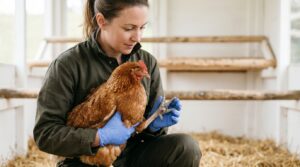
A pair of disposable gloves is one of the simplest things to keep in the kit.
They can be useful when:
- Examining wounds
- Handling feces-contaminated feathers
- Cleaning an injured area
- Handling a sick bird
- Cleaning equipment afterward
Keep several pairs rather than just one.
If you have a flock, you may need to handle more than one bird or clean up afterward.
Gloves don’t replace handwashing.
Wash your hands thoroughly after handling sick or injured poultry.
3. Sterile Gauze Pads
Sterile gauze is useful for basic wound care and temporary pressure.
For example, if a chicken has a small external wound that is bleeding, clean gauze can be gently applied with appropriate pressure while you assess the situation.
Keep several sizes available.
Gauze can also be useful when cleaning an area around an injury.
Don’t aggressively scrub a wound.
The objective is to protect the area, not cause additional tissue damage.
4. Non-Stick Wound Dressings 🩹
A non-stick dressing can be useful for covering certain superficial wounds.
Ordinary dry gauze can stick to a wound as it dries.
A suitable non-adherent dressing can make later inspection and changing the dressing less traumatic.
Keep a few sterile pieces in your kit.
If a wound is deep, heavily contaminated, actively bleeding, or located in a sensitive area, veterinary assessment may be necessary rather than relying on a home dressing.
5. Self-Adhesive Bandage Wrap
Self-adhering veterinary wrap can be useful for securing a dressing.
But there is an important warning:
Don’t wrap a chicken’s leg, wing, or body tightly.
A bandage that is too tight can interfere with circulation or breathing.
If you don’t know how to apply a particular type of wrap correctly, ask a veterinarian to demonstrate it.
For a first-aid kit, having the material available is useful, but knowing when not to use it is equally important.
6. Saline Solution 💧
Sterile saline is one of the most useful gentle cleaning supplies to keep available.
It can be useful for rinsing certain superficial wounds or flushing debris from areas such as around the eye when appropriate.
Choose a sterile product intended for appropriate medical or eye use.
Avoid homemade solutions when sterile saline is readily available.
Most importantly, don’t assume that rinsing an eye solves the underlying problem.
Persistent eye discharge, swelling, cloudiness, injury, or difficulty keeping the eye open deserves veterinary attention.
7. Clean Towels
Don’t underestimate the usefulness of ordinary clean towels.
Keep several dedicated towels in your kit.
They can help with:
- Holding a frightened chicken
- Wrapping a bird temporarily
- Transporting an injured chicken
- Keeping a bird calm
- Protecting the bird from slipping
- Cleaning up
Choose towels that are washable and don’t have loose threads that could catch on toes or injuries.
A towel can also help create a calm, darkened environment during transport.
8. A Small Flashlight 🔦
A compact flashlight makes examination much easier.
It can help you see:
- Small wounds
- Feather damage
- Debris
- External parasites
- The condition of the vent
- Changes around the eyes
- Blood on feathers
- Objects on the ground or in the coop
A headlamp can be especially convenient because it leaves both hands free.
Keep spare batteries or make sure the rechargeable light is maintained.
9. Blunt-Tipped Scissors ✂️
Small scissors can be useful for carefully trimming feathers away from a minor wound when necessary.
Choose scissors with rounded or blunt tips.
Sharp scissors around a frightened chicken create an unnecessary injury risk.
Never cut blindly through matted feathers.
If feathers are stuck to a significant wound or you cannot clearly see what you’re cutting, stop and get veterinary guidance.
10. Tweezers
A clean pair of tweezers can be useful for removing superficial debris that is clearly accessible.
For example, you might encounter a small piece of bedding or plant material attached to feathers.
But don’t dig into a wound.
Don’t use tweezers to pull out something deeply embedded.
If an object appears lodged in tissue, removing it incorrectly can cause additional bleeding or damage.
That’s a veterinarian’s job.
11. A Digital Kitchen Scale ⚖️
This might not look like first-aid equipment, but it can be extremely useful.
A small digital scale allows you to monitor a chicken’s weight when illness is suspected.
Weight trends can provide information that is difficult to judge just by looking at feathers.
For a sick chicken, record:
Date + weight + appetite + behavior
For example:
| Date | Weight | Appetite | Behavior |
|---|---|---|---|
| Monday | 1.85 kg | Normal | Active |
| Tuesday | 1.78 kg | Reduced | Quiet |
| Wednesday | 1.70 kg | Poor | Isolated |
The numbers above are only an example of how to record information.
The important thing is the trend for your individual chicken.
12. A Small Thermometer 🌡️
A thermometer can help you monitor the environment of a hospital or recovery area.
This can be especially useful for young chicks or birds requiring supportive care.
But don’t assume that one temperature works for every sick chicken.
Adult chickens, chicks, injured birds, and birds suffering from heat stress have different needs.
If a bird is seriously ill, ask your veterinarian about appropriate environmental support rather than trying to manage temperature based on guesswork.
13. A Separate Hospital Crate 🏠
Technically, this isn’t something that belongs inside the first-aid box.
But it belongs on the same emergency checklist.
A sick or injured chicken may need to be separated from the flock.
A hospital crate should provide:
- Good ventilation
- Dry bedding
- Safe footing
- Easy access to water
- Easy access to food
- Appropriate environmental temperature
- Enough space to stand and reposition normally
Avoid overcrowding the crate.
You want the chicken to feel secure without restricting movement unnecessarily.
14. Paper Towels or Disposable Bedding
Paper towels can be surprisingly useful during illness.
They make it easier to monitor droppings and keep the hospital area clean.
They can also reduce the risk of a chicken slipping compared with some smooth surfaces.
Replace soiled material frequently.
For an injured chicken, clean and dry bedding is particularly important.
15. A Small Water Container and Feeder
Keep dedicated containers for the hospital area.
Choose containers that are:
- Stable
- Easy to clean
- Difficult to tip
- Appropriate for the size of the bird
Keeping these separate from the main coop equipment makes isolation and cleaning easier.
If a chicken is weak, make sure food and water are easy to reach.
Don’t force a severely ill or struggling chicken to eat or drink.
Ask a veterinarian how to provide supportive nutrition and hydration safely.
16. Poultry-Safe Disinfectant 🧼
A suitable disinfectant can be useful for cleaning equipment and the hospital area.
The important point is to follow the product’s instructions carefully.
Pay attention to:
- Dilution
- Contact time
- Rinsing requirements
- Ventilation
- Whether the product is appropriate for the intended surface
Never mix disinfectants together.
And don’t spray strong chemicals directly onto a chicken.
Disinfection is for appropriate surfaces and equipment, not a substitute for treating the bird.
17. A Notebook or Digital Health Log 📱
Your first-aid kit should contain information, not just supplies.
Record:
- Chicken identification
- Date and time
- Symptoms
- Weight
- Food and water intake
- Droppings
- Breathing
- Injuries
- Treatments or products already used
- Changes over time
This information can be extremely useful when speaking with a veterinarian.
A short video can also document unusual breathing, walking problems, neurological signs, or other behaviors that may not occur during a clinic visit.
18. Keep Your Veterinarian’s Information Ready ☎️
Don’t wait until an emergency to search for a poultry veterinarian.
Keep the contact information for:
- Your regular veterinarian
- An emergency veterinary clinic, if available
- A veterinarian who treats birds or poultry
- Your local animal-health authority, when appropriate
Write the information down.
Save it in your phone.
Do both.
When a chicken is seriously ill, you don’t want your first task to be searching the internet for a number.
19. What About Antiseptics and Wound Products?
Some wound-care products may be appropriate for chickens, but this is an area where product choice and concentration matter.
Don’t assume that something safe for humans is automatically appropriate for poultry.
Keep products only when you know:
- What they are
- What they are intended for
- How they should be diluted
- Where they can safely be used
- Whether they are appropriate for poultry
If you’re uncertain, ask your veterinarian before using them.
A basic kit with sterile saline, gauze, dressings, gloves, and clean equipment is better than a box filled with medications you don’t understand.
20. What You Should NOT Put in the First-Aid Kit 💊
A common backyard mistake is turning the first-aid kit into a collection of leftover medications.
Avoid automatically stocking:
- Human antibiotics
- Leftover prescription medications
- Random painkillers
- Human cold medicine
- Unidentified powders
- Old veterinary medications
- Medications prescribed for another chicken
- Products without clear labels
Medication choice depends on the problem, the bird, the dose, and sometimes whether the chicken or eggs are part of the food supply.
Some medications also have important withdrawal requirements.
A first-aid kit is not a pharmacy.
21. Have an Emergency Transport Plan 🚗
You may eventually need to take a chicken to a veterinarian.
Prepare for that before an emergency.
Keep a suitable carrier available.
It should provide:
- Adequate ventilation
- Secure closure
- Protection from extreme temperatures
- A non-slip surface
- Enough space for the chicken to maintain a natural position
A towel can help keep the bird secure and reduce visual stimulation.
Never leave a chicken unattended in a hot vehicle.
22. Know What First Aid Can and Cannot Do
This is perhaps the most important part of the kit.
First aid can help you:
🩹 Control minor bleeding
🧼 Clean appropriate superficial wounds
🏠 Separate a sick or injured bird
🌡️ Provide an appropriate recovery environment
📝 Monitor changes
📱 Document symptoms
🚗 Prepare for veterinary transport
First aid cannot reliably:
❌ Diagnose respiratory disease
❌ Determine the cause of severe diarrhea
❌ Treat serious infections without appropriate diagnosis
❌ Repair major fractures
❌ Replace professional care for severe injuries
❌ Determine the correct medication for every illness
Knowing this boundary protects the chicken.
23. When a Chicken Needs a Vet 🚨
Contact a veterinarian promptly when you notice serious or worsening problems such as:
- Difficulty breathing
- Persistent open-mouth breathing
- Collapse
- Severe weakness
- Inability to stand
- Significant bleeding
- Deep wounds
- Severe swelling
- Eye injury
- Prolapsed tissue
- Suspected poisoning
- Severe neurological abnormalities
- A bird that cannot eat or drink normally
- Rapid deterioration
Also seek veterinary guidance when multiple chickens become sick.
A flock-wide problem may require a completely different response from an isolated minor injury.
24. Watch for Problems That Affect the Whole Flock 🐔🐔🐔
One chicken with a small injury is one situation.
Several chickens with respiratory signs, severe diarrhea, sudden weakness, or unexplained deaths is another.
If multiple birds become sick:
Don’t simply treat each bird individually.
Think about:
- Contagious disease
- Feed problems
- Toxins
- Water contamination
- Environmental problems
- Biosecurity
Separate sick birds when appropriate, limit unnecessary movement between groups, and contact a veterinarian or appropriate animal-health authority.
25. Build Your Kit Around Your Actual Flock
You don’t need a huge emergency box.
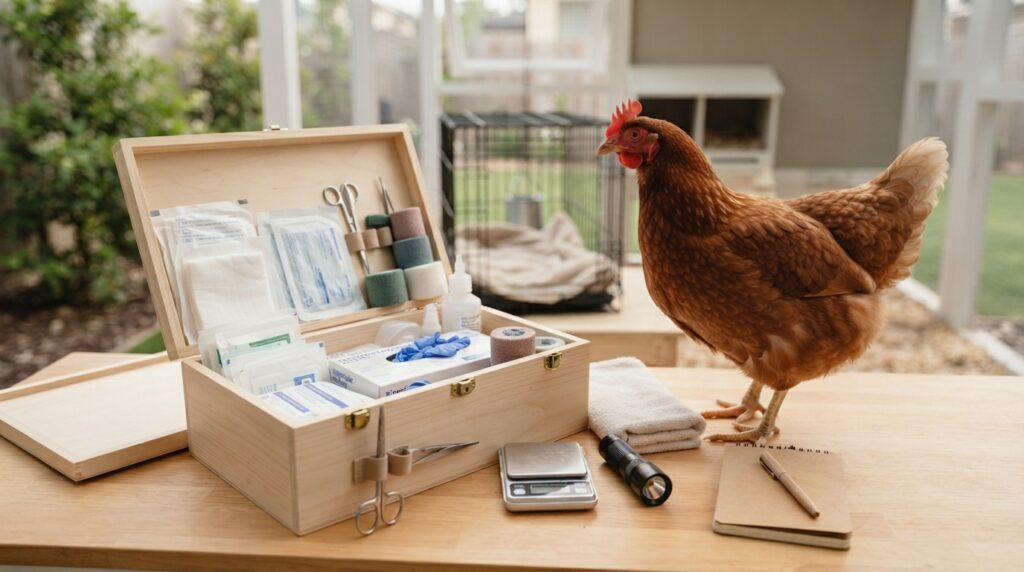
A beginner-friendly kit might include:
🩹 Basic supplies
- Disposable gloves
- Sterile gauze
- Non-stick dressings
- Self-adhesive wrap
- Sterile saline
- Clean towels
- Paper towels
- Blunt-tipped scissors
- Tweezers
🔎 Monitoring supplies
- Digital scale
- Thermometer
- Flashlight
- Notebook
- Pen
- Phone for photos and videos
🏠 Support supplies
- Hospital crate
- Separate food and water containers
- Clean bedding
- Suitable surface disinfectant
☎️ Emergency information
- Veterinarian contact
- Emergency clinic information
- Local animal-health contact information
That’s already enough to make a meaningful difference in how prepared you are.
26. Check the Kit Every Few Months 🔄
A first-aid kit is only useful if the supplies are actually usable.
Every few months, check:
Are the gauze packages intact?
Has the saline expired?
Do the batteries work?
Does the flashlight still charge?
Are the scissors clean?
Are the supplies contaminated?
Are medications clearly labeled?
Do you still have your veterinarian’s contact information?
Replace anything expired, damaged, contaminated, or missing.
27. Make an “Emergency Card”
Put one simple card inside the kit.
CHICKEN EMERGENCY CHECK
Chicken: __________
Date/time: __________
Main problem: __________
Breathing: Normal / Abnormal
Eating: Normal / Reduced / Not eating
Drinking: Normal / Reduced / Not drinking
Droppings: __________
Weight: __________
Visible injury: __________
Other symptoms: __________
Other chickens affected: Yes / No
Vet contacted: __________
This prevents you from forgetting important details when you’re stressed.
28. The Most Valuable First-Aid Tool Is Observation 👀
You can own the best supplies in the world and still miss an important problem if you don’t notice that your chicken has changed.
Learn your flock’s normal:
- Appetite
- Activity
- Breathing
- Posture
- Droppings
- Comb appearance
- Weight
- Social behavior
Then you’ll recognize when something is different.
A chicken that is suddenly sitting alone, refusing food, breathing abnormally, or behaving strangely is telling you something.
Your first-aid kit gives you tools.
Observation tells you when to use them.
Quick Chicken First-Aid Kit Checklist 🐔🩹
Save this list to your phone:
☐ Disposable gloves
☐ Sterile gauze
☐ Non-stick dressings
☐ Self-adhesive bandage wrap
☐ Sterile saline
☐ Clean towels
☐ Paper towels
☐ Blunt-tipped scissors
☐ Tweezers
☐ Flashlight/headlamp
☐ Digital scale
☐ Thermometer
☐ Notebook and pen
☐ Hospital crate
☐ Separate food and water containers
☐ Clean bedding
☐ Appropriate surface disinfectant
☐ Veterinarian contact information
☐ Emergency transport carrier
And most importantly:
☐ Know when to stop doing first aid and call the vet.
Final Thoughts 🌿🐔
A chicken first-aid kit isn’t about having a treatment for every possible disease.
It’s about being prepared for the first few minutes of an unexpected problem.
A few simple supplies can help you clean a minor wound, protect an injured bird, monitor a sick chicken, collect useful information, and transport her safely if professional care is needed.
Keep the kit together. Keep it clean. Check it regularly. Know where your veterinarian’s contact information is.
And don’t fill the box with random medications just because they might “come in handy.”
The most valuable combination is much simpler:
Basic supplies + good observation + calm handling + timely veterinary care. ❤️
When something goes wrong in the coop, being prepared means you can spend less time searching for supplies and more time figuring out what your chicken actually needs.