Introduction
Hawks are a natural part of many environments, and backyard chickens can sometimes become an easy target when they are ranging in open spaces.
A hawk attack can happen quickly. You may notice a sudden alarm from the flock, feathers on the ground, or a chicken disappearing from the yard.
The good news is that you don’t have to turn your backyard into a fortress to reduce daytime risk.
The most effective approach is usually making chickens harder to spot, harder to reach, and less exposed in open areas.
Here are practical ways to make your chicken run safer while still giving your flock room to move. 🌿
1. Give Chickens Overhead Protection
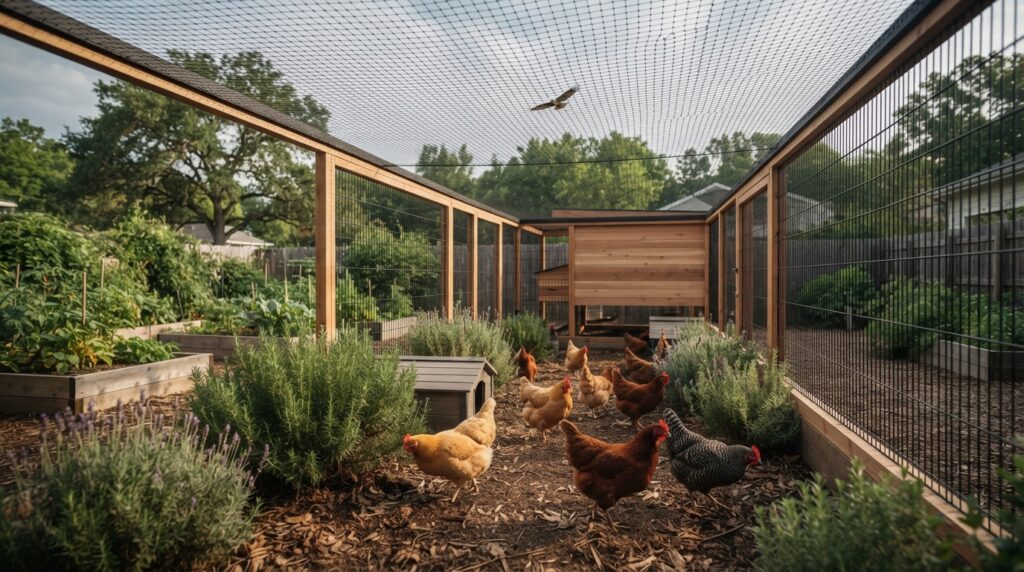
One of the simplest ways to reduce exposure is to cover the chicken run.
A properly installed roof or strong poultry netting can create a physical barrier between chickens and aerial predators.
This is particularly useful if your flock spends much of the day in an outdoor run.
A completely open run gives a flying predator a much clearer opportunity to approach.
When installing overhead protection:
- Make sure the material is securely attached.
- Check for gaps around the edges.
- Inspect it regularly for damage.
- Keep it high enough for chickens to move comfortably.
- Make sure it cannot collapse onto the birds.
For smaller backyard flocks, covering the main run can be a much more practical solution than trying to monitor chickens continuously.
2. Add Vegetation and Hiding Areas 🌳
Chickens feel safer when they have places to move under cover.
Trees, shrubs, bushes, shade structures, and other suitable obstacles can break up a large open space.
Instead of giving chickens one huge exposed lawn, consider creating several areas where they can move between cover.
This can also make the backyard more interesting for the flock.
However, vegetation shouldn’t replace physical protection when hawk pressure is significant.
A chicken standing underneath a small shrub isn’t necessarily protected from a determined predator.
Think of vegetation as additional cover, not your only defense.
3. Avoid Large Open Spaces
An enormous, unobstructed yard may look wonderful for free-ranging chickens, but it also leaves birds exposed.
Consider dividing the available space into smaller areas.
For example:
Coop → covered run → partially sheltered outdoor area
This gives chickens access to outdoor space while reducing the amount of time they spend completely exposed.
You don’t necessarily need a huge roaming area to provide enrichment.
A thoughtfully designed smaller space can provide opportunities for scratching, dust bathing, foraging, and exploring.
4. Pay Attention to Where Hawks Perch 🦅
Look around your property.
Hawks may use elevated locations to observe their surroundings.
Possible perches include:
- Tall trees
- Utility structures
- Fences
- Poles
- Rooflines
- Other elevated locations
You should not attempt to capture, injure, poison, or kill a hawk.
These birds are protected in many places, and wildlife laws vary by location.
Instead, use the information to understand where your chickens are most exposed.
If you notice a particular open area being watched from above, consider moving chickens toward a covered or sheltered section of the run.
5. Give Chickens Multiple Escape Options
A chicken caught in a completely open area has fewer opportunities to escape.
Design the run so that chickens can quickly move toward cover.
You can use safe structures such as:
- Low shelters
- Shrubbery
- Covered sections
- Small tunnels
- Platforms
- Secure shade structures
The goal is not to create a complicated obstacle course.
It is simply to avoid making the entire chicken area one large, empty target.
6. Keep Young or Small Birds More Protected
Smaller birds can be particularly vulnerable to aerial predators.
Young chickens should be kept in appropriately protected housing rather than assuming they can safely free-range with adult birds.
If you have mixed-size birds, pay attention to whether the smallest chickens spend more time in exposed locations.
Providing secure areas where smaller birds can retreat can improve their safety.
7. Don’t Rely on Decoys Alone
You may see suggestions for fake owls, reflective objects, scare devices, or other visual deterrents.
These can sometimes be discussed as ways to discourage birds of prey, but predators can become accustomed to stationary objects.
A plastic owl sitting in exactly the same location every day should not be considered reliable protection.
If you use visual deterrents, treat them as supplementary measures, not your primary defense.
Physical barriers and sheltered spaces are much more dependable ways to reduce access.
8. Consider Your Chicken Breed and Flock Behavior
Different chickens behave differently.
Some birds stay close to cover naturally, while others wander into wide-open spaces.
Observe your flock.
Ask:
- Which chickens spend the most time away from cover?
- Do they respond quickly when the flock becomes alarmed?
- Are smaller birds being separated from the group?
- Does the flock have easy access to shelter?
Good predator prevention starts with understanding how your own chickens use the space.
9. Take Hawk Sightings Seriously
You don’t have to wait for an attack before changing your setup.
If you repeatedly see a hawk around the chicken area, treat that as useful information.
Temporarily restricting free-ranging and increasing access to covered areas can reduce exposure while you reassess the enclosure.
A recurring predator sighting is a good reason to inspect your run rather than simply hoping the bird moves on.
10. Use a Trail Camera to Understand What Is Happening 📷
If you’re unsure when or where aerial predators are approaching, a wildlife camera can help you observe activity around the run.
Place it where it can monitor:
- Open sections of the yard
- Chicken run entrances
- Areas where chickens frequently gather
- Potential predator approach routes
A camera can also reveal whether chickens are spending more time in exposed areas than you realized.
The goal is to collect information, not interfere with wildlife.
11. Avoid Creating an Attractive Target
Think about the chicken area from above.
If you were looking down at your backyard, would the chickens be easy to see?
A large group of birds moving around in an open lawn is highly visible.
You can reduce visual exposure by combining:
Overhead cover + vegetation + shelters + smaller protected zones
This creates a more complex environment and gives chickens places to move when they become alarmed.
12. Have a Response Plan After an Attack
If a hawk attacks or repeatedly circles the chicken area, don’t simply return the flock to the same setup.
First inspect:
- Where the chickens were when the attack occurred
- Whether the area was completely open
- Whether overhead protection was missing
- Where the flock ran
- Whether a bird was separated
- Whether the same area is repeatedly exposed
Then make a specific change.
For example, if chickens repeatedly gather in an uncovered part of the yard, adding a covered section there may be more useful than making changes somewhere else.
A Simple Daytime Hawk-Safety Checklist ✅
Before letting chickens roam, check:
☐ Is the main run covered?
☐ Are there sheltered areas?
☐ Can chickens quickly reach cover?
☐ Are young or small birds adequately protected?
☐ Are there large open areas where chickens remain exposed?
☐ Have hawks been repeatedly seen nearby?
☐ Is the overhead netting or roofing secure?
☐ Are there damaged or open sections?
☐ Do chickens have several places to retreat?
☐ Have you observed where the flock naturally spends its time?
These simple checks can make predator prevention much more intentional.
Final Thoughts 🌿🐔
You cannot completely eliminate the presence of hawks from a backyard.
You can, however, reduce how exposed your chickens are during the day.
The strongest strategy is not usually one magic deterrent. It is a combination of secure overhead protection, sheltered spaces, thoughtful run design, and regular observation.
If hawks are regularly appearing, don’t wait for another chicken to disappear.
Look at the yard from the chicken’s perspective.
Where is the flock most exposed? Where can it hide? How quickly can it reach cover?
Then improve those weak points.
A safer chicken run doesn’t have to be complicated. Sometimes the biggest improvement is simply giving your flock more cover and fewer open targets. 🐔💚