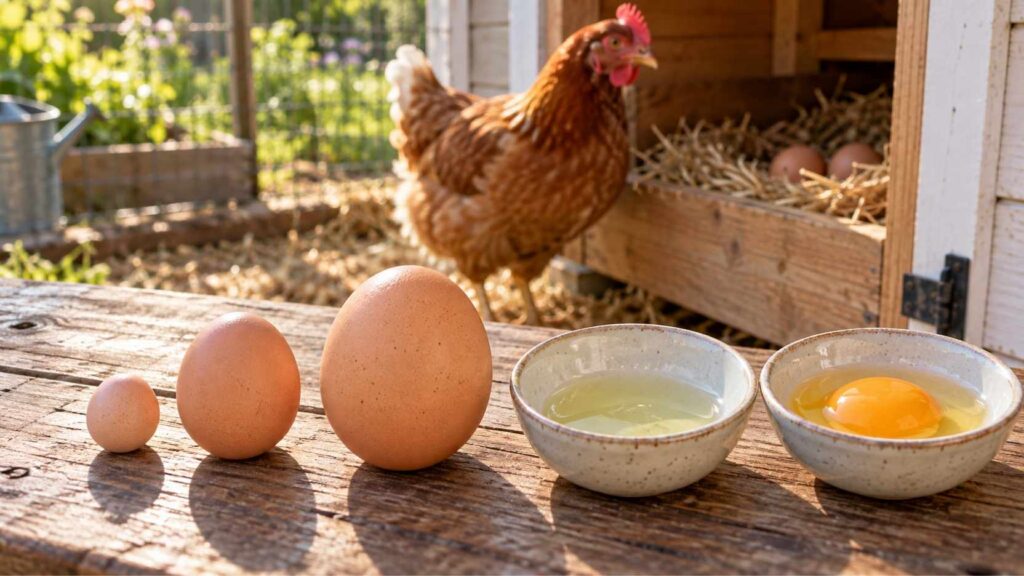
You walk into the coop, check the nesting box, and discover an egg that looks almost comically small compared with a normal supermarket egg. 🥚 If the hen has only recently started laying, it is easy to search for “fairy egg” and assume that every tiny chicken egg belongs in that category. In reality, many unusually small eggs from new layers are simply pullet eggs, while a true fairy egg usually has a different story inside the shell.
The easiest way to distinguish a fairy egg vs pullet egg is not by size alone. Look at the hen’s age, whether she has started laying recently, how frequently tiny eggs appear, and—most importantly—whether the egg contains a normal yolk when opened. 🔍 Think of identification as a five-step check: size → frequency → yolk → hen age → laying history.
Fairy Egg Or Just A New Layer’s Small Egg?
A young hen’s first eggs are often smaller than the eggs she will produce after her reproductive system becomes more established. Her early eggs can still be completely normal inside, containing recognizable albumen and a proportionate yolk even though the entire egg looks undersized. 🐔 If your recently started layer produces several small but otherwise ordinary eggs, you are probably watching normal early-laying development rather than repeated fairy eggs.
A fairy egg is usually more unusual because something other than a normal yolk begins the egg-forming process. The resulting egg may be extremely tiny and can contain mostly egg white, sometimes surrounding a small piece of reproductive tissue rather than a yolk. That distinction makes what is inside the egg more informative than simply measuring its shell.
What Backyard Keepers Mean By A “Pullet Egg”
In everyday backyard-flock language, a pullet egg usually means one of the smaller eggs produced when a young female chicken first begins laying. 🐣 The reproductive tract is functioning, but the bird is still transitioning into a more established laying pattern, so egg size and even shell appearance can vary during this period. Many of these eggs are perfectly recognizable miniature versions of what that hen will eventually produce.
A small first chicken egg may therefore have a normal yolk, normal white, and normal shell, just at a reduced size. As laying becomes more consistent, egg size commonly increases, although the speed of that change differs between individual hens and breeds. Do not expect yesterday’s tiny egg to become a full-sized egg overnight; improvement is usually something you observe across multiple eggs and several weeks.
What People Usually Mean By A “Fairy Egg”
A fairy egg is a traditional name for an unusually small chicken egg, particularly one that contains no normal yolk. ✨ These eggs have also been called wind eggs or yolkless eggs, and the terminology is not completely standardized among backyard chicken owners. That is why internet discussions become confusing: one person may call every miniature egg a fairy egg while another reserves the term specifically for tiny yolkless eggs.
A yolkless egg can form when a small piece of tissue or material moving through the reproductive tract stimulates the egg-making process as though it were a yolk. Albumen and shell material may then be deposited around it, creating a surprisingly complete-looking little egg. One isolated fairy egg from an otherwise healthy chicken is generally very different from a pattern of persistent abnormal laying accompanied by other problems.
The Crack-It-Open Test: Does It Have A Normal Yolk?
The most useful home identification step is also the simplest: crack the egg into a clean bowl and examine the contents. 🍳 If your tiny egg contains a recognizable, proportionate yolk surrounded by egg white, and the bird has only recently begun laying, a pullet egg becomes the more likely explanation. Size still matters, but the presence of a normal yolk tells you that the usual egg-forming sequence occurred.
If the tiny egg contains no yolk, mostly white, or an unusually small piece of material instead of a recognizable yolk, it fits the common description of a fairy egg much better. You may occasionally encounter eggs that do not fit neatly into either category because biological processes are not perfectly uniform. The goal is therefore not to assign an absolute label from appearance alone but to combine the contents with the hen’s age and laying history.
One Tiny Egg Vs Seven Small Eggs In A Row
Frequency provides another useful clue because a single strange egg and a continuing run of small normal eggs tell different stories. 🗓️ A new layer producing five, six, or seven small yolked eggs over consecutive laying days is demonstrating a pattern consistent with early pullet-sized eggs. Over time, you may notice those eggs gradually becoming larger and more consistent.
A single marble-sized or dramatically undersized yolkless egg appearing between otherwise normal eggs is more characteristic of the occasional event backyard keepers call a fairy egg. If the next eggs immediately return to the hen’s normal size, that unusual little egg may simply have been an isolated reproductive irregularity. Keeping a simple egg log can make these patterns much easier to recognize, especially when several similar hens share the same nesting boxes.
Why An 18–20-Week-Old Pullet May Start Small
Many common laying breeds can begin producing eggs somewhere around 18 to 24 weeks of age, although this is not a fixed deadline. 🐥 Breed, genetics, nutrition, season, body development, and daylight all influence when an individual pullet begins laying. Some mature earlier, while larger or slower-developing breeds may start considerably later.
Once laying begins, the first eggs can be surprisingly small because the bird is at the beginning of her reproductive cycle. Egg size frequently increases as the pullet matures and continues laying, which means a collection of small but normal eggs during those early weeks is not automatically concerning. Think of the first eggs as the beginning of the hen’s production pattern, not necessarily the final size she will lay for the rest of her life.
Does Breed Determine The Eventual Egg Size?
Breed and genetic line strongly influence expected mature egg size, which is why comparing every backyard egg with the same supermarket standard can be misleading. A breed known for relatively large eggs may eventually produce noticeably bigger eggs than a small-bodied breed whose normal mature eggs remain more modest. 🐔 Even within one breed, individual hens can produce somewhat different sizes.
This matters when evaluating pullet eggs because “small” should ideally mean small relative to what that particular bird is expected to lay. A young hen’s first egg might weigh much less than her future eggs without being abnormal, while another breed’s mature egg could naturally remain relatively small. Instead of judging one egg in isolation, watch how that hen’s personal egg size changes over the following weeks.
What To Observe Over The Next Few Weeks
When a new pullet starts laying, consider keeping a simple record of date, approximate egg size, shell quality, and whether the egg contained a normal yolk. 📋 You do not need laboratory measurements; even noting “tiny,” “small,” “medium,” and “larger” can reveal a trend. If the eggs gradually become larger and the hen behaves normally, you are probably witnessing her laying system settling into a routine.
Also watch shell shape and quality because early layers can occasionally produce other oddities while their reproductive cycles become established. An unusual egg once in a while can happen, but repeated abnormalities deserve more attention than a single imperfect egg. Your goal is to recognize patterns, not to panic over one strange morning in the nesting box.
When A Tiny Egg Is Worth Investigating
One unusually small egg from an otherwise active hen that is eating, drinking, moving normally, and continuing to lay does not automatically signal a serious problem. ⚠️ Pay more attention when abnormal eggs become persistent or are accompanied by behavior such as repeated straining, prolonged nesting without producing an egg, marked lethargy, reduced appetite, unusual abdominal appearance, or concerning vent changes. Those signs move the situation beyond ordinary egg identification and justify advice from a poultry-experienced veterinarian.
Nutrition and flock management also deserve a review when shell or laying problems continue. Laying hens need a nutritionally appropriate complete ration and access to clean water, while calcium should be provided appropriately for birds in the laying stage rather than assuming every abnormal egg simply needs more supplementation. Persistent problems are better investigated systematically than treated by randomly adding supplements.
Pullet Egg Vs Fairy Egg Vs Normal Mature Egg
Here is a practical Three-Column Egg Identification Card you can use whenever a mysterious little egg appears. 🥚 The categories are guides rather than rigid diagnoses because backyard terminology—especially “fairy egg”—is used differently by different keepers. Use several clues together rather than allowing egg size alone to make the decision.
| Identification Clue | Pullet Egg | Fairy Egg | Normal Mature Egg |
|---|---|---|---|
| Typical size | Smaller than the hen’s eventual eggs | Often dramatically tiny | Typical size for that hen or breed |
| Yolk | Usually normal yolk present | Commonly yolkless | Normal yolk present |
| Hen age | Common in newly laying pullets | Can occur at different ages | Established laying hen |
| Frequency | Several small eggs may occur in succession | Often isolated or occasional | Regular pattern |
| Laying history | Hen recently started laying | May appear unexpectedly | Hen’s usual established egg |
| What happens next | Eggs often become larger over time | Next egg may return to normal | Usually remains fairly consistent |
| Best clue | Young hen + repeated small yolked eggs | Extremely tiny + no normal yolk | Matches hen’s normal production |
The Simple Rule For Identifying That Tiny Egg
If your 18-to-24-week-old pullet has just begun laying and produces several small eggs with normal yolks, calling them pullet eggs is usually the clearest description. 🐓 If an exceptionally tiny egg appears unexpectedly and cracks open without a normal yolk, it fits the common backyard definition of a fairy egg much more closely. Neither identification requires guessing from shell size alone.
So when you discover another miniature surprise in the nest box, resist the urge to diagnose it before opening it. Check the hen’s age, count how many similar eggs she has produced, examine the yolk, and compare the pattern over the next few weeks. That simple process turns the confusing question of fairy egg vs pullet egg into something a new backyard chicken keeper can actually figure out.