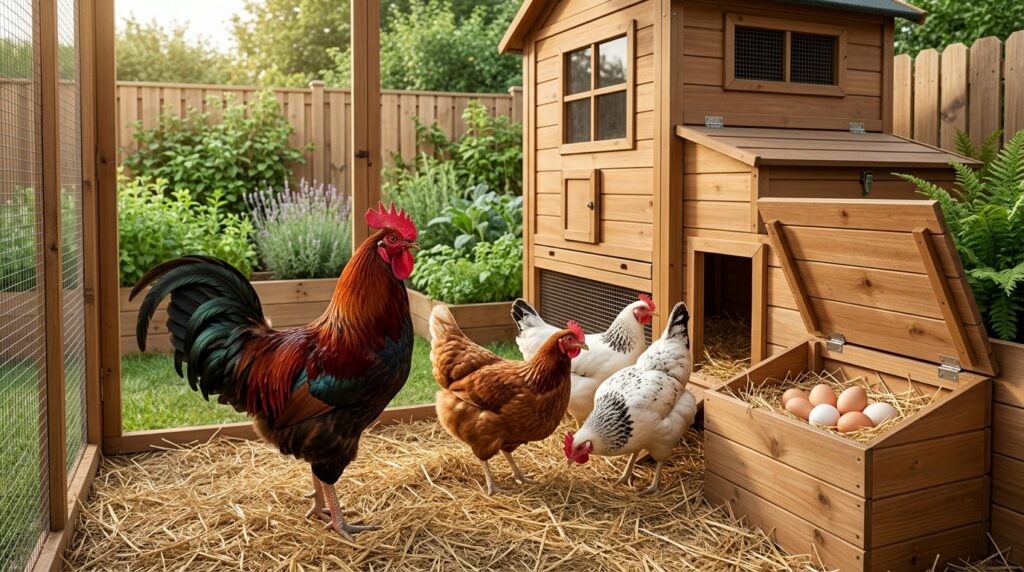
If you are starting a backyard chicken flock, you might assume that you need at least one rooster to keep your hens laying eggs.
It sounds logical: chickens reproduce through mating, so surely a male chicken must be part of the process.
But there is an important distinction every beginner should understand: hens can lay eggs without a rooster. A rooster is needed for fertilization if you want to hatch chicks, not for ordinary egg production. Ask IFAS+1
So, should you add a rooster to your backyard flock?
That depends on your goals, available space, local regulations, neighbors, and ability to manage another bird. Roosters can be useful in a breeding flock, but they also bring responsibilities that beginners sometimes underestimate.
This guide explains what roosters actually do, when keeping one makes sense, and what to consider before bringing one home.
🥚 1. Do Hens Need a Rooster to Lay Eggs?
No — hens lay eggs without a rooster
A hen’s body naturally produces and lays eggs once she reaches sexual maturity. This process does not require mating.
The difference is whether an egg is fertilized.
- Without a rooster: Hens can lay eggs, but those eggs are not fertilized and cannot develop into chicks.
- With a rooster: Mating can fertilize eggs, which may develop into chicks under suitable incubation conditions.
A rooster does not switch egg production on, and adding one will not automatically make hens lay more eggs.
Egg production is influenced by factors such as age, breed, nutrition, daylight, health, and environmental conditions.
If your main goal is collecting fresh eggs for breakfast, a flock of hens can meet that goal without a rooster.
🐣 2. When Do You Actually Need a Rooster?
A rooster becomes useful when you want to produce fertile eggs and raise your own chicks.
For example, you may want to:
- Hatch chicks using a broody hen.
- Use an incubator to hatch eggs.
- Maintain or develop a breeding flock.
- Produce replacement birds from your existing flock.
- Preserve particular chicken breeds or genetic lines.
If you want to hatch chicks, you need fertile eggs, and a rooster is the usual way to fertilize eggs within a naturally managed flock.
However, owning a rooster is not the only way to obtain fertile eggs. You can also purchase appropriately sourced fertile hatching eggs from a reputable breeder.
Remember that fertilized eggs do not automatically become chicks. Successful hatching also depends on egg condition, storage, incubation temperature, humidity, turning, and other factors.
🐓 3. What Does a Rooster Actually Do?
A rooster is more than a male chicken that makes noise in the morning. He has several natural behaviors within a flock.
Mating and fertilization: A rooster mates with hens, allowing eggs to become fertilized.
Crowing: Roosters crow to communicate and establish their presence. Crowing can happen at dawn and at other times throughout the day.
Flock behavior: Some roosters alert hens to potential threats and call them when food is available. However, these behaviors vary between individual birds.
Social hierarchy: Roosters participate in flock relationships and may compete with other males for dominance and access to hens.
One important misconception is that every rooster is naturally gentle or protective. Temperament varies. Some are relatively calm, while others may chase, threaten, or injure people and other chickens.
Do not choose a rooster based only on appearance or breed reputation. Individual behavior, handling history, and appropriate management matter.
🔊 4. Are Roosters Too Noisy for a Backyard?
This is one of the biggest practical concerns for people living in residential neighborhoods.
Roosters crow. And they do not necessarily wait until sunrise.
They may crow early in the morning, during the day, or in response to other roosters, disturbances, and changes around them.
Before adding one, consider:
- How close are your neighbors?
- Are bedrooms or nearby homes close to the coop?
- Are you allowed to keep roosters in your area?
- Can you tolerate regular crowing?
- Are there noise restrictions or nuisance rules?
A common mistake is assuming that a rooster will only crow occasionally or that keeping him inside a dark enclosure overnight will reliably prevent noise.
There is no dependable way to guarantee a quiet rooster. Restricting normal movement or using devices that interfere with crowing can also create animal-welfare concerns. RSPCA Knowledgebase+1
Beginner tip: Check local regulations before buying a rooster. Some residential areas allow hens but prohibit roosters because of noise.
⚔️ 5. Can Roosters Become Aggressive?
Yes. Some roosters display aggressive behavior, particularly as they mature.
Possible behaviors include:
- Charging toward people.
- Chasing children or visitors.
- Jumping toward legs.
- Pecking or striking with their feet.
- Fighting with other roosters.
- Excessively mounting or injuring hens.
Not every rooster behaves this way, but you should be prepared to manage these possibilities.
How to reduce risks
- Choose a bird with a known temperament from a reputable source.
- Avoid encouraging aggressive behavior through rough handling or teasing.
- Supervise children around poultry.
- Give hens enough space to move away from unwanted attention.
- Monitor injuries, feather loss, and signs of stress.
- Have a safe separation plan if the rooster becomes dangerous.
Never assume that a rooster is safe around children simply because he was calm as a chick.
If aggression becomes persistent or causes injuries, consult an experienced poultry keeper or veterinarian about appropriate management and rehoming options.
🐔 6. How Many Hens Should You Keep With One Rooster?
If you plan to breed chickens, the number of hens matters.
A rooster that mates too frequently with a small number of hens may cause feather loss, skin injuries, and stress.
There is no universal hen-to-rooster ratio that works for every flock. Breed, individual behavior, housing, age, and breeding goals all matter.
As a general starting reference, some poultry extension guidance discusses approximately one rooster for every 10–12 hens, while other recommendations differ. Small and backyard poultry+1
Rather than treating a ratio as a guarantee:
- Watch whether hens are being overmated.
- Check the backs and necks of hens for feather damage.
- Make sure birds have enough space.
- Provide places where hens can avoid unwanted attention.
- Separate the rooster if he is causing repeated injuries.
If you have only three or four hens, adding a rooster may create more management challenges than benefits.
🏡 7. Do You Have Enough Space for a Rooster?
Adding another chicken means increasing the demands on your coop and run.
You need to consider:
- Adequate floor and outdoor space.
- Enough feeder and waterer access.
- Suitable roosting space.
- Secure fencing and predator protection.
- Separate housing if birds need to be isolated.
- Additional bedding, feed, and cleaning supplies.
A rooster should not be squeezed into an already crowded flock simply because you want fertile eggs.
Crowding can increase competition, stress, injuries, and the spread of disease.
Also consider whether you can safely separate birds if the rooster becomes aggressive or if you need to introduce new chickens.
💰 8. What Does Keeping a Rooster Cost?
A rooster may not require a completely separate feeding system, but he still adds to your flock’s expenses.
Potential costs include:
| Expense | Why it matters |
|---|---|
| Feed | Additional bird to feed |
| Housing | More space and secure facilities |
| Bedding | More material for cleaning and maintenance |
| Veterinary care | Health checks and treatment when needed |
| Biosecurity | Separate equipment or quarantine arrangements |
| Emergency housing | A place to separate an injured or aggressive bird |
If you are keeping chickens primarily for household eggs, remember that a rooster does not increase the number of eggs your hens naturally produce.
You should be able to explain why you want one before taking on the additional costs.
🐣 9. What Happens If Your Rooster Produces More Chicks Than You Can Keep?
This is an important issue that beginners sometimes overlook.
If you hatch your own chicks, you may end up with more male birds than expected.
Young roosters can sometimes live together, but fighting may become more common as they mature. Keeping several adult males together can require additional space and careful management.
Before incubating eggs, decide:
- How many chicks can your property support?
- What will you do with extra roosters?
- Can you find responsible homes?
- Are local rules compatible with keeping additional birds?
- Can you separate males if fighting develops?
Do not assume that a local rescue or another poultry keeper will automatically take unwanted roosters. Responsible rehoming can be difficult, especially in areas where noise restrictions are common.
A breeding plan should include a realistic plan for every chick, not just the hens you hope to keep.
⚖️ 10. Rooster vs. No Rooster: Which Is Better for Beginners?
| Your goal or situation | Practical choice |
|---|---|
| Fresh eggs for household use | Hens only |
| Small suburban backyard | Usually hens only, subject to local rules |
| Want to hatch your own chicks | Consider a rooster or sourced fertile eggs |
| Interested in breeding chickens | A managed breeding flock |
| Close neighbors or strict noise rules | Usually avoid a rooster |
| Limited space and budget | Start with hens |
| Want to learn poultry care first | Start with a manageable hen-only flock |
There is no rule that every backyard flock needs a rooster.
For many beginners, starting with hens is simpler. You can learn about feeding, egg collection, coop maintenance, health monitoring, and predator protection before deciding whether breeding is something you want to pursue.
📋 11. Beginner Checklist Before Adding a Rooster
Before bringing a rooster home, ask yourself:
- Do I actually want to hatch chicks?
- Do local regulations allow roosters?
- Can I manage regular crowing?
- Do I have enough hens and suitable space?
- Can I monitor hens for injuries or overmating?
- Do I have a safe way to separate aggressive birds?
- Can I afford additional feed and veterinary care?
- Do I have a responsible plan for extra male chicks?
- Have I considered the effect on my neighbors?
- Can I provide proper care throughout the bird’s life?
If several answers are no, it may be better to wait.
Final Thoughts: You Can Have a Happy Egg-Laying Flock Without a Rooster ❤️
Do you need a rooster? If your goal is simply to collect fresh eggs, the answer is no.
Hens lay eggs naturally without mating. A rooster is useful when you want fertile eggs and plan to hatch chicks, but he also brings additional responsibilities involving noise, space, flock behavior, breeding, and local regulations.
For beginners, a small, well-managed group of hens is often a sensible starting point. Learn how to care for them, understand their needs, and decide whether breeding genuinely fits your long-term plans.
Do not add a rooster just because you think your hens need one. Add one only when you have a clear purpose and can provide the right environment for him and the rest of your flock. 🐓