Your young chicken suddenly crouches when you approach, lowers her body, and spreads her wings slightly, even though she used to run away whenever you reached toward her. 🐔 This behavior, commonly called the submissive squat, can be an exciting sign that your pullet is approaching sexual maturity. Naturally, your next question is how long after squatting do chickens lay eggs, and whether you should expect that first egg within days or weeks.
Some backyard chicken owners report finding their first egg approximately one to two weeks after noticing squatting, but that is an informal observation rather than a scientifically established countdown. A pullet might begin laying shortly after this behavior appears, while another could continue squatting for several weeks before producing her first egg. 🥚 The most reliable approach is to observe several readiness signs together instead of using squatting as an exact egg-laying timer.
Does Squatting Mean Your Chicken Will Lay Soon?
Squatting is a reproductive behavior in which a female chicken lowers her body, slightly spreads or braces her wings, and becomes relatively still. 🐓 This posture is associated with mating receptivity, particularly when a rooster approaches, although some pullets display it when a familiar person reaches toward them. Because the behavior often develops around sexual maturity, it can suggest that your chicken is getting closer to laying.
However, squatting alone does not prove that an egg is already forming or that laying will begin immediately. Chickens can react differently depending on their personalities, breed, experience with people, and stage of development. A pullet that never noticeably squats may still become a perfectly normal laying hen, and a rooster is not required for hens to produce eggs.
How Many Days After Squatting Do Chickens Usually Lay?
The commonly discussed 7–14-day window is a backyard observation, not a dependable biological rule supported by a validated study of squatting-to-first-egg intervals. 🗓️ Some owners notice their pullets squatting shortly before the first egg, whereas others wait longer even after seeing the same behavior repeatedly. What matters more is whether squatting appears alongside other indicators of reproductive development.
According to University of Wisconsin Extension, many chickens begin laying at approximately 18–22 weeks of age under suitable conditions, although breed and management affect the timing. Other poultry guidance gives a broader range of approximately 16–24 weeks, and some slower-maturing birds may begin later. Therefore, a squatting pullet at 19 weeks may be approaching her first egg, while a younger or slower-developing bird may still need more time.
Five Other Signs Your Pullet May Be Getting Ready
Squatting becomes more meaningful when several physical and behavioral changes appear together. 👀 These indicators reflect the pullet’s gradual transition toward reproductive maturity, although none can independently predict the exact first-egg date. Use the following five signs as a practical observation checklist rather than a guaranteed sequence.
| Readiness Sign | What You May Notice |
|---|---|
| 1. Redder comb and wattles | The comb and wattles become larger, fuller, and more noticeably red as maturity approaches. |
| 2. Nest exploration | Your pullet enters nesting boxes, investigates bedding, or spends more time examining secluded corners. |
| 3. Increased vocal activity | She may become more vocal around nesting areas, although not every pullet develops distinctive calls. |
| 4. Changes in body development | Her abdomen and pelvic region gradually develop as the reproductive system matures. |
| 5. Changes in feeder activity | You might notice appetite or feeding-pattern changes as growth continues and laying approaches. |
A bright red comb, regular squatting, and increased nesting-box exploration together provide a stronger indication of approaching maturity than any single behavior. Penn State Extension also identifies comb development and changes in pelvic spacing as useful indicators during the transition to egg production. 🔎 However, beginners should avoid forcefully handling a pullet’s abdomen or attempting invasive examinations simply to predict her first egg.
Why Is My Chicken Squatting But Still Not Laying?
One common explanation is that your pullet is developing normally but has not completed the transition to egg production. 🌤️ Genetics, body development, nutrition, daylight exposure, and environmental conditions all influence when laying begins. A flock containing different breeds may therefore have several birds squatting at approximately the same time while their first eggs arrive on different dates.
Shortening daylight during autumn and winter can delay the onset of laying, particularly in naturally lit backyard flocks, while stressful changes may disrupt otherwise normal behavior. Moving into a new coop, predator disturbances, overcrowding, or inadequate access to appropriate feed can also complicate the transition. Before assuming something is wrong, confirm your chicken’s approximate age, observe her overall condition, and remember that squatting does not override the bird’s individual development schedule.
What Should You Prepare Before The First Egg?
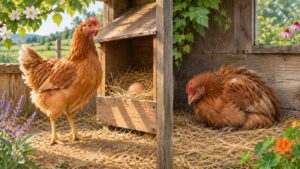
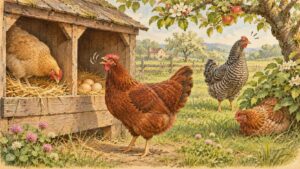
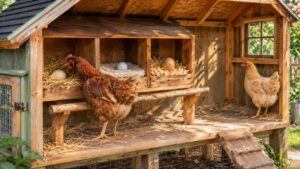
Prepare nesting boxes before your pullets begin laying so they can become familiar with the designated area. 🪺 A practical starting arrangement is approximately one nesting box for every four hens, with clean, dry bedding and enough privacy to discourage unnecessary disturbances. Place the boxes somewhere accessible, protected from excessive traffic, and separate from the birds’ preferred nighttime roosting area.
Nutrition is equally important because egg production introduces substantial calcium requirements for shell formation. Provide an appropriate complete pullet or pre-lay ration during the transition, then follow the feed manufacturer’s recommendations for changing to layer feed at the correct stage rather than introducing high-calcium feed too early. 💧 Keep clean water continuously available, and consider offering appropriate calcium supplementation separately once hens are laying, especially when managing birds at different stages.
Why Your Pullet Might Lay Somewhere Unexpected
Even with perfectly prepared nesting boxes, a first-time layer may deposit her first egg on the coop floor, beneath a shelter, or in another sheltered location. 🥚 Young hens are still establishing their laying habits, so a misplaced first egg does not necessarily indicate a serious problem. Checking hidden corners and accessible outdoor areas helps you distinguish no egg production from eggs being laid somewhere you have not discovered.
You can encourage nest use by keeping bedding comfortable, reducing disturbance, and placing a clean artificial egg in an appropriate nesting box. Avoid repeatedly moving or frightening a pullet while she investigates possible laying locations, because consistency makes the environment easier for her to learn. 🐔 Once eggs begin appearing, collect them regularly and maintain clean nesting areas to support practical everyday flock management.
When Should You Investigate Delayed Egg Laying?
A healthy-looking pullet that is squatting but has not produced an egg after two weeks does not automatically require treatment. Many birds have not started laying at 24 weeks, especially slower-maturing breeds or those encountering shorter daylight periods, so evaluate their age and circumstances before becoming concerned. 📋 If a pullet approaches approximately 26–30 weeks without laying, review breed expectations, diet, development, daylight, possible hidden nests, and overall health, and consider contacting a poultry veterinarian if the delay remains unexplained.
However, there is an important difference between a normal submissive squat and a chicken repeatedly straining as though she is trying to pass an egg. 🚨 A hen showing persistent straining, pronounced tail pumping, a swollen abdomen, an unusual upright stance, weakness, breathing difficulty, or lethargy needs prompt veterinary attention because reproductive problems such as egg binding can become dangerous. Do not wait for the seven-day tracker to finish if your chicken appears distressed or unwell.
7-Day First-Egg Observation Tracker
Rather than repeatedly guessing when your pullet will lay, spend seven days recording her behavior and physical development. 📝 Check around the same time each day, observe without forcing physical responses, and note whether important readiness signs are becoming more noticeable. The goal is to identify patterns, prepare the coop, and create useful records without turning ordinary development into a stressful countdown.
Use Yes, No, or Unsure for squatting and nest exploration, and describe changes in comb color, appetite, and egg activity using short notes. Record the bird’s age and breed above your sheet, because these details provide important context when interpreting the results. Remember that completing seven days without an egg is not itself a problem if your pullet remains healthy and is still within a reasonable developmental window.
Pullet name: __________________
Breed: __________________
Age in weeks: __________________
Date tracking started: __________________
| Day | Squatting | Comb Changes | Nest Exploration | Appetite | First Egg / Notes |
|---|---|---|---|---|---|
| Day 1 | ______ | ______ | ______ | ______ | ______ |
| Day 2 | ______ | ______ | ______ | ______ | ______ |
| Day 3 | ______ | ______ | ______ | ______ | ______ |
| Day 4 | ______ | ______ | ______ | ______ | ______ |
| Day 5 | ______ | ______ | ______ | ______ | ______ |
| Day 6 | ______ | ______ | ______ | ______ | ______ |
| Day 7 | ______ | ______ | ______ | ______ | ______ |
Final Thoughts: Squatting Is A Clue, Not A Countdown
Seeing your pullet squat for the first time can be a rewarding milestone, especially when you have raised her from a young chick. 🐣 Although some chickens begin laying within one or two weeks of noticeable squatting, there is no guaranteed number of days between the first squat and the first egg. Her age, breed, daylight exposure, physical maturity, and other readiness signs provide a much more useful picture.
Focus on maintaining a healthy flock rather than trying to accelerate the process. Prepare nesting boxes, provide appropriate nutrition, observe changes consistently, and allow normal development to take its course unless warning signs appear. 🥚 Your first egg may arrive sooner than expected, but understanding what squatting actually means will help you prepare without unnecessary worry.