Introduction
Keeping backyard chickens can be rewarding, but the daily routine does not always fit neatly around work, family responsibilities, or changing schedules. Someone who leaves home early may struggle to open the coop in the morning, while someone who gets home late may worry about whether the chickens are safely inside before dark.
That is where an automatic chicken coop door can help.
These devices open and close a coop entrance using a timer, a light sensor, or a combination of controls. They can make daily chicken care more flexible, but they are not completely maintenance-free, and they do not replace a secure coop or regular flock checks.
So, are automatic chicken coop doors worth the investment? For many busy backyard keepers, yes, provided the door fits the coop and the owner has a reliable backup plan.
🐣 What Is an Automatic Chicken Coop Door?
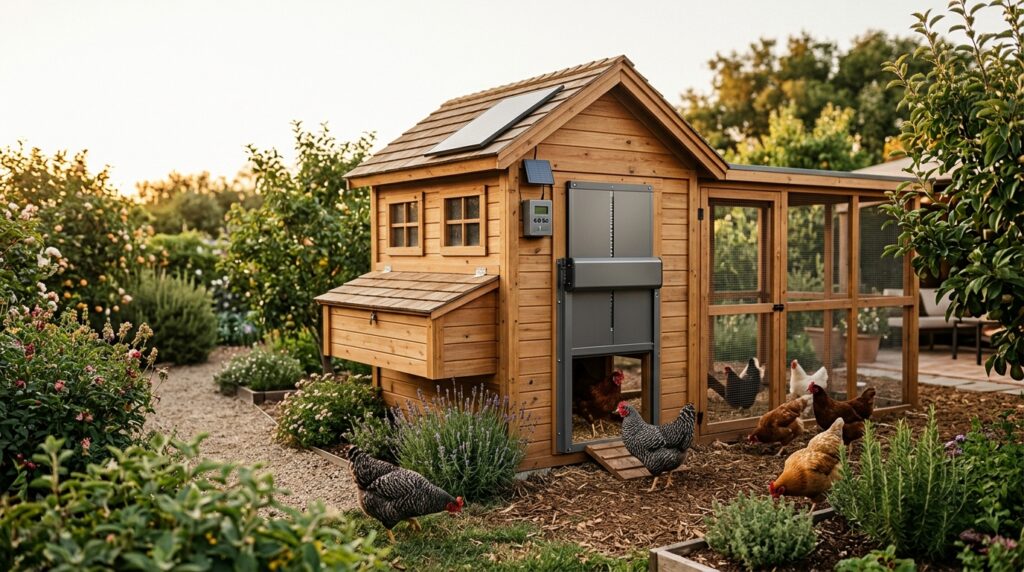
An automatic coop door is a motorized entrance that opens in the morning and closes in the evening according to its settings.
Depending on the model, it may include:
- A light sensor that responds to changing daylight.
- A timer that opens and closes at programmed times.
- Battery, solar-assisted, or mains-powered operation.
- Manual controls for opening or closing the door.
- Obstruction-detection features on some models.
Some products include the complete door and motor, while others are openers designed to operate an existing door. Before purchasing one, check exactly what is included.
✅ The Biggest Benefits for Busy Chicken Keepers
1. Less pressure around your daily schedule
One of the biggest advantages is not having to be physically present for every routine opening and closing.
If you work early shifts, manage school drop-offs, or occasionally return home after sunset, an automatic door can reduce the pressure of timing your entire day around the flock.
It can also help during seasons when sunrise and sunset change significantly.
However, it only automates the door. You still need to provide food, water, cleaning, health checks, and appropriate care.
2. More consistent opening and closing
A programmed door can follow a regular schedule, even when your workday changes.
Light-sensor models respond to outdoor brightness, while timer-based models follow preset times. Some combine both methods.
Neither approach is perfect for every setting. A light sensor may respond unexpectedly to artificial lighting or unusual conditions, while a fixed timer may need seasonal adjustment.
Choose the control system that best matches your coop’s location and your flock’s behavior.
3. An additional layer of predator protection
Closing the coop at night helps reduce opportunities for predators to enter through an open doorway. This can be especially useful when you cannot always return home before dark.
But an automatic door is only one part of predator prevention. Weak walls, exposed ventilation openings, loose mesh, gaps, and vulnerable run fencing can still leave your chickens at risk.
Choose a model that closes securely, fits the opening correctly, and cannot easily be forced open from outside. Continue checking the entire enclosure.
4. Greater flexibility when life gets busy
Automation can be particularly helpful for people balancing jobs, children, travel, and other responsibilities.
It may also make chicken keeping more manageable for someone who finds repeated early-morning or evening trips difficult.
The benefit is not that you stop caring for your flock. Instead, you have more flexibility to complete essential care at times that suit your routine.
⚠️ The Disadvantages You Should Consider
1. Automatic doors can fail
Like any mechanical or electronic device, an automatic door can develop problems.
Possible issues include:
- Dead or depleted batteries
- Power interruptions
- A jammed or misaligned door
- Dirt, bedding, or debris blocking movement
- Incorrect timer or sensor settings
- Damage from weather or normal wear
The exact risks depend on the model and installation. A door that fails to close can leave the entrance exposed, while one that closes at the wrong time may leave a chicken outside.
Before relying on automation, learn how to operate the door manually. Check the mechanism regularly and have a plan for responding to a failure.
2. Installation requires careful planning
A door may look simple to install, but it needs a suitable opening and a stable mounting surface.
Measure the existing entrance and confirm that the opening is appropriate for your chicken breeds. Large birds may need more clearance than smaller breeds.
Also check that:
- The door can move without obstruction.
- The frame is secure and properly aligned.
- The surrounding structure has no gaps that compromise security.
- Rain, mud, bedding, or other debris will not routinely interfere with movement.
- The installation follows the manufacturer’s instructions.
An automatic opener may not work well with a heavy, warped, or poorly aligned existing door.
3. It cannot tell whether every chicken is safely inside
This is one of the most important limitations.
A typical automatic door follows a schedule or sensor. It does not necessarily know where each chicken is or whether a bird is injured, trapped, or reluctant to enter.
A hen may remain outside because she is new to the flock, being bullied, unwell, or simply slower to return to the coop.
You must still check the flock and make sure every bird is safely inside before depending on the door for overnight protection.
4. It adds maintenance and ownership costs
The purchase price is only part of the decision. Depending on the product, you may also need batteries, a solar panel, mounting materials, replacement components, or professional installation.
You will also need to clean the mechanism, check the power source, test its operation, and inspect the surrounding structure.
If your current manual door is easy to manage and fits naturally into your daily routine, automation may offer less value.
🔋 Light Sensor vs. Timer: Which Is Better?
| Feature | Light sensor | Timer |
|---|---|---|
| How it works | Responds to ambient light | Follows preset times |
| Main advantage | Can adapt to changing daylight | Provides a predictable schedule |
| Main limitation | Unusual lighting may affect operation | May need seasonal adjustments |
| Best fit | A coop where daylight changes are the main scheduling concern | A keeper who prefers direct control over opening and closing times |
Some models offer both options. If your yard has bright security lights, deep shade, or unpredictable lighting, consider how those conditions might affect a light sensor.
Whichever system you choose, observe the flock’s evening routine and set closing times so birds have enough opportunity to enter.
🌦️ Battery, Solar, or Plug-In Power?
The right power source depends on your coop and local conditions.
Battery-powered doors can be convenient where there is no nearby electrical outlet. However, batteries need monitoring and replacement or recharging according to the product’s requirements.
Solar-assisted doors can suit outdoor coops without mains power. Their reliability depends on the solar setup, available sunlight, battery capacity, and weather conditions. Do not assume a small solar panel will provide unlimited power in every season.
Plug-in models can provide a consistent power source where a suitable electrical connection is available. Outdoor electrical equipment must be installed and protected appropriately, with attention to moisture and local electrical safety requirements.
There is no universally best option. Choose one you can maintain reliably in your actual environment.
💰 Are Automatic Chicken Coop Doors Worth the Money?
Consider how often opening and closing the coop creates a problem for you.
An automatic door may be a worthwhile upgrade if you regularly leave before sunrise, return after dark, work unpredictable shifts, or find twice-daily trips difficult.
It may be less necessary if you work from home, already have a dependable routine, or can easily open and close the coop yourself.
Before buying, compare the total cost with the practical benefit. Include installation, batteries or power requirements, maintenance, replacement parts, and the time needed to monitor the system.
Do not pay extra for app connectivity or advanced features unless they solve a real problem for your setup.
🛠️ How to Use an Automatic Door More Safely
Once installed, follow a simple routine:
- Test it before depending on it. Observe multiple complete opening and closing cycles while you are present.
- Confirm that the flock enters on time. Watch for birds that linger outside or struggle to use the entrance.
- Check the actual closure. Do not rely only on a display or app notification.
- Keep the mechanism clear. Remove bedding and debris that could interfere with movement.
- Monitor the power source. Follow the manufacturer’s battery, charging, and maintenance guidance.
- Know the manual procedure. Make sure you can operate the door if the automatic system stops working.
- Inspect the whole coop. Repair damaged mesh, weak latches, and gaps elsewhere in the structure.
If the door has an obstruction-detection feature, read the manual carefully. Safety features vary by model, so do not assume every door responds to an obstruction in the same way. Never test a closing mechanism with your hand, a chicken, or another living animal.
Final Thoughts
Automatic chicken coop doors can be a useful investment for busy backyard keepers, especially when work, family responsibilities, or mobility make dawn and dusk routines difficult.
Their biggest advantage is convenience combined with more consistent access times. Their biggest limitation is that they automate one task, not the entire responsibility of keeping chickens safe.
Before purchasing, assess your schedule, coop design, flock behavior, power options, and ability to maintain the mechanism. Start with a secure coop, choose a suitable door, test it thoroughly, and continue checking your chickens every day.
The best automatic coop door is not necessarily the one with the most features. It is the one that fits your setup, works reliably under your conditions, and makes responsible chicken keeping easier.