Thinking about adding quail to your backyard flock? Their eggs are tiny treasures, but production differs dramatically from chickens. This guide compares quail egg performance—seasonality, frequency, and size—with chickens, helping you set realistic expectations and maximize your yield.
Seasonal Egg Cycles: How Light and Temperature Shape Laying Patterns
Both quail and chickens are photoperiodic birds, meaning day length directly triggers ovulation. However, their sensitivity and natural cycles differ in ways that matter for the typical American backyard keeper.
Chickens: The Seasonal Standard
Most heritage chicken breeds naturally slow or stop laying in winter when daylight drops below 14 hours. Modern hybrid layers (like Red Sex Links or Leghorns) have been selected for year-round production under artificial lighting, but even they exhibit a 10–15% drop during short days without supplemental light. A typical hen lays 5–6 eggs per week during peak spring/summer, tapering to 0–3 per week in winter.
Quail: A Different Rhythm
Coturnix quail (the most common for egg production) are extremely responsive to light. They require a minimum of 14–16 hours of light per day to maintain peak laying. Unlike chickens, quail do not have a strong innate seasonal pause; they will lay consistently year-round if provided consistent artificial light above 16 hours. Without it, however, their laying drops sharply within 2–3 weeks of decreasing day length. In practice, a quail kept under natural light in North America may lay 5–6 eggs per week from April through August, then fall to 1–2 eggs per week from November through February.
Real-world case: “I keep 20 quail in a garage with a timer light set to 16 hours all year. They lay 18–20 eggs daily, even through a Michigan winter. My neighbor’s free-range chickens drop to 3 eggs a week each.” — Mark T., small-scale quail raiser, Ohio
Key difference: Chickens can tolerate some seasonal dip naturally; quail are almost entirely dependent on artificial lighting for winter production. If you can provide a dark, temperature-controlled space with a timer light, quail can outproduce chickens per bird in winter. If you rely on passive outdoor housing, expect a severe drop in quail eggs during colder months.
Temperature Effects
Heat stress reduces laying in both species above 85°F, but quail are slightly more heat-tolerant than chickens. Cold below 40°F significantly depresses quail laying unless they have supplemental warmth. Chickens handle cold better due to larger body mass and feather coverage.
Egg Size and Nutritional Profile: Tiny but Dense
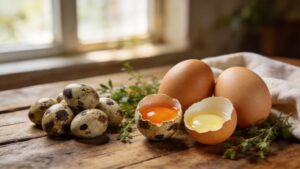
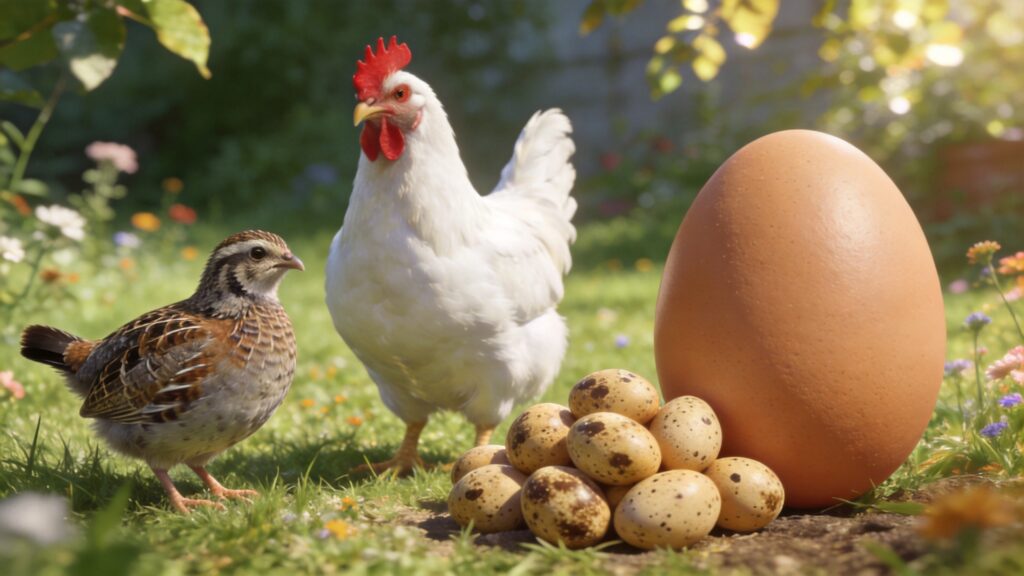
A quail egg weighs only 9–14 grams, compared to a chicken egg’s 50–70 grams. That means it takes 5–6 quail eggs to match one large chicken egg by weight. But size isn’t the whole story.
Physical Size & Shell Color
- Chicken egg (large): ~50 g, white/brown shell, strong membrane.
- Quail egg (Coturnix): ~10–12 g, speckled tan/cream shell, thinner membrane but surprisingly durable.
- Yolk-to-white ratio is much higher in quail eggs (~35% yolk vs. ~30% in chicken eggs), giving them a richer flavor and creamier texture.
Nutritional Comparison (per 100 g edible portion)
| Nutrient | Chicken Egg | Quail Egg | Difference |
|---|---|---|---|
| Calories | 155 | 158 | ~ same |
| Protein | 13 g | 13 g | ~ same |
| Fat | 11 g | 11 g | ~ same |
| Vitamin B12 | 1.1 μg | 1.6 μg | +45% |
| Iron | 1.8 mg | 3.7 mg | +106% |
| Selenium | 15.4 μg | 32 μg | +108% |
| Cholesterol | 373 mg | 844 mg | +126% |
Takeaway: Quail eggs are nutrient-dense—especially in iron, selenium, and B12—but also contain significantly more cholesterol per gram. For most people, dietary cholesterol from eggs has minimal impact on blood cholesterol, but those with specific restrictions should note the difference. The higher yolk ratio means quail eggs are excellent for baking, custards, and poaching (where you want a firm yet tender yolk).
When cooking, remember that 5–6 quail eggs replace 1 chicken egg in most recipes. For hard-boiling, quail eggs cook in 2–3 minutes instead of 9–12.
Practical Advice for Americans
- Use quail eggs as a garnish or appetizer—perfect for deviled eggs on hors d’oeuvres platters.
- Because of higher iron content, quail eggs have a slightly gamey, richer flavor that many describe as “buttery.”
- If you sell eggs, pricing quail eggs at $0.50–$1.00 per dozen (premium market) is common, whereas chicken eggs sell at $0.20–$0.40 per dozen at farmer’s markets.
Maximizing Production: Breed Selection and Smart Management
To get the most eggs per bird, you need the right genetics and environment. Here’s how to optimize for quail versus chickens.
Breed Selection: Pick the Right Bird
- Coturnix japonica (Japanese quail) — The gold standard. Lays 280–320 eggs per year under ideal light. Matures in 6–8 weeks. Small, quiet, easy to house.
- Bobwhite quail — Not recommended for eggs; they lay only 60–80 eggs per year and require more space. Mostly for hunting or meat.
- For chickens: Choose White Leghorns (280–320 eggs/year) or ISA Browns (300+ eggs/year) for industry-level production. Heritage breeds like Orpingtons lay 150–200 eggs/year with better winter hardiness.
Comparison: A Coturnix quail lays ~5 eggs/week for 60 weeks; a high-production chicken lays ~5–6 eggs/week for 80–100 weeks. Per bird, chickens win for lifespan and total egg weight. Per square foot, quail win: you can keep 6 quail in a 2’x2’ cage producing 30 eggs/week, equivalent to a chicken’s peak in 1/6 the space.
Management Tips for Peak Quail Egg Production
- Lighting schedule
- Provide 16–18 hours of light daily. Use a timer (e.g., 6 AM to 10 PM). Consistency matters more than intensity—a single 40-watt LED bulb per 10 sq ft is sufficient.
- Protein-rich feed
- Quail need 20–24% protein for laying (chickens require 16–18%). Use a specific game bird layer feed or supplement with mealworms, black soldier fly larvae, or a 22% protein crumble. Low protein drops egg count rapidly.
- Calcium supplement
- Provide crushed oyster shell or calcium grit in a separate dish. Quail need about 4% calcium in their diet; deficiency leads to soft-shelled eggs and decreased laying.
- Temperature control
- Keep quail at 60–75°F. Below 50°F, they stop laying unless provided a heat lamp. Above 90°F, they pant and reduce production. Chickens tolerate 40–85°F better, but both benefit from shade and ventilation.
- Stress reduction
- Quail are skittish. Avoid sudden noises, handling, and overcrowding (max 1 bird per 0.5 sq ft floor space). Stressed quail stop laying for 1–2 weeks. Chickens are less sensitive, but still benefit from calm environments.
Case study: Sarah’s Homestead in Colorado runs 100 Coturnix quail in a 10’×8’ shed with automatic lights at 16 hours and a 22% protein crumble. She harvests 90–95 eggs daily (consistent 95% lay rate). Her neighbor’s 20 chickens produce only 12–14 eggs per day in winter. “Quail give me more eggs per square foot and per dollar of feed,” she says. “But I spend 10 minutes a day on egg collection vs. 5 for chickens—the small eggs add up.”
When to Consider Chickens Instead
If you prioritize convenience (larger eggs, easier handling, foraging ability) and have ample space, chickens may be better. Chickens also produce eggs consistently under natural lighting if you don’t want to rig artificial lights. However, if you want high density, rapid maturity, and a steady supply of gourmet eggs in a small footprint, quail are hard to beat.
Conclusion: Set Realistic Expectations for Your Flock
Quail eggs are a nutrient-dense, space-efficient alternative to chicken eggs, but they demand precise lighting and higher protein feed to maintain year-round production. Expect 5–6 tiny eggs per quail per day under ideal conditions—totaling roughly 1 large chicken egg’s worth every 5–6 days per bird. For a family wanting a steady supply of gourmet eggs in a small backyard, quail offer an excellent niche. If you need volume and simplicity, stick with chickens. Choose based on your space, time, and taste preferences.