Introduction
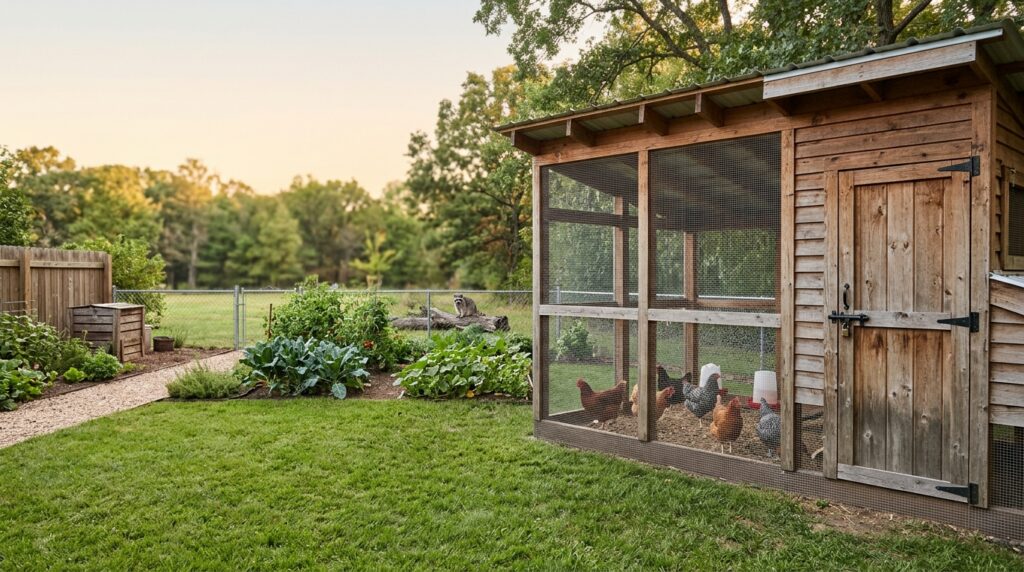
A chicken coop can look secure and still have weak points that a raccoon can exploit. A loose latch, a gap beneath a door, or lightweight wire around a run may be enough to put your flock at risk.
Raccoons are strong, dexterous animals that can manipulate simple closures and climb fences. While no coop can be guaranteed completely predator-proof, thoughtful construction and regular inspections can significantly reduce the chances of a nighttime attack.
The good news? You don’t necessarily need to rebuild your entire setup. Start by checking the doors, latches, wire mesh, roof, and places where predators might dig or squeeze through. 🔎
1. Upgrade the Door Latches 🔒
A simple hook or sliding bolt may be easy for a person to open, but it may also be vulnerable to a determined raccoon.
What to do:
- Use sturdy, weather-resistant latches that keep doors firmly closed.
- Consider a locking carabiner or another secondary closure that prevents a latch from being lifted or manipulated.
- Secure both the human-sized coop door and any smaller pop door used by the chickens.
- Check that the door cannot be pushed inward or pulled outward enough to create an opening.
- Replace loose screws, bent hardware, and worn hinges.
Practical tip: Close every door as part of your evening routine, then give it a gentle pull to confirm it is actually secured. A latch that looks closed may not have engaged properly.
Automatic chicken doors can be helpful, but they are not a substitute for reliable construction. Check that the door closes fully, its power source works if applicable, and no debris blocks its movement.
2. Choose Strong, Appropriate Mesh 🛠️
One of the most common coop-security mistakes is relying on ordinary chicken wire as the main predator barrier.
Chicken wire is primarily designed to contain poultry. It may bend, break, or allow a predator to reach through, depending on its gauge, condition, and installation.
For stronger protection, consider welded hardware cloth or another appropriately rated predator-resistant mesh.
Look for these features:
- Strong wire that resists bending and damage.
- Openings small enough to prevent raccoons from reaching through to grab chickens.
- Secure attachment to solid framing.
- No sharp edges, loose corners, or sections pulling away from the structure.
Mesh with openings around ½ inch is often used in vulnerable areas, although the best choice depends on the construction and other local predators.
Important: Strong mesh alone is not enough. A raccoon may exploit a weak frame, loose fasteners, or an unprotected roof. Use suitable screws and washers or other secure fastening methods rather than relying on a few staples.
3. Check the Bottom Edge and Digging Areas 🕳️
Predator protection needs to extend to ground level. Even if raccoons are more commonly associated with climbing and opening closures, other predators may dig beneath a coop or run.
Inspect the perimeter for:
- Gaps beneath doors.
- Uneven ground that leaves openings under the walls.
- Loose mesh along the bottom edge.
- Soil erosion after heavy rain.
- Areas where the run meets the coop.
One option is a horizontal predator apron made from securely attached hardware cloth extending outward from the run. When buried or covered with soil or suitable ground material, it can discourage digging animals from reaching the enclosure by going directly beneath the fence.
The apron must be firmly connected to the enclosure, and its dimensions should suit the site and likely predators. There is no single apron size that guarantees protection in every situation.
4. Don’t Forget the Roof and Upper Gaps 🏠
Raccoons can climb, so a fence that stops at a modest height may not be enough.
Look upward as well as downward. Inspect:
- The roof of the chicken run.
- Gaps where roofing meets walls.
- Loose boards near the eaves.
- Openings around ventilation panels.
- Branches or nearby structures that provide easy access to the enclosure.
A secure, covered run can help prevent climbing predators from entering from above. Use strong, appropriately supported materials rather than assuming lightweight netting will withstand every animal or weather condition.
Ventilation is still essential for healthy chickens. Cover vulnerable openings with suitable mesh while maintaining adequate airflow and avoiding excessive heat or moisture buildup.
5. Seal Small Gaps Around the Coop
A raccoon may not need to break through a solid wall if another part of the coop is poorly fitted.
Walk around the entire structure and look for:
- Cracked or rotting boards.
- Gaps around pipes and cables.
- Loose access panels.
- Damaged vents.
- Spaces where the run connects to the coop.
- Corners that have separated from the frame.
Repair damaged timber and secure loose panels. For openings around utility lines, use materials suitable for the location and safe around poultry.
Do not block necessary ventilation just to eliminate every opening. Instead, cover vulnerable openings with a secure barrier designed for the purpose.
6. Remove Things That Attract Raccoons 🍽️
Physical barriers are the priority, but reducing attractants can make your property less appealing to wildlife.
- Store feed in tightly closed, sturdy containers.
- Clean up spilled feed each day.
- Avoid leaving food scraps in the run overnight.
- Secure garbage and compost where possible.
- Collect eggs regularly.
- Keep the area around the coop free of unnecessary clutter that could conceal wildlife.
Raccoons are opportunistic feeders. Accessible food may encourage repeat visits, so good feed storage and sanitation are useful parts of a broader predator-management plan.
Never assume removing food alone will keep raccoons away. A hungry or curious animal may still investigate the coop.
7. Use a Simple Evening Security Check
A consistent routine is often more useful than a complicated system you rarely maintain.
Before bed, check:
- Every chicken is accounted for and inside the secure enclosure.
- The pop door and human access door are fully closed.
- Latches and secondary closures are engaged.
- Mesh is intact and firmly attached.
- No new gaps or digging attempts are visible.
- Feed and food scraps are secured.
- Automatic doors, if used, have operated correctly.
Repeat the inspection after strong winds, heavy rain, repairs, or any sign of predator activity.
If you discover a damaged barrier, repair it promptly and move the flock to a genuinely secure alternative enclosure if necessary. A temporary patch should not be treated as a permanent fix.
8. Common Coop-Security Mistakes to Avoid
Relying on chicken wire alone: It may be useful for containing birds, but it should not be assumed to provide adequate predator resistance.
Using a latch that is easy to manipulate: Add a reliable secondary closure and test the door after locking it.
Protecting only the walls: Roof gaps, loose corners, and openings beneath doors can undermine an otherwise sturdy coop.
Ignoring wear and weather damage: Wood can rot, fasteners can loosen, and mesh can pull away over time.
Assuming motion lights solve the problem: Lights or cameras may help you notice activity, but they cannot replace secure physical barriers.
Final Thoughts 🐓
Raccoon-proofing a chicken coop is less about finding one perfect product and more about eliminating weak points. Strong latches, suitable mesh, secure framing, protected ground-level edges, and a covered run all work together to reduce risk.
Start with the areas a raccoon could manipulate, climb over, reach through, or exploit. Then build a short evening inspection into your routine and repair damage as soon as you find it.
Your chickens depend on the enclosure you provide. A little preventive maintenance can make that enclosure substantially more secure and give you greater peace of mind at night.