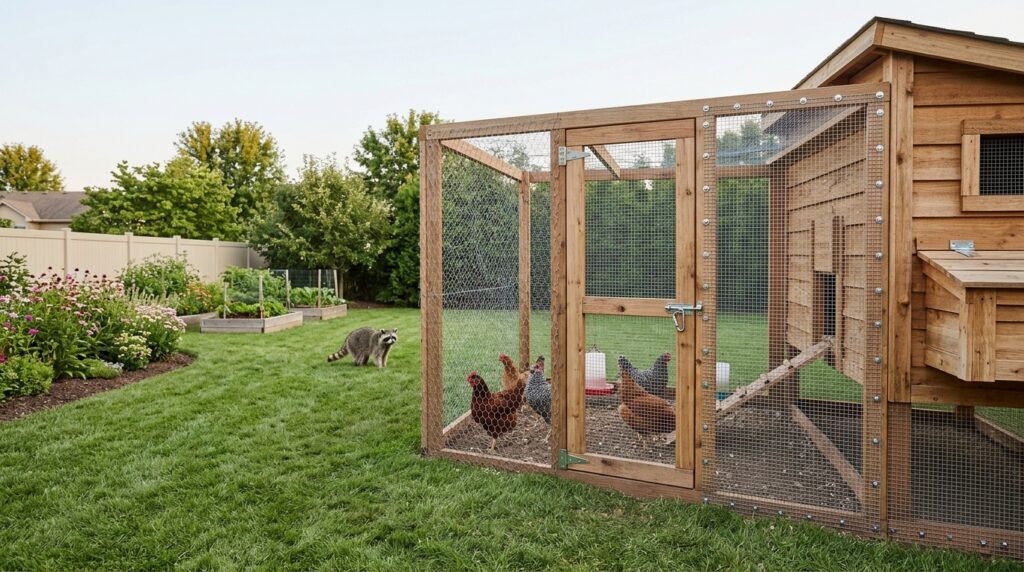
Introduction
Chicken wire seems like the obvious choice for a backyard chicken coop. It’s affordable, easy to find, and designed specifically for keeping chickens contained. But there’s an important difference between keeping chickens inside and keeping hungry predators outside.
Animals such as raccoons, foxes, dogs, and other local predators may bend, tear, dig beneath, climb over, or reach through parts of a poorly secured enclosure. Even when the wire itself remains intact, weak fasteners, gaps, and unsecured doors can leave your flock vulnerable.
The solution isn’t necessarily to replace your entire coop. Understanding what chicken wire can and cannot do helps you choose stronger materials and identify the weak points that matter most. 🔎
1. Chicken Wire Is Designed Mainly to Contain Chickens
Traditional chicken wire is usually made from thin, twisted wire formed into a hexagonal mesh. It is useful for separating poultry from garden beds, creating temporary boundaries, and helping keep chickens in a designated area.
However, chicken wire is not generally designed as a heavy-duty predator barrier.
Its thin strands can bend or break under pressure, depending on the product’s quality, installation, and condition. A determined animal may damage it or exploit an opening around its edges.
The key distinction: Chicken wire helps contain poultry, but it should not be your only line of defense against predators.
It may still have a place in a backyard setup, especially for non-security purposes. The problem arises when owners assume that enclosing a run with chicken wire automatically makes it safe overnight.
2. Predators Can Damage Wire or Exploit Its Openings 🦝
Different predators pose different challenges, so a secure coop needs to account for more than one type of threat.
- Raccoons: They are strong climbers with dexterous front paws. They may manipulate simple latches or reach through openings to grab poultry.
- Foxes: They may dig beneath an enclosure or exploit weak ground-level barriers.
- Dogs: A dog may push against, bite, or tear at a weak fence, especially if it becomes excited by the birds.
- Weasels and similar small predators: Depending on the species and mesh size, small animals may squeeze through openings that seem insignificant.
Not every predator behaves the same way, and no single mesh specification solves every problem. Local wildlife, the coop’s location, and the quality of the installation all matter.
The goal is to build a barrier that resists the likely threats in your area rather than relying on one material to do everything.
3. Hardware Cloth Is Often a Better Choice for Vulnerable Areas
For many backyard chicken setups, welded hardware cloth is a stronger option than ordinary chicken wire for protecting vulnerable openings.
Hardware cloth is made from wire joined at its intersections. The strength depends on wire gauge, opening size, material, and construction, so not every product provides the same level of protection.
For vulnerable areas, many keepers consider mesh with openings around ½ inch. Smaller openings can help prevent predators from reaching through, although the appropriate choice depends on the animals you need to exclude.
Use suitable hardware cloth around:
- Windows and ventilation openings.
- The walls of the chicken run.
- Gaps near the roofline.
- Vulnerable lower sections of the enclosure.
- Openings where the run connects to the coop.
Secure the mesh to sound framing with appropriate fasteners, screws, and washers. A strong panel attached with a few weak staples can still pull loose under pressure.
Remember: Hardware cloth is not automatically predator-proof. The entire enclosure, including its framing and fasteners, must be strong enough for its intended purpose.
4. The Bottom of the Coop Needs Protection Too 🕳️
A fence can look secure above ground while leaving a vulnerable gap underneath.
Digging predators may try to get beneath the run, while uneven soil, erosion, or settling can create openings over time.
Inspect the entire perimeter for:
- Gaps beneath doors.
- Loose wire along the ground.
- Soil washed away after heavy rain.
- Spaces where fencing meets the coop.
- Signs of digging or disturbed soil.
One commonly used solution is a predator apron. This involves attaching sturdy mesh to the base of the enclosure and extending it horizontally outward along the ground, where it can be buried or covered with suitable material.
The apron should be securely connected to the enclosure and sized for the likely predators and site conditions. It can discourage digging, but it does not guarantee protection against every animal.
5. Strong Mesh Cannot Compensate for Weak Doors and Latches 🔒
Imagine installing heavy-duty hardware cloth around the entire run but closing the coop with a loose hook. The weak latch may become the easiest way for a predator to enter.
Check every access point, including:
- The main human-sized door.
- The smaller chicken pop door.
- Feed-storage areas.
- Access panels used for cleaning or egg collection.
- Hinges and the surrounding door frame.
Choose sturdy latches that cannot easily be lifted or manipulated, and consider a secondary locking clip where appropriate. Close each door completely and test it with a gentle pull.
Automatic doors can help with daily routines, but inspect them regularly to make sure they close fully and remain operational during power or battery problems.
6. Don’t Forget the Roof and Upper Openings 🏠
Many backyard keepers focus on the sides of a run and overlook the top.
Raccoons and other climbing animals may reach the upper edges of an enclosure. A gap between the wall and roof can provide an entry point even when the lower fencing is strong.
Check for:
- Loose roofing panels.
- Gaps around ventilation areas.
- Branches that provide access to the run.
- Weak connections between walls and roof supports.
- Lightweight coverings that may tear or sag.
A securely supported roof or covered run can reduce exposure to climbing predators and other wildlife. Choose materials suitable for the expected animal pressure and weather, and maintain enough ventilation to keep the enclosure comfortable for your chickens.
7. A Quick Comparison: Chicken Wire vs. Hardware Cloth
| Feature | Chicken wire | Welded hardware cloth |
|---|---|---|
| Main use | Poultry containment and light barriers | Stronger barriers for vulnerable openings |
| Resistance to bending | Often limited | Depends on wire gauge and construction; generally available in sturdier options |
| Small predator exclusion | Depends on mesh size and installation | Smaller openings can offer better protection |
| Installation | Often lightweight and flexible | Requires secure fastening to solid framing |
| Cost | Often less expensive | Often more expensive |
| Best role | General containment where predator exclusion is not the main concern | Predator-resistant sections of a well-designed enclosure |
Neither material guarantees safety on its own. A well-built enclosure also needs secure doors, reliable fasteners, sound framing, and protection against access from above and below.
8. How to Check Your Coop This Weekend
You don’t need to inspect every detail from memory. Walk around the coop slowly and check each section.
- Look for bent, torn, or loose wire.
- Test every latch and door.
- Inspect the bottom edge for gaps and digging.
- Check the roof and upper corners.
- Examine how mesh is attached to the frame.
- Repair damaged wood and loose fasteners.
- Store feed securely and clean up spilled food.
- Repeat the inspection after storms or any suspected predator visit.
If you discover a significant opening, move your chickens to a genuinely secure alternative enclosure while you repair it. Don’t rely on a temporary patch as a permanent solution.
Final Thoughts 🐓
Chicken wire has useful applications, but it should not be mistaken for a complete predator-defense system. Its limitations become especially important when chickens are left in an outdoor run overnight.
For better protection, use appropriately strong hardware cloth in vulnerable areas, secure it to solid framing, protect the ground-level perimeter, and inspect every door, latch, and roof connection.
Most importantly, think of the coop as a complete system. A strong fence cannot make up for a weak latch, and excellent mesh cannot protect birds if predators can dig beneath the enclosure.
A careful inspection and a few targeted improvements can help make your backyard coop more secure and your flock safer.