Understanding Your Options: Cage, Ground, or Aviary?
If you’re new to raising quail (or even if you’re a seasoned backyard poultry keeper), one of the first decisions you’ll face is how to house them. Unlike chickens, quail have unique behaviors and vulnerabilities that make housing choices critical. The three most common systems—cages, ground pens, and aviaries—each come with distinct trade-offs depending on whether your goal is egg production, meat, breeding, or simply watching these charismatic little birds thrive. This guide breaks down the pros, cons, and construction essentials for each method, tailored to the American homesteader or hobbyist.
Before diving into details, let’s establish a quick frame of reference. Most domestic quail kept in the US are Coturnix (Japanese quail), which mature quickly, lay eggs by 6–8 weeks, and rarely fly long distances. However, they will flush (suddenly launch straight up) when startled—a behavior that dictates the most important design rule: height matters more than you think.
Comparison at a Glance: Cage vs. Ground Pen vs. Aviary
| Feature | Cage | Ground Pen (Floor Pen) | Aviary |
|---|---|---|---|
| Egg production per bird | Highest (95%+ lay rate) | Moderate (70–85%) | Low to moderate (50–70%) |
| Space efficiency | Excellent (1 sq ft per bird) | Good (2–3 sq ft per bird) | Poor (4–6 sq ft per bird) |
| Cleanliness & disease control | Easy (droppings fall through) | Difficult (litter management) | Moderate (deep litter or soil) |
| Predator protection | Very high | Moderate (requires reinforced floor/walls) | High with proper netting and roof |
| Natural behaviors (scratching, dust bathing) | Restricted (dust bath in dish only) | Moderate (if given bedding) | Full range (foraging, flying short bursts) |
| Risk of injury (head trauma) | Low (if height < 18 in) | Moderate (if too high or too low) | Low (if height ≥ 6 ft) |
| Best for | Max eggs/meat, small spaces, beginners | Breeding trios, hatcheries, moderate budget | Display, conservation, pet owners who want natural behavior |
Cage Systems: Maximizing Egg Production and Cleanliness
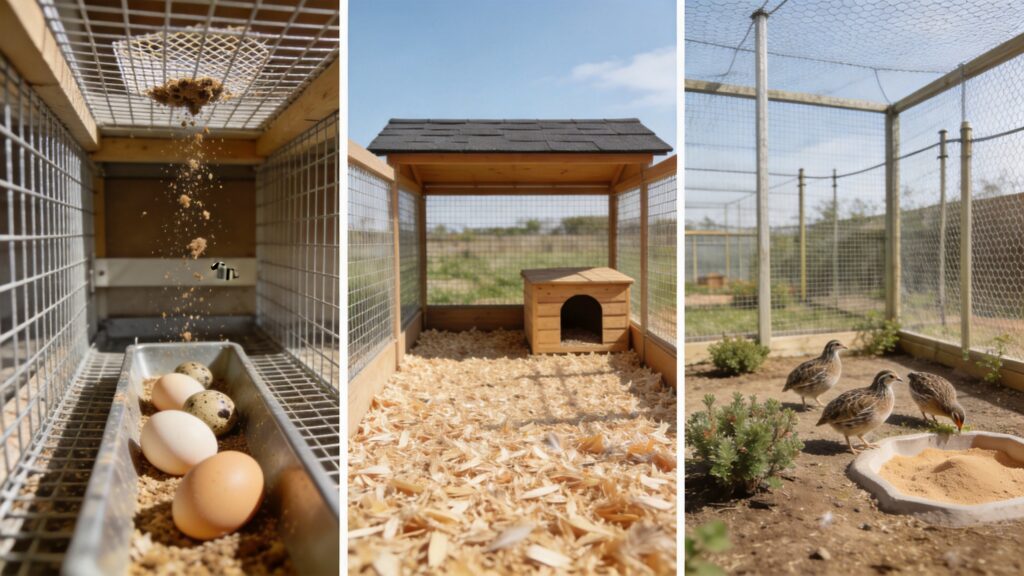
Wire cages suspended over the ground are the gold standard for commercial quail operations, and many backyard enthusiasts adopt them for good reason. With a floor of ½-inch or ⅜-inch welded wire mesh, eggs roll forward to a collection tray while waste falls through, keeping the birds away from droppings. This drastically lowers the risk of coccidiosis and other fecal-borne diseases.
Pros: You can stack cages vertically, multiply output, and control feeding with precision. Cleaning takes minutes. Because the birds are confined, you can manage a large flock in a tiny footprint—ideal for urban sheds or garages. Cons: Quail cannot scratch, dust bathe properly (unless you add a tray), or express normal foraging. Over time, some birds develop foot lesions or feather pecking if perches are not provided (quail don’t perch like chickens, but soft resting surfaces are helpful).
Construction tips: Build cages with a solid top (solid panel or very fine mesh) to prevent birds from flushing and hitting their heads. The cage height should be no more than 18 inches—more on that later. Use 16-gauge wire for durability, and provide a shallow water bottle or nipple system to avoid wet spots. For dust bathing, place a shallow tray with sand mixed with wood ash inside the cage for 30 minutes daily.
Ground Pens (Floor Pens): A Middle Ground with Caveats
A ground pen is essentially a fenced enclosure on the ground with solid walls or heavy wire, usually topped with a roof. Birds walk on litter (pine shavings, sand, or straw). This allows them to scratch, dust bathe, and behave more naturally than in a cage. However, the trade-off is daily labor—litter must be turned and replaced frequently to prevent ammonia buildup and disease.
Pros: Lower initial cost per bird (you can build a large pen out of wood and hardware cloth). Quail are less stressed and show brighter feather colors and better leg health. Cons: Eggs get dirty, hidden, or broken easily. Predators (rats, raccoons, snakes) can dig under the walls. Disease spreads faster in litter that stays damp. Also, the height of the pen creates a dangerous zone—if it’s between 18 inches and 6 feet, quail will launch upward and hit the roof hard, causing skull fractures or neck injuries.
Construction tips: Use a solid bottom (concrete or buried wire apron) to prevent digging predators. The walls should be at least 6 inches buried or secured with heavy pavers. For the roof, you have two safe choices: either keep the ceiling under 18 inches so quail can’t gain enough lift to hurt themselves, or go over 6 feet and add plenty of netting overhead to cushion flight paths. I’ll expand on that choice in the next section. Provide at least one dark hiding spot per 4 birds (a cardboard box or wooden hut) and a dedicated dust bath area with dry sand.
Aviaries: The Most Natural but Highest Maintenance
An aviary is a large walk‑in enclosure, often 6–8 feet tall, with a full roof and heavy wire walls. Here, quail can fly short distances, roost on low branches, and engage in virtually all natural behaviors. This system is ideal for breeding quality stock or for keepers who want an ornamental display, but it requires significant space and vigilance.
Pros: Quail develop strong muscles, excellent feathering, and natural social hierarchies. They show less feather picking and are much more enjoyable to watch. They can escape predators through flight (if given cover). Cons: You can’t keep high density—say 1 bird per 4–6 square feet of floor space, or more if vertical space is used. Cleaning a large aviary is a chore (deep litter or frequent mucking). Eggs can be scattered everywhere. And predators (hawks, owls, raccoons) can penetrate weak netting or gaps in the roof.
Construction tips: The roof must be solid (metal or heavy-duty polycarbonate) or double‑layered aviary netting with small mesh (½ inch) to keep out squirrels and snakes. Erect the aviary in a location with partial shade and good drainage. Plant low shrubs or provide plastic plants to create visual barriers. For hiding spots, use “quail huts” (low boxes with multiple entrances) placed every 5–6 feet. Always include a covered area where birds can get out of rain or direct sun.
The Height Dilemma: Why 18 Inches or 6 Feet?
Here’s the single most important structural rule for any quail housing: avoid the “death zone” between 20 inches and 5 feet. I know it sounds extreme, but the physics of a flushing quail are unforgiving.
“A startled Coturnix quail can jump upward at an acceleration that reaches 3–4 times gravity. In the first tenth of a second, it will clear 12 inches. Within 0.5 seconds, it’s moving at 12 feet per second. If the ceiling is at 2 feet, the bird’s head impacts the roof at full speed—often resulting in immediate death from spinal compression or skull fracture. Below 18 inches, the bird only has time to hunch its neck upward, hitting the roof with its back or the top of its head, which spreads the impact force over a larger area. Above 6 feet, the bird has enough time to angle its body and land on its feet or tuck in flight.” — Dr. Susan Reed, Avian Biomechanics Research
Let’s break it down into three scenarios:
- Ceiling height ≤ 18 inches: The quail cannot fully extend its legs and wings to launch. It may still bump its head, but the velocity is so low that serious injury is rare. This is why cage systems default to this height. Birds are safe because they simply can’t generate enough lift.
- Ceiling height 20 inches to 5 feet: This is the danger zone. Quail can generate substantial upward momentum, especially birds that are kept in ground pens where they have solid footing to push off. They hit the ceiling with the crown of their skull, which is the weakest point. Even a soft mesh roof can cause whiplash and brain trauma.
- Ceiling height ≥ 6 feet: The bird has enough vertical distance to accelerate, then decelerate, or to angle its body into a controlled flight. In aviaries with netting, the mesh absorbs some impact, and the quail can use its wings to break its fall. Serious injuries become rare.
Practical takeaway: If you’re building a ground pen and you can’t make the roof higher than 6 feet (say, in a garage with low rafters), then you must lower the roof to under 18 inches. Many backyard builders make the mistake of building a 3-foot-tall pen because it seems convenient—that’s the single most dangerous height. Either go low (cage style) or go high (aviaries). There is no safe middle.
Three Non‑Negotiable Features for Any Quail Setup
Regardless of which system you choose, your housing must include three essential elements. Skipping any of them will result in dead or stressed birds.
1. A Solid Roof (or Heavy‑Duty Netting)
Quail are prey for almost everything with teeth or talons: raccoons, foxes, owls, hawks, snakes, and even neighborhood cats. A roof isn’t optional—it’s mandatory. For cages and floor pens, use solid metal, plywood, or heavy‑gauge wire (1×2 inch welded wire covered with hardware cloth). For aviaries, use metal roofing panels for the first 2 feet of overhang and aviary netting (½‑inch mesh) for the rest. The roof must also prevent quail from escaping. They are surprisingly good at finding gaps, and a loose bird is a dead bird outside.
2. Hiding Spots for Safety and Stress Reduction
In the wild, quail live in dense underbrush. They need dark, enclosed spaces to retreat when startled or to roost at night. Without hiding spots, they become chronically stressed, which leads to feather pecking, immune suppression, and decreased egg production. Provide at least one “quail hut” per 5–6 birds. These can be as simple as cardboard boxes (replace often) or wooden boxes with a 3×4 inch entrance. Place them elevated slightly off the ground (2–4 inches) to give a sense of security. In aviaries, add clumps of tall grass, piles of straw, or low‑branching shrubs.
3. Dust Baths – Essential for Feather Health
Quail must bathe in dry, fine dust daily to remove excess oil, parasites, and dirt. A bird without access to dust will soon develop matted feathers, feather lice, and eventually skin lesions. Provide a shallow container (at least 2 inches deep) filled with a mix of fine sand (play sand is perfect) and a small amount of food‑grade diatomaceous earth or wood ash. Place it in a covered area to keep it dry. Refresh it every week. In aviaries, designate a sunny, well‑drained spot as a natural dust bath area and maintain it with regular additions of dry sand.
- Quick checklist for dust bath success:
- Use fine sand – particles smaller than 2 mm
- Keep it completely dry – add a small tarp over the bath in wet weather
- Replace monthly (or when it smells musty)
- Place it in an area the quail already frequent (near feeding or hiding spots)
Final Recommendations for the American Homesteader
Choosing between cage, ground pen, and aviary comes down to your primary goal. If you’re aiming for maximum eggs with minimal hassle, go with a cage system at 18 inches tall. You’ll sacrifice some natural behavior but gain incredible efficiency. If you want balanced health for a small breeding flock, a ground pen with a roof height under 18 inches (or, if space allows, over 6 feet) works well. But be prepared to clean litter regularly. For the hobbyist who values observation and welfare above all, an aviary is worth the investment—just follow the height rule and predator‑proof every seam.
No matter which path you choose, remember: quail thrive on routine, security, and clean environments. Build with the three essentials—roof, hiding spots, dust baths—and respect the height rule. Your birds will reward you with healthy eggs and a fascinating window into their miniature world.