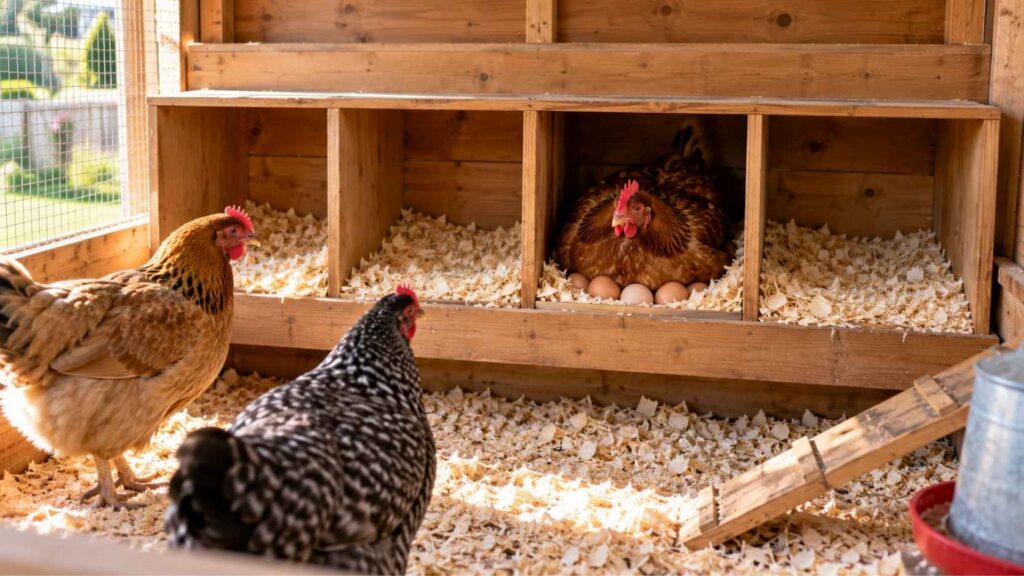
You carefully built several nesting boxes, filled every one with clean bedding, and expected your hens to spread themselves out like polite little tenants. Instead, four boxes sit empty while every hen wants the exact same nesting box, sometimes waiting outside, complaining loudly, or attempting to squeeze in beside the hen already laying. 🐔 If you are wondering why chickens use the same nesting box when perfectly good alternatives are available, you probably have not done anything wrong.
Hens can develop strong preferences for particular nest locations, and providing the recommended number of boxes does not guarantee they will use them equally. One box may simply feel more attractive because of its location, degree of enclosure, bedding, familiarity, or other details that humans barely notice. 🥚 The goal is therefore not to force perfectly even box usage, but to determine whether your flock’s favorite-nest habit is harmless or creating a genuine management problem.
Yes—Sharing A Favorite Nesting Box Is Common
Chicken keepers frequently discover that the flock treats several available nests as though only one is officially approved. Eight hens might concentrate their eggs in one box despite having four choices, while another flock may have hens waiting for the preferred nest rather than stepping into an identical empty one beside it. 😄 This behavior can seem irrational from our perspective, but nest choice is not based simply on the mathematical availability of boxes.
Research on laying hens has found that birds can form persistent preferences for particular nest locations and nest characteristics. Some hens continue choosing familiar locations even when alternatives are available, which helps explain why a favorite nesting box can stay popular day after day. Familiarity matters, so once several hens establish a routine around one location, that routine can be surprisingly difficult to disrupt.
Why Does One Box Become The Favorite?
Start by comparing the preferred box with the ignored boxes instead of assuming the hens selected it randomly. Hens generally value a nesting area that provides some enclosure and seclusion, and practical poultry guidance commonly recommends putting nests in quieter locations rather than exposed, high-traffic areas. 🪺 Position within the coop, surrounding activity, the entrance, bedding condition, and how protected the hen feels can all affect whether one box seems more suitable.
Light can be part of the picture, but avoid treating “chickens always choose the darkest box” as an absolute rule because research has found that light preferences can vary. Nest surface and bedding may matter too, while a location the hens have successfully used repeatedly can become familiar and preferred over time. Existing eggs may also act as a nest-site cue, but no single factor explains every flock, so compare the boxes before changing everything at once.
Why Do They Wait When Another Box Is Empty?
This is usually the behavior that convinces beginners something must be wrong. A hen may pace, vocalize, peer into the occupied box, or wait nearby while another completely empty nesting box sits inches away. 📣 To the keeper, the alternative looks identical; to the hen, it may not represent the same preferred laying site.
Pre-laying hens are strongly motivated to locate an acceptable nest, and individual birds can become consistent about where they want to lay. That means a hen waiting for her usual box is not necessarily failing to notice the empty one—she may simply prefer the familiar site strongly enough to wait. Unless the waiting turns into aggression, prolonged crowding, floor laying, or egg damage, you usually do not need to intervene simply because the behavior looks inefficient.
Is It Okay For Two Hens To Be In One Nesting Box?
Finding two hens in one nesting box can look ridiculous, especially when unused boxes are sitting nearby. 🐔🐔 Occasional sharing does happen, and if both birds remain calm, have enough space, and the eggs stay intact, one crowded nesting session is not automatically an emergency. Watch what happens rather than immediately pulling birds apart.
Repeated crowding deserves more attention because several birds entering a confined nest can increase the chance of eggs being stepped on, cracked, or soiled. Very large communal-style spaces can also encourage multiple birds to pile into the same location, which is one reason appropriately sized individual nest boxes are useful. If hens are climbing over one another, trapping a bird underneath, pecking aggressively, or repeatedly breaking eggs, the issue has moved beyond harmless sharing.
When Sharing Becomes A Problem
A popular nesting box is mostly a management curiosity when hens take turns, occasional sharing remains peaceful, and eggs come out clean and undamaged. You may hear impatient clucking or see a short queue in the morning without needing to redesign the coop. 🥚 In that situation, record what you see and keep collecting eggs regularly, because the flock may simply have established a strong favorite.
Take action when popularity creates repeated broken eggs, serious fighting, injuries, hens being driven away, or eggs appearing on the coop floor or in hidden corners. Those outcomes suggest that available nest access is no longer working well enough for the flock, regardless of how many boxes technically exist. Also inspect the ignored nests for wet bedding, mites, sharp edges, instability, excessive exposure, difficult access, or another practical reason the hens may be avoiding them.
Normal Vs Problem Nest-Box Behavior
| What You See | What It Usually Means | What To Do |
|---|---|---|
| Several eggs in one favorite box 🥚 | Normal preference | Observe |
| Hen briefly waiting outside | Usually manageable | Observe |
| Two hens occasionally sharing | Often tolerable if calm | Monitor |
| Mild vocal complaining | Common around preferred nests | Observe |
| Repeated cracked eggs | Crowding may be excessive | Take action |
| Aggressive pecking or driving hens out | Access conflict | Take action |
| Hens regularly laying on the floor | Nest setup may need adjustment | Investigate |
| Ignored boxes are dirty, exposed, or unstable | Alternatives may be unattractive | Correct setup |
| Birds repeatedly piled tightly together | Increased crowding risk | Adjust nests |
Should I Add More Boxes?
A commonly used backyard guideline is roughly one nesting box for every four to five laying hens, although recommendations vary somewhat by housing system. If you have twelve hens competing for a single nest, adding boxes is sensible because the flock genuinely lacks enough nesting capacity. 🛠️ Providing adequate boxes also gives subordinate or displaced hens somewhere appropriate to lay if the favorite is unavailable.
Adding more boxes does not necessarily solve the problem when you already have plenty. If eight hens have four suitable nests and still choose one, installing another four may simply produce seven empty boxes surrounding the same popular one. Before spending money, ask whether the flock needs more capacity or whether it merely has a preference.
How To Make The Other Nesting Boxes More Appealing
Compare the neglected boxes directly with the favorite and look for simple differences. Keep bedding clean, dry, comfortable, and reasonably consistent, make sure boxes are stable and easy to enter, and avoid putting nests directly beneath roosts where droppings can contaminate them. 🌾 A quieter or more enclosed setup may also make an ignored nest more attractive, particularly if it currently faces bright activity or constant foot traffic.
You can also correct obvious inconsistencies instead of trying to “train” hens by repeatedly moving them from their favorite. If one box has deeper bedding, a better entrance, more enclosure, or a calmer position, make the alternatives more comparable and observe whether usage changes. Make one adjustment at a time when possible, because changing everything simultaneously makes it difficult to learn what was actually influencing the flock.
Don’t Rebuild Your Coop Just Because One Box Is Popular
Backyard chicken care becomes unnecessarily expensive when every odd behavior is treated as proof that the entire setup needs replacing. If your hens have adequate nest capacity, the boxes are clean and accessible, birds are not being injured, and eggs remain intact, a favorite nesting box may simply be a flock preference you can live with. 💚 Chickens do not need to distribute themselves evenly just because we built the boxes evenly.
So when all your hens insist on laying in the same place, start with observation rather than demolition. Check whether the preferred nest differs in location, privacy, bedding, accessibility, or familiarity; then watch for the practical problems that actually justify intervention. 🐔 Sometimes the most sensible backyard-poultry solution is not another construction project—it is accepting that your hens held a vote, and apparently only one nesting box won.