
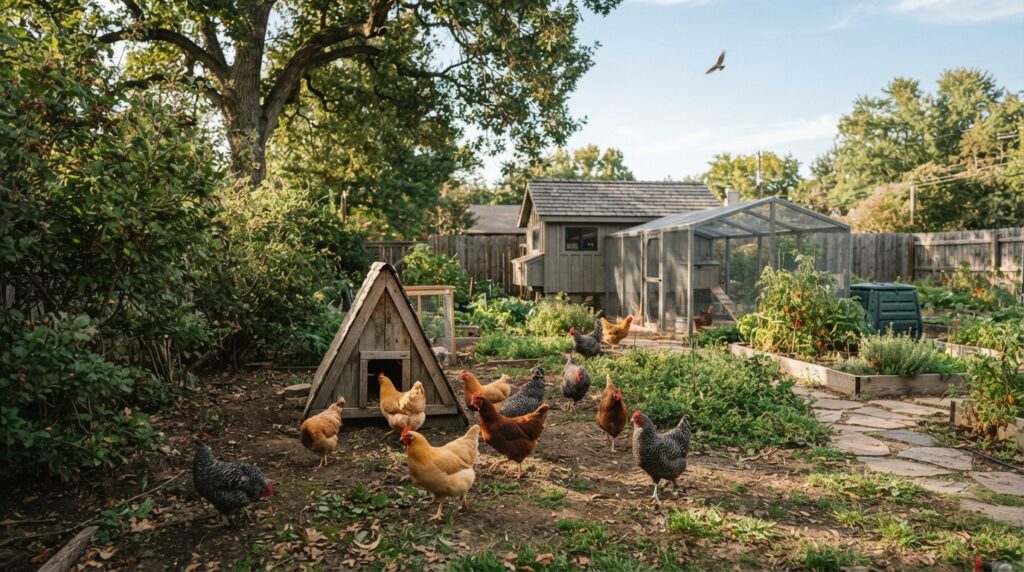
Free-ranging gives chickens more opportunities to forage, explore, dust-bathe, and behave naturally.
But it also exposes them to predators.
Hawks and other birds of prey can be a serious concern for backyard poultry, particularly when chickens spend time in open areas without overhead protection. Young birds and smaller chickens may be especially vulnerable.
The good news is that you do not have to choose between letting chickens outside and completely eliminating outdoor access.
A better approach is to make your yard harder for predators to use while giving your chickens places to hide quickly. 🐔🌳
🦅 Know What You’re Protecting Against
“Hawks” is a broad term.
Different raptors have different hunting behaviors, sizes, and preferred prey. Other predators, including owls and eagles in some areas, may also pose risks.
Not every raptor you see near your property is necessarily hunting your chickens.
Before changing your setup, observe what is actually happening.
Look for:
- Raptors repeatedly visiting the property
- Birds circling or perching near the chicken area
- Chickens suddenly running for cover
- Missing or injured birds
- Feathers concentrated in a particular area
- Predator activity occurring at predictable times
Identifying the actual pattern can help you decide which prevention measures are most useful.
🌳 Give Chickens Places to Hide
One of the most effective principles for free-ranging chickens is simple:
Don’t make them stand in a completely open space.
Natural vegetation can provide useful cover.
Consider maintaining areas with:
- Shrubs
- Small trees
- Dense vegetation
- Garden structures
- Brushy edges
- Low shelters
These give chickens somewhere to move when they perceive danger.
You can also create artificial shelters.
For example, a simple roofed structure or sturdy table-like shelter can provide shade and overhead protection while chickens are outside.
The objective is to create multiple hiding opportunities throughout the ranging area, rather than forcing the flock to cross a large open lawn whenever it needs to move.
🏠 Use Covered Runs for Higher-Risk Areas
If your property has significant raptor activity, a covered run can provide a safer compromise between complete confinement and unrestricted free-ranging.
A properly constructed run can give chickens outdoor space while limiting access from above.
Depending on your setup, the roof may be made from:
- Poultry-safe netting
- Welded wire
- Other appropriately designed enclosure materials
The material needs to be strong enough and appropriately installed for the predators and environmental conditions in your area.
Avoid creating sharp edges or gaps that could injure chickens.
🕸️ Don’t Confuse Poultry Netting With Predator Protection
Traditional lightweight chicken wire is useful for some poultry-management tasks, but it should not automatically be treated as a complete predator barrier.
For a run intended to prevent predator entry, choose fencing and overhead protection based on the actual threat.
Also inspect the enclosure regularly.
Predators can exploit:
- Torn netting
- Loose connections
- Gaps
- Damaged fencing
- Unsecured doors
A protective structure is only useful if it remains intact.
👀 Supervise Free-Range Time
You don’t necessarily have to keep chickens outside all day.
If hawk activity is a recurring concern, supervised ranging can reduce risk.
Spend time near the flock while they forage, especially during periods when you have noticed predator activity.
Your presence may make the area less attractive to some predators.
More importantly, supervision allows you to respond quickly if a raptor approaches.
You can then encourage the chickens toward covered areas rather than leaving them exposed.
🐥 Protect Chicks and Smaller Birds
Young chicks are especially vulnerable outdoors.
They are smaller, less experienced, and may have fewer opportunities to escape.
If you are raising chicks, consider keeping them in a secure brooder or protected enclosure until they are appropriately developed for outdoor conditions.
Likewise, smaller bantam chickens may require more protection than larger birds depending on the predators in your area.
A mixed flock can therefore benefit from additional covered areas.
🌿 Design the Yard for Escape, Not Just Foraging
When planning a free-range area, think about how chickens move through it.
A huge open lawn may look attractive to people but provide very little protection for poultry.
Instead, create a landscape with short distances between cover points.
For example:
Coop → shrubs → covered shelter → garden → covered run
This gives chickens more opportunities to move between protected areas.
You don’t need to transform your entire yard into a jungle.
Even strategically positioned shelters can make an exposed area more usable.
🚫 Be Careful With Predator Deterrents
You may see advice recommending fake owls, shiny objects, scare devices, or other visual deterrents.
These may sometimes appear promising, but predators can become accustomed to stationary or predictable deterrents.
If you use visual deterrents, don’t treat them as your only defense.
A secure physical barrier and access to cover are generally more dependable parts of a predator-management strategy.
Likewise, avoid methods that could injure or poison wildlife.
The goal is to protect the chickens without creating another animal-welfare problem.
💡 Move and Change Temporary Deterrents
If you’re using a non-harmful visual deterrent, variation can make more sense than leaving one object in the same location indefinitely.
For example, a temporary deterrent might be repositioned periodically.
But think of these measures as an extra layer rather than the foundation of your system.
Your primary protection should still come from:
Cover + secure housing + appropriate fencing + observation.
🌤️ Pay Attention to Weather and Yard Conditions
Your chickens’ behavior can change depending on weather and environmental conditions.
An exposed yard may become especially uncomfortable or risky when there is little vegetation or shelter.
Provide shade and protected areas for normal weather conditions as well.
This has another advantage:
The same shelters that help chickens escape aerial predators can also provide shade, protection from rain, and places to rest.
Good predator protection can therefore improve the overall usability of your free-range space.
🐔 Learn Your Chickens’ Alarm Behavior
Chickens have different alarm responses.
When a potential aerial predator appears, you may notice the flock suddenly becoming alert, looking upward, freezing, running, or seeking cover.
Pay attention to these patterns.
Over time, you may learn that certain sounds or behaviors signal danger.
This can help you intervene quickly during supervised ranging.
However, do not assume that chickens will always detect predators in time.
Their behavior is another layer of information, not a substitute for physical protection.
🔍 Inspect Your Property Regularly
Predator protection is not a one-time project.
Walk around your chicken area periodically and look for changes.
Check:
- Overhead netting
- Fence connections
- Gate gaps
- Shelter roofs
- Damaged vegetation
- New predator perches
- Areas where chickens spend most of their time
Also look for places where chickens are choosing to remain exposed.
If they consistently gather in one open location, consider whether additional cover would improve that area.
🥚 Don’t Forget About Ground Predators
Aerial predators are only one part of the problem.
Depending on where you live, chickens may also face risks from dogs, cats, snakes, foxes, raccoons, or other predators.
That means a strategy focused only on hawks may leave other vulnerabilities untouched.
A good chicken setup considers:
Above + ground level + below ground.
Secure doors at night.
Maintain appropriate fencing.
Protect vulnerable openings.
Keep feed stored properly.
Remove attractants that could encourage predators to spend more time around the coop.
🏡 Create a “Safe Zone” Near the Coop
A useful design is to make the area immediately around the coop especially secure.
This can become the flock’s reliable retreat.
For example:
Coop → covered run → protected garden area → supervised open ranging
If a predator appears, the chickens have a familiar protected area nearby.
This is generally more practical than expecting them to sprint across a large yard to reach safety.
🌱 Balance Freedom With Risk
Free-ranging does not have to mean unlimited access to every part of the property.
You can divide the yard into different zones.
Low-risk zone
Covered run with strong protection.
Medium-risk zone
Vegetation and shelters with regular supervision.
Higher-risk zone
Open areas used only when conditions are favorable and adults can supervise.
This gives you flexibility.
If you notice increased raptor activity, you can temporarily restrict access to the more exposed areas without abandoning outdoor time completely.
❤️ Final Thoughts
Protecting free-range chickens from hawks and other raptors is less about finding one magical deterrent and more about stacking several sensible layers of protection.
Give chickens places to hide. Add overhead protection where appropriate. Use secure runs for higher-risk areas. Supervise free-ranging when predator activity is high. Pay particular attention to chicks and smaller birds. Regularly inspect the property for new vulnerabilities. 🐔🌳
Most importantly, remember that free-ranging involves some level of natural predator risk.
You may not be able to eliminate that risk completely.
But you can design your backyard so your chickens have more cover, fewer exposed areas, and a safe place to retreat.
The goal isn’t to create a predator-proof backyard.
It’s to create a backyard where your flock has a much better chance of staying safe while still enjoying the freedom to forage and explore. 🦅➡️🐔💚




