
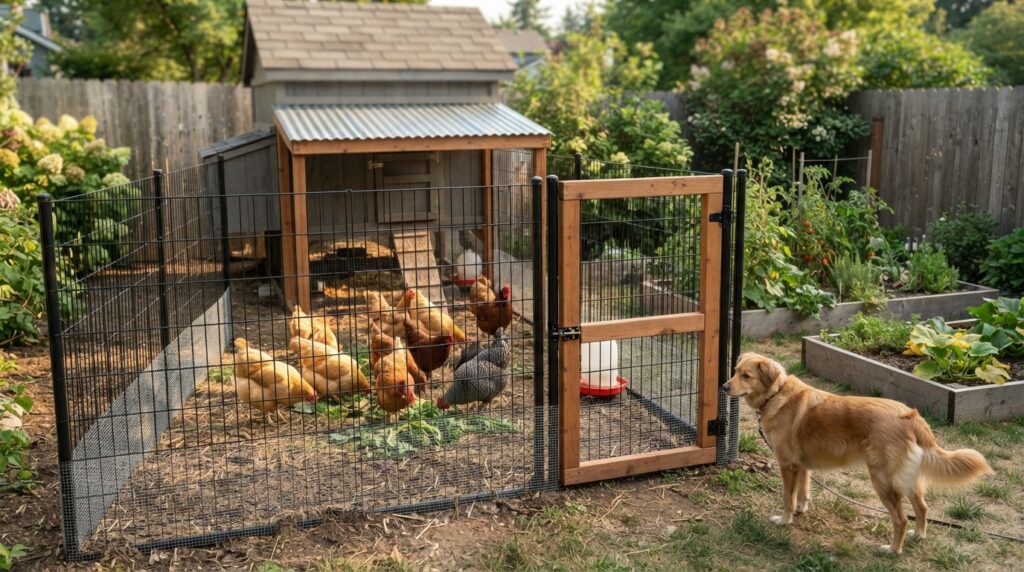
Finding a dead or injured chicken after a neighbor’s dog gets into your yard can be upsetting, frustrating, and stressful. You may be dealing with a grieving flock, damaged fencing, an unfamiliar dog, and a difficult conversation with your neighbor all at once. 🐔💔
The most important thing is to secure the remaining chickens first.
Even if the dog has left, don’t immediately let the flock return to its usual free-range area. A dog that has discovered chickens may come back, and the same weakness in your fencing could allow another incident to happen.
The goal now is simple:
Protect the surviving flock, identify how the dog got in, repair the weakness, and establish a clear plan with your neighbor.
🚨 First: Move the Chickens to a Secure Area
If a dog has just attacked your flock, bring the surviving chickens into the coop or another properly enclosed area.
Don’t release them again until you have checked the entire perimeter.
Look for:
- Broken or pushed-down fencing
- Open gates
- Gaps underneath fences
- Loose sections of wire
- Damaged doors
- Places where a dog could dig underneath
- Areas where the dog may have jumped or climbed over
Don’t assume the dog entered through the most obvious location.
A determined dog may exploit a surprisingly small weakness, particularly if the fencing is lightweight or poorly secured.
🐔 Check Every Chicken
After an attack, inspect the entire flock.
Some chickens may have injuries that aren’t immediately obvious.
Watch for:
- Bleeding
- Difficulty standing or walking
- Limping
- Drooping wings
- Labored breathing
- Swelling
- Puncture wounds
- Unusual weakness
- Hiding or extreme inactivity
A chicken can be seriously injured without having a large visible wound.
If a chicken has significant injuries, difficulty breathing, uncontrolled bleeding, or appears severely weak, contact a veterinarian promptly.
Don’t assume that a chicken that is still standing is necessarily okay.
🩹 Separate Injured Birds
If one chicken has been injured, consider separating it from the rest of the flock in a clean, quiet, secure area while you assess the situation.
Other chickens may peck at blood or wounds, potentially making injuries worse.
The injured bird should have easy access to water and an appropriate environment for recovery.
Veterinary care may be necessary depending on the injury.
Avoid experimenting with household chemicals or medications that aren’t appropriate for poultry.
🔎 Find the Exact Entry Point
Once the chickens are safe, investigate how the dog reached them.
This is one of the most important steps because repairing the wrong problem won’t prevent another attack.
Walk the entire perimeter.
Look for evidence such as:
- Paw marks
- Disturbed soil
- Bent fencing
- Fur caught on wire
- Fresh digging
- Broken fasteners
- Open gates
- Scrape marks
- Holes beneath fences
Think about the dog’s likely route.
Did it:
Dig under?
Push through?
Jump over?
Enter through a gate?
Use an opening that was already there?
The answer will determine what kind of repair is actually needed.
🧱 Strengthen the Bottom of the Fence
If the dog dug underneath the enclosure, simply filling the hole may not be enough.
Dogs may return to a location where they previously found an easy way through.
Depending on your enclosure design, you can make digging more difficult by securing the bottom edge of the fence and extending appropriate fencing material along the ground.
The exact solution depends on the soil, fence construction, and size of the dog.
The key principle is:
Don’t leave an easy path underneath the barrier.
🔒 Upgrade Weak Gates and Latches
Gates are often overlooked.
A gate that looks closed may still leave a gap large enough for a dog to push through.
Check whether:
- The gate closes completely
- The latch stays secured
- The bottom has a large gap
- Hinges are loose
- The gate can be pushed inward
- The dog can reach the latch
For a chicken enclosure, use a reliable latch that chickens cannot accidentally open and that a dog cannot easily manipulate.
If children regularly use the gate, choose a system that remains practical for the people responsible for the flock.
🕸️ Use Stronger Poultry Enclosures When Necessary
Lightweight chicken wire isn’t automatically a complete predator barrier.
It can be useful for certain poultry applications, but a determined dog may bend, tear, or push through inadequate materials.
For a dog-prone area, consider a stronger enclosure system appropriate for the size and strength of the animals involved.
Pay attention to the entire structure, not just the wire.
A strong fence attached poorly to weak posts can still fail.
🌳 Consider a Covered Run
If your chickens currently free-range throughout the yard, you may want to create a protected outdoor area where they can still exercise and forage.
A covered run can provide a useful middle ground between:
Completely enclosed chickens
and
Unrestricted free-ranging.
This is particularly useful if the neighbor’s dog is loose frequently.
Your chickens can still spend time outdoors while having a physical barrier between themselves and roaming animals.
🐕 Talk to Your Neighbor Calmly
Once your chickens are secure, talk to the neighbor.
This conversation can be uncomfortable, especially if you are upset.
Try to focus on facts rather than accusations.
Explain:
- What happened
- When it happened
- Where the dog entered
- What damage occurred
- What you have done to secure your flock
- What you need from the neighbor going forward
The goal is to prevent another incident.
A calm conversation can be more productive than starting with anger, even when the situation is understandably upsetting.
📸 Document What Happened
If the incident caused property damage or you need to discuss responsibility with the dog’s owner, keep a factual record.
Depending on local circumstances, this might include:
- Photographs of damaged fencing
- Photographs of the affected area
- Date and approximate time
- Number of chickens affected
- Veterinary records for injured birds
- Repair receipts
- Messages exchanged with the neighbor
- Relevant local animal-control or livestock information
Don’t exaggerate losses or make claims you cannot document.
Good records help keep a difficult situation focused on what actually happened.
⚖️ Check Your Local Rules
Responsibility for a dog killing poultry can vary considerably depending on where you live.
Local rules may address:
- Dogs running loose
- Animal control
- Livestock protection
- Property damage
- Dangerous or repeatedly roaming animals
- Compensation for livestock losses
Don’t assume that rules from another city, province, or country apply to your situation.
If the dog continues to enter your property or presents an ongoing danger, contact the appropriate local authority or animal-control office for guidance.
🚫 Don’t Try to Punish the Dog Yourself
It can be tempting to retaliate after losing a chicken.
Don’t.
Do not poison, injure, trap, or deliberately harm the neighbor’s dog.
Apart from potentially causing unnecessary suffering, such actions can create additional safety and legal problems.
Your objective should be to keep the dog away from the chickens, not to harm the animal.
Physical barriers, responsible animal control, and communication are much better long-term solutions.
🐥 Reconsider Unrestricted Free-Ranging
You don’t necessarily have to stop giving your chickens outdoor time permanently.
But after an attack, reassess the risk.
Ask yourself:
- Is the dog regularly allowed to roam?
- Can it enter the property again?
- Is the fence strong enough?
- Can the chickens reach a secure enclosure quickly?
- Are there other dogs nearby?
- Is someone usually home?
- Can free-ranging be supervised?
If the answer to several of these questions is “no,” unrestricted ranging may no longer be the safest option.
A protected run can allow outdoor activity without exposing the flock to the same level of risk.
🏡 Create a “Chicken Safe Zone”
A useful backyard setup is to create several layers of protection.
For example:
Coop → secure run → protected yard → supervised free-range area
The chickens don’t have to depend on one barrier.
If something goes wrong in one area, they still have another protected space to retreat to.
Add shelters, shrubs, low structures, or other suitable cover where practical.
This can also help protect chickens from aerial predators and provide shade and weather protection.
🔄 Check the Fence Regularly
A repaired fence can become vulnerable again.
Weather, animals, gardening equipment, vegetation, and normal wear can create new gaps.
Make a quick perimeter inspection part of your routine.
Look especially at:
- Fence bottoms
- Gate corners
- Latches
- Posts
- Connections
- Areas with soft soil
- Places where vegetation has pushed against fencing
A five-minute inspection can identify a small problem before it becomes another major opening.
🐔 Watch the Flock After the Attack
An attack can change how chickens behave.
Surviving birds may become more cautious or spend more time near the coop.
Give them time to settle.
Keep their environment predictable, provide normal access to food and water, and avoid unnecessary disturbance.
If a bird continues to behave abnormally, stops eating or drinking, or shows signs of illness or injury, seek veterinary advice.
❤️ Final Thoughts
When a neighbor’s dog kills a chicken, the first instinct may be anger.
But the most useful response is to turn that frustration into a stronger protection system.
Secure the surviving flock. Check every bird. Find the exact entry point. Repair the fence properly. Strengthen weak gates and barriers. Talk with the dog’s owner calmly. Document the incident when appropriate. And check your local rules if the problem continues. 🐔🏡
You may also discover that your backyard can support a better balance between free-ranging and protection.
A secure run, strategic shelters, stronger fencing, and supervised outdoor time can give chickens plenty of room to behave naturally without leaving them completely exposed.
The best fence is not the one that looks strongest. It’s the one that actually stops the problem you’re dealing with. 🐔🔒




