
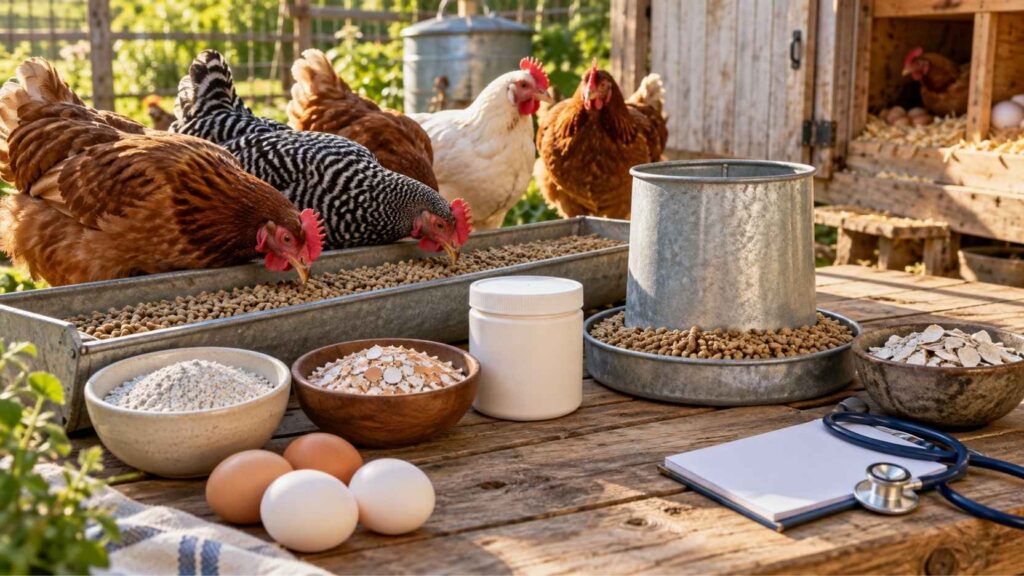
Oyster shell is one of the most familiar supplements in a backyard chicken coop, but it is not the only possible calcium source for laying hens. 🐔 Whether oyster shell is unavailable, expensive in your area, or simply something you prefer not to use, several alternatives can fit a well-managed feeding system when they are chosen carefully. The important question is not whether a product says “calcium,” but whether it is appropriate for poultry, provides calcium in a useful form, and fits alongside a nutritionally complete ration.
That distinction matters because calcium supplementation is only one part of producing normal eggshells, and simply adding more calcium cannot correct every shell problem. Thin or soft eggs can also be associated with nutritional imbalance, heat stress, age, stress, disease, or inadequate vitamin D and phosphorus, so the flock’s complete feeding program matters more than any single ingredient. Think of an oyster shell alternative for chickens as one tool in the feeding system rather than a magical ingredient that automatically produces perfect eggs.
Why Laying Hens Need More Calcium Than Growing Chickens
A laying hen is continually moving significant amounts of calcium into eggshell production, which makes her requirements very different from those of a growing chick or non-laying bird. Chicken eggshell is overwhelmingly mineral material, with calcium carbonate making up most of that mineral structure, so a hen must obtain enough usable calcium while continuing to meet all her other nutritional needs. 🥚 Modern layer feeds are therefore formulated with substantially more calcium than starter or grower feeds, commonly around 3–4% or somewhat higher depending on formulation and production stage.
That does not mean every chicken in the yard should receive unrestricted high-calcium feed simply because a few hens are laying. Chicks and growing pullets need diets formulated for growth, while roosters and other non-laying birds do not have the same heavy calcium demand created by eggshell formation, which is one reason separate free-choice calcium can be useful in mixed flocks. 🌾 The laying birds can use additional calcium while the flock’s basic feeding program remains appropriate for the age and production status of the birds.
Does Oyster Shell Have To Be Oyster Shell?
Oyster shell works because it supplies calcium, not because oysters contain a special egg-producing substance that cannot be replaced. Coarse oyster shell is particularly convenient because hens can consume it separately from their main ration, and poultry recommendations frequently suggest offering supplemental calcium free-choice so laying hens can regulate their intake. Penn State and Oregon State guidance both describe separate calcium supplementation for laying birds alongside an appropriate layer ration.
This means the nutritional purpose and the ingredient source should be considered separately. A keeper may look for an alternative because oyster shell is difficult to find locally, because another poultry calcium product costs less, or because the household prefers to avoid marine-shell products. 🔎 Whatever the reason, the replacement should be feed-safe, nutritionally appropriate, and identifiable by its label, rather than a random calcium-containing material borrowed from gardening, construction, or human supplementation.
Alternative #1: Feed-Grade Limestone
Feed-grade limestone is one of the clearest oyster shell alternatives because limestone is primarily calcium carbonate, the same general calcium compound used in eggshell mineralization. Utah State guidance specifically lists limestone or oyster shell grit as calcium supplementation options for laying hens, while Penn State also recognizes limestone as a calcium source affecting egg quality. For flock owners who want a straightforward non-marine option, properly labeled feed-grade limestone can therefore be practical and economical.
The words feed-grade are the important part. ⚠️ Do not assume garden lime, masonry lime, hydrated lime, or an unidentified bag of powdered limestone from a hardware supplier is interchangeable with poultry calcium, because products made for other purposes may have different processing, particle sizes, additives, or chemical forms. Buy a product specifically labeled for livestock or poultry feeding and follow its feeding instructions rather than improvising with construction or landscaping materials.
Alternative #2: Recycled Chicken Eggshells
Eggshells are already rich in calcium carbonate, making crushed eggshells for chickens an intuitive way to recycle something your flock produces every day. Scientific analyses show that chicken eggshell is composed predominantly of calcium carbonate, so properly prepared shells can return some calcium to the feeding cycle instead of going into the trash. ♻️ The practical approach is to save shells, make sure they are clean and thoroughly dry, and crush them into small pieces before offering them separately rather than feeding recognizable half-shells.
The main limitation is simple mathematics: your hens cannot generate an unlimited calcium supplement from the shells of eggs they already laid. A small household that uses every egg may collect useful quantities, but shell supply rises and falls with egg production and does not replace the need for a correctly formulated ration. Recycled eggshells are therefore best viewed as a low-cost supplemental option, not a reason to downgrade the quality of the flock’s primary feed.
Alternative #3: Commercial Limestone-Based Poultry Calcium
Some feed stores sell packaged poultry calcium supplements based on limestone or calcium carbonate rather than oyster shell, which can be an easy option for keepers who want a ready-to-use product. 🛒 The advantage is convenience: poultry-specific products are normally labeled with feeding directions, intended species, and ingredient information rather than forcing the owner to guess whether a generic mineral product is suitable. This can make them especially attractive for small backyard flocks where buying bulk feed-grade limestone makes little financial sense.
Do not judge the product solely from pictures on the bag or words such as “shell strength.” Turn the package around and read the ingredient statement, guaranteed analysis, intended use, particle form, and feeding directions, because two products marketed for similar purposes may be formulated differently. A legitimate commercial poultry product also gives you a much clearer feeding reference than an unlabeled home remedy mentioned casually in an online discussion.
Alternative #4: A Complete Layer Feed
The most important calcium source for many laying flocks is not technically a supplement at all—it is a complete layer feed formulated for active egg production. Oregon State notes that layer feeds typically contain extra calcium, while Mississippi State emphasizes that a complete laying ration supplies nutrients in appropriate proportions and can improve shell quality when poor nutrition is the underlying problem. 🌾 This means the feeding foundation should be corrected before assuming that every thin shell demands a larger container of supplemental calcium.
Treats can quietly undermine that foundation when they become too large a share of the daily diet. Scratch grains, kitchen scraps, corn, mealworms, and garden leftovers may be enjoyable additions, but they can dilute the protein, vitamins, minerals, and calcium supplied by a carefully formulated feed when fed excessively. Oregon State specifically warns that scratch added to prepared feeds lowers the overall nutrient concentration, which is why moderation matters even when the treats themselves appear wholesome.
Alternative #5: Veterinarian-Directed Calcium
Sometimes a calcium problem is no longer a simple flock-management question. If one hen repeatedly produces shell-less or severely abnormal eggs despite receiving an appropriate layer ration and access to a suitable calcium source, individual health problems, reproductive issues, age, disease, or other nutritional factors may need investigation. 🩺 Repeatedly increasing calcium for the entire flock can miss the real problem, particularly when every other hen is producing normal eggs.
This is where veterinarian-directed calcium belongs as a separate category from everyday supplementation. Avoid converting anecdotes about human calcium tablets, antacids, injectable calcium, or other medications into universal backyard-flock instructions, because individual treatment depends on the bird and the underlying problem. For a sick or repeatedly affected hen, a veterinarian familiar with poultry can determine whether calcium treatment is appropriate and whether another condition should be investigated.
Quick Calcium Options Comparison
| Calcium source | Best use | Cost | Convenience | Shellfish concern | Feeding role | Major caution |
|---|---|---|---|---|---|---|
| Feed-grade limestone | Routine non-marine calcium option | Usually low | High if locally available | None | Usually supplemental | Must be specifically suitable for feed |
| Crushed eggshells | Recycling household eggshells | Very low | Moderate | None | Supplemental | Supply depends on eggs produced |
| Commercial limestone poultry calcium | Small flocks wanting packaged convenience | Moderate | High | None | Usually supplemental | Read the actual ingredient label |
| Complete layer feed | Nutritional foundation for laying hens | Normal feed cost | Very high | Depends on formulation | Complete feed | Treats can dilute the balanced ration |
| Veterinarian-directed calcium | Individual birds with persistent problems | Variable | Low | Product-dependent | Individual treatment | Not a routine DIY flock supplement |
The biggest takeaway from this comparison is that these five choices do not all perform exactly the same job. Layer feed forms the nutritional foundation, while limestone, eggshell, or another labeled poultry calcium product can provide supplemental calcium depending on the feeding system and needs of the laying hens. 🥚 Veterinary treatment belongs in a different category entirely because it addresses an individual bird rather than routine everyday flock nutrition.
What To Observe Before Adding More Calcium
Start with the eggs rather than automatically reaching for another supplement. Are you finding thin shells, easily cracked shells, shell-less eggs, or only an occasional unusual egg, and is the problem appearing in one hen or throughout the flock? A single odd egg from a young layer can mean something very different from a sustained decline in shell quality across several mature hens.
Then look at the feeding system as a whole: confirm that active layers are actually eating an appropriate ration, determine how much of their diet is being displaced by treats, and verify that supplemental calcium is accessible if your system uses it. 🔍 Also consider weather, flock age, stress, water availability, and health because abnormal shells are not caused exclusively by insufficient calcium. Thin or soft shells can occur when calcium, phosphorus, and vitamin D nutrition is inadequate, while heat stress and other factors can also contribute.
When An Abnormal Egg Becomes Worth Investigating
An occasional unusual egg does not automatically mean your flock has a serious nutritional problem, particularly in hens that are just beginning to lay. What deserves more attention is a persistent pattern—repeated shell-less eggs, consistently thin shells despite an appropriate diet, declining body condition, reduced activity, or the same individual hen repeatedly experiencing problems. 🚨 At that point, adding increasingly large amounts of calcium without identifying the cause can create confusion rather than solving the underlying issue.
Whole-flock problems should first prompt a review of feed quality, feeding practices, access to food and water, and whether the ration is appropriate for laying birds. Problems repeatedly limited to one hen are more likely to justify individual observation and, when persistent or accompanied by signs of illness, professional veterinary assessment. This distinction keeps ordinary chicken calcium supplementation separate from diagnosing and treating a potentially sick bird.
The Practical Bottom Line
You do not need oyster shell specifically for calcium simply because it is the product most often mentioned in backyard chicken discussions. Feed-grade limestone, properly prepared recycled eggshells, commercial limestone-based poultry calcium, and a well-formulated layer feed can all play useful roles, while veterinarian-directed calcium exists for situations that go beyond ordinary flock feeding. 🐓 The safest approach is to choose products made or clearly labeled for animal feeding and keep the flock’s complete diet at the center of the system.
Most importantly, remember that calcium and grit are not the same supplement and that extra calcium cannot compensate for an otherwise unbalanced diet. A complete layer ration plus an appropriate calcium strategy is usually much more sensible than continually adding random supplements whenever an imperfect egg appears. For the next step in your feeding system, see “Oyster Shell and Grit: The Two Supplements Everyone Confuses” and “Soft Shells, Weird Eggs, and Egg Eating: What’s Going On?”




