Millions of quail are raised each year in the United States—some in backyard coops for eggs, others in industrial battery cages. But behind the soft clucking and tiny eggs lies a contentious question: Are we treating these birds as sentient beings or just biological machines? This article explores the ethics of quail keeping, weighing their status as pets versus livestock, and challenges us to rethink our responsibilities toward these overlooked creatures.
The Dual Identity: Pets Versus Livestock
Quail occupy a strange middle ground in American animal husbandry. Unlike chickens, which have a clear cultural split between backyard pets and factory-farmed broilers, quail are often categorized as “alternative livestock”—too small for most industrial operations but too numerous for the average pet owner to form individual bonds. This ambiguity creates ethical blind spots.
Proponents of quail as livestock argue that these birds are hardy, low-maintenance, and efficient converters of feed into protein. A single Japanese quail can lay over 300 eggs per year, requiring only a fraction of the space a chicken needs. For homesteaders seeking self-sufficiency, quail offer a practical solution. Yet the very traits that make them efficient—their rapid growth, high egg production, and tolerance of crowding—also make them vulnerable to neglect.
On the other side, a growing community of quail keepers treat them as pets, giving them names, hand-feeding them mealworms, and providing spacious aviaries. “My quail come running when they hear the treat jar,” says Sarah Lin, a quail enthusiast from Oregon. “They have distinct personalities—some are curious, others shy. They deserve the same enrichment as parrots.” This perspective clashes with the livestock model, where quail are often kept in wire-bottomed cages with no perches, dust baths, or natural light.
“I rescued a flock from a factory farm—all 30 birds were packed into a cage the size of a microwave. Within two weeks of giving them dirt to dust-bathe and branches to perch on, their feather condition improved dramatically. They started singing. It broke my heart that we call this ‘livestock.’”
— Maya Ortega, animal activist and founder of Quail Haven Rescue
The debate isn’t just philosophical—it has real consequences for the 10 million quail raised in the US each year. If we define them solely as egg machines, we risk ignoring their complex needs. If we treat them as pets, we may impose unrealistic expectations. The truth lies in a nuanced middle ground that respects both their utility and their sentience.
Space Requirements: What Quail Actually Need
One of the most common mistakes novice keepers make is underestimating space. Quail are ground-nesting birds that evolved to roam grasslands and scrub. In captivity, they need room to run, hide, and engage in natural behaviors like dust-bathing and foraging. The industry standard for egg-laying quail in battery cages allows just 38 square inches per bird—roughly the size of a sheet of printer paper. Compare that with the minimum 1–2 square feet per bird recommended by the American Quail Association for backyard flocks. The gap is vast, and the impacts are visible: feather pecking, cannibalism, and stress-induced egg binding are common in cramped environments.
To visualize these differences, consider the following comparison table:
| Housing Type | Minimum Space | Typical Density | Behavioral Impact |
|---|---|---|---|
| Battery cage (industrial) | 38 in² (≈0.26 ft²) | 8–12 birds per cage | High aggression, feather loss, low mobility |
| Commercial colony cage | 100 in² (≈0.69 ft²) | 5–6 birds per cage | Slightly better, but still barren |
| Backyard aviary (ethical) | 2 ft² | 4–6 birds per 10 ft² | Natural foraging, dust-bathing, reduced stress |
| Free-range (pasture) | 10 ft²+ per bird | 10–20 birds per 100 ft² | Full natural behaviors; lower egg production |
Notice the drastic difference: an industrial quail lives its entire life on a surface smaller than a tablet, unable to stretch its wings or flap. In contrast, an ethical backyard setup provides enough space for quail to form a social hierarchy without lethal fighting. The takeaway? Space is not just a luxury—it’s a fundamental welfare necessity. For anyone considering quail, calculate your available floor area and commit to no fewer than 1.5 square feet per bird (for lightweight breeds like Coturnix) unless you plan to provide daily free-range time.
Enrichment: Beyond a Wire Floor
Even with adequate square footage, a bare cage is still a prison. Quail require enrichment to prevent boredom and stress. Key elements include:
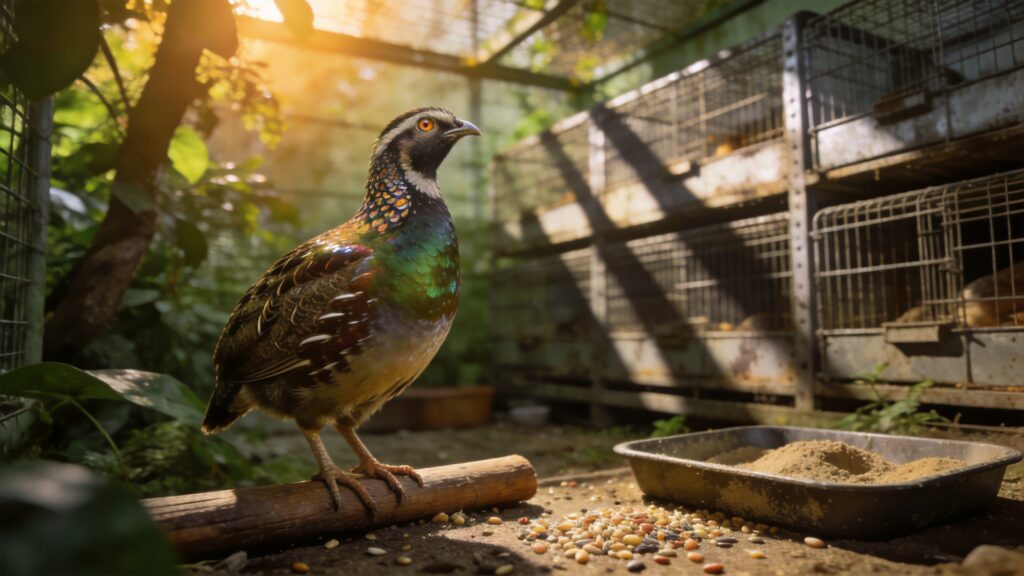
- Dust baths — A shallow tray filled with sand, fine dirt, and a pinch of diatomaceous earth. Quail instinctively bathe to remove parasites and maintain feather condition.
- Cover and hiding spots — Dense fake plants, small cardboard boxes, or upside-down baskets. Quail are prey animals; they need places to retreat when frightened.
- Foraging opportunity — Scatter seeds or mealworms on the floor, hang millet sprays, or provide a “bug box” with dried black soldier fly larvae.
- Perches and platforms — Contrary to popular belief, quail enjoy low perches (2–4 inches high) to sit on, especially for sleeping. Avoid high perches that can cause leg fractures.
- Environmental variety — Rotate toys, change the layout, and introduce safe objects like untreated pine cones or clean straw.
In a 2023 survey by the Backyard Quail Keepers Association, 78% of respondents who provided at least three of these enrichment items reported zero incidence of feather picking, versus 42% of those with barren cages. The evidence is clear: enrichment isn’t a bonus—it’s essential.
Humane Treatment: From Hatchery to Harvest
Quail welfare doesn’t stop at housing—it extends to every stage of their lives. Hatchery practices are notoriously opaque. Most commercial quail are from large-scale hatcheries where eggs are incubated in trays and day-old chicks are shipped in ventilated boxes. Mortality during transit can reach 5–10%, and survivors often arrive weak or dehydrated. Ethical keepers should source from reputable breeders who practice careful incubation and provide live arrival guarantees.
Then there is the question of slaughter. While backyard pet keepers rarely harvest their quail, many people raise quail for meat. The most humane method—recommended by the Humane Slaughter Association—involves using a sharp, cone-shaped kill cone and a quick, clean cut. Gas killing (carbon dioxide) is controversial because quail, like other birds, may experience severe stress in high CO₂ environments. For those who choose to raise quail for meat, it is ethical to learn proper techniques, ensure rapid unconsciousness, and avoid causing suffering in the bird’s final moments.
However, the larger ethical concern is the disposal of spent layers. Commercial egg-laying quail are typically slaughtered at 12–18 months when their egg production drops. Many are simply culled as waste. Activists argue this creates a “disposable” view of life. “If you’re not willing to care for a quail through its entire lifespan—which can be 3–5 years—you shouldn’t keep them for eggs,” says Dr. Karen Wu, an avian veterinarian. “Eggs are a byproduct of a bird’s natural cycle. That doesn’t make the bird a machine.”
Voices from the Field: Owners and Activists
To understand the real-world divide, I spoke with two people on opposite ends of the spectrum. Tom Henderson runs a 2,000-bird quail operation in Iowa, selling eggs to local restaurants. “I care deeply about my birds,” he insists. “They have ample floor space, windows for natural light, and a strict veterinarian plan. But at the end of the day, they’re livestock. I don’t name them. I don’t bring them inside. That’s okay—it’s a different relationship.” Tom’s setup is far better than industrial cages, yet he acknowledges that even his “ethical” farm relies on culling male chicks (since only females lay eggs).
Opposing Tom is Nina Alvarez, founder of Quail Compassion, an activist group that advocates for banning battery cages for quail. “Quail are not ‘miniature chickens’—they have unique needs that are almost never met in commercial settings,” she says. She points to a study from the University of California that found quail in barren cages exhibit stereotypic pacing (a sign of poor mental health) 60% of the time. “If we wouldn’t treat a cat or dog that way, why do we accept it for quail?” Her group has successfully petitioned two pet food chains to stop selling quail eggs from battery-caged operations.
The tension between these perspectives isn’t easily resolved. What unites them is a shared recognition that the status quo is broken. Whether you see quail as pets or livestock, the baseline of care should be the same: adequate space, enrichment, and humane handling throughout their lives.
Practical Steps for Ethical Quail Keeping
If you’re considering quail—for eggs, meat, or simply as companions—here is a checklist to ensure you’re meeting ethical standards:
- Research local regulations. Some US cities prohibit quail due to noise concerns (males can call loudly). Check ordinances before buying.
- Provide a minimum of 2 sq. ft. per bird for a pair, with extra space for groups. The more space, the less aggression.
- Invest in a proper coop or aviary. Quail need protection from predators (raccoons, hawks, snakes). Use hardware cloth, not chicken wire.
- Offer unlimited access to dust baths. Mix play sand, dirt, and a little ash or diatomaceous earth. Change weekly.
- Feed a complete game bird feed (not chicken feed, which lacks enough protein). Provide calcium via oyster shell for laying hens.
- Plan for males. If you hatch or buy chicks, you’ll likely have excess males. Decide whether to keep a small ratio (1 male per 4–5 females) or cull humanely.
- Prepare for end-of-life care. Quail can live 2–5 years. Have a plan for retirement or humane euthanasia if they become ill.
Below is a quick-reference table for daily, weekly, and monthly tasks to maintain welfare:
| Frequency | Task |
|---|---|
| Daily | Check food & water; observe behavior; remove soiled bedding spots; collect eggs (if desired) |
| Weekly | Deep clean dust bath; scrub waterers; replace litter in dry areas; inspect for parasites |
| Monthly | Thorough coop cleanout; check perches and hardware; weigh a few birds to track health |
| Seasonally | Adjust lighting (quail need 14–16 hours for egg production); vet check if possible |
A Final Reflection on Eggs and Ethics
Every quail egg on your plate carries a story. Was that bird packed into a wire box with 20 others, pecking at its neighbor out of stress? Or did it spend its days foraging in a sun-dappled aviary, taking dust baths and perching on a low branch? The answer depends on us, the consumers and keepers. Quail may never replace chickens in the public’s ethical imagination, but that doesn’t make their lives less worthy of consideration. As we push for cage-free eggs for hens, let’s not forget the smallest factory—the one that fits in a shoebox.
Whether you choose to keep quail as pets or as productive livestock, the ethical line is not drawn by their purpose, but by the quality of their existence. They are not machines. They are creatures who feel fear, pleasure, and pain. The least we can do is give them a life worth living.