
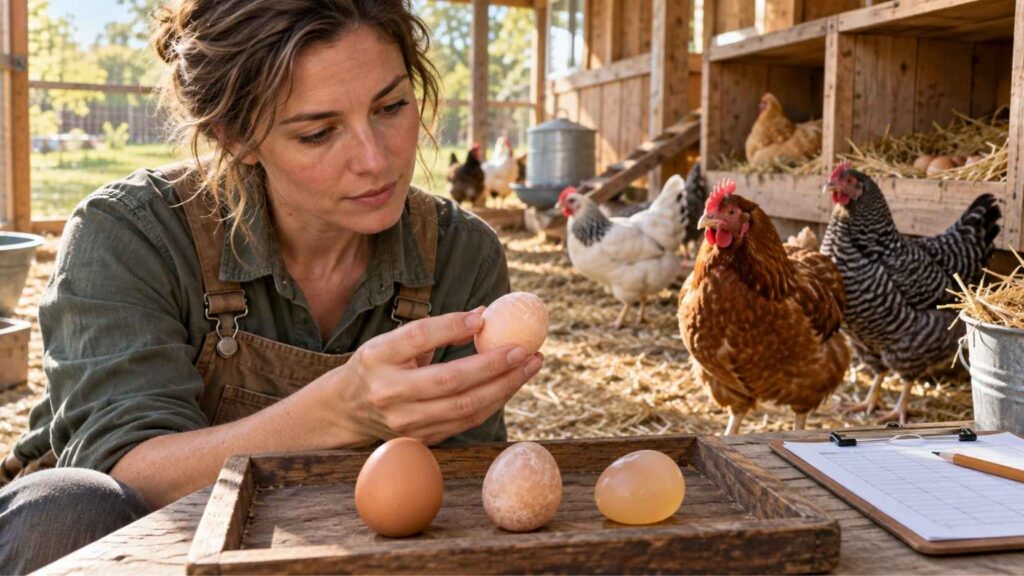
When a flock suddenly produces fewer eggs and some of the eggs are soft, rubbery, or nearly shell-less, it is tempting to search for one explanation. 🥚 But egg quantity and shell quality are different outcomes, and changes in both can happen together without sharing exactly the same cause. Treating them as one symptom can lead beginners toward the wrong fix.
For example, a flock may be laying less because of heat, molt, broodiness, shorter daylight, or hidden nests while one hen separately produces a soft egg. The opposite can also happen: a flock-wide problem such as poor nutrition or severe heat can affect both production and shell quality. The most useful approach is therefore a two-lane investigation: “Why are there fewer eggs?” and “Why are some eggs poorly shelled?”
Separate The Two Questions First
A low egg count does not automatically mean a calcium problem. Hens may reduce laying because of seasonal daylight, molt, broodiness, age, heat, stress, nutrition, illness, or changes in their environment, while hidden nests and egg eating can make production only appear lower. 🐔 Before changing supplements, confirm that fewer eggs are truly being produced.
Shell quality requires a separate look because forming a hard shell depends on adequate nutrition, calcium availability, normal reproductive function, and enough time for shell deposition. One strange egg can occur occasionally, especially in young pullets or older layers, without indicating a flock-wide emergency. Repeated soft or shell-less eggs deserve more attention because persistence tells you more than one isolated abnormal egg.
Path A — Diagnose The Drop In Egg Numbers
Start with the flock’s calendar and environment. Shortening daylight and molt commonly reduce laying, broody hens may stop producing while sitting on nests, and older hens generally lay fewer eggs than they did during peak production. 🍂 Hot weather can also reduce feed intake and egg output, especially when birds struggle to stay cool.
Next, make sure the eggs are not simply disappearing. Search for hidden nests, broken shells, egg-eating behavior, or evidence that another animal is taking eggs, and note any recent predator scares, flock introductions, moves, or housing changes. A production problem should be separated from a collection problem before you begin changing the diet.
Path B — Diagnose Soft Or Shell-Less Eggs
A soft or shell-less egg has not developed the firm mineralized shell you normally expect, leaving a flexible covering or mostly the inner membranes. An occasional abnormal egg may occur when a pullet’s laying cycle is still becoming consistent, when an older hen’s cycle becomes irregular, or after stress. 🥚 Repeated abnormalities from the same bird are more informative than a single odd egg.
Check whether laying hens receive a complete layer ration as their main food and whether an appropriate calcium source, such as oyster shell, is available separately. Large amounts of scratch grains, table scraps, or treats can dilute the nutrients supplied by a balanced ration if they replace too much regular feed. Calcium matters, but adding more calcium cannot correct every shell problem or compensate for an unbalanced overall diet.
Where The Two Paths Overlap
Some factors belong in both lanes, which explains why fewer eggs and soft shells sometimes appear at the same time. Heat stress and poor overall nutrition can reduce laying while also making consistent shell formation more difficult, and major stress can temporarily disturb both processes. ☀️ Those shared factors are worth investigating first when several hens change at once.
Other explanations mainly belong to one lane. Broodiness and molt are strong explanations for fewer eggs but are not primary signs of a shell-quality problem, while calcium shortage is much more directly associated with weak shells than with a simple reduction in egg count. Hidden nests can make production look poor without changing the eggs themselves.
| Possible Factor | Fewer Eggs | Soft Shells |
|---|---|---|
| Heat stress | ✓ | ✓ |
| Poor overall nutrition | ✓ | ✓ |
| Calcium shortage | Sometimes indirectly | ✓ |
| Broodiness | ✓ | Usually no |
| Molting | ✓ | Not a primary sign |
| Hidden nest | Appears so | No |
| Age | ✓ | Can contribute |
| Stress | ✓ | Can contribute |
Identify Whether This Is A Flock Problem Or Hen Problem
The number of affected birds can dramatically narrow your search. If most hens slow down at roughly the same time, investigate shared conditions such as weather, daylight, feed, water access, housing changes, or flock-wide stress before assuming every bird has an individual disorder. 👀 A problem affecting almost everyone usually points toward something everyone experiences.
If one hen repeatedly lays soft eggs while the rest produce normal shells, focus more closely on that bird. Note her age, appetite, behavior, body condition, and whether you can reliably identify which eggs are hers. Individual reproductive problems are unlikely to be solved simply by changing the entire flock’s feed when everyone else is laying normally.
Use A 7-Day Egg Log Instead Of Guessing
Keep a simple seven-day record of egg count, shell condition, weather, feed changes, water problems, broodiness, molt, and unusual behavior. 📋 This can reveal patterns that memory misses, such as soft eggs appearing only during the hottest days or production dropping immediately after a stressful flock change. It also tells you whether the problem is improving, stable, or becoming more frequent.
Avoid changing several variables at once unless an urgent welfare problem requires immediate action. If you simultaneously change feed, add supplements, move the coop, remove treats, and alter routines, improvement will not tell you which change mattered. A short log turns troubleshooting into pattern recognition instead of random trial and error.
When The Pattern Needs More Than Backyard Troubleshooting
Some patterns should move beyond ordinary home troubleshooting. A hen that repeatedly lays shell-less eggs while also becoming weak, lethargic, isolated, unwilling to eat, or visibly distressed should be evaluated promptly by a poultry-experienced veterinarian. 🚨 Straining, repeated unsuccessful nest visits, abnormal posture, or a sudden major change in behavior also deserves professional attention.
A severe flock-wide production drop also deserves investigation when season, molt, broodiness, heat, and obvious management changes do not explain it. Disease, parasites, toxins, nutritional problems, and reproductive disorders can produce overlapping signs that cannot be reliably identified from egg count alone. When the birds look sick rather than merely less productive, treat that as a health problem rather than an egg-production puzzle.
Two-Lane “No Eggs Vs Bad Eggs” Diagnostic Tree
For Lane A: No Eggs, first confirm that eggs are not hidden, eaten, or removed, then check daylight, molt, broodiness, heat, age, stress, feed intake, and overall flock health. 🐓 If many hens are affected, prioritize flock-wide conditions before assuming a single-bird problem. If the decline is sudden, severe, persistent, or accompanied by illness, seek qualified veterinary help.
For Lane B: Bad Eggs, decide whether the abnormality is isolated or repeated, then review balanced layer feed, calcium availability, treat intake, heat, stress, age, and which hen is producing the eggs. If one hen is repeatedly affected, investigate her individually rather than treating the entire flock as deficient. When both lanes point toward the same factor, you may have found a shared contributor rather than proof of one universal cause.
The Better Question Is Not “What Is The One Cause?”
When fewer eggs and soft eggs appear together, ask which factors explain egg quantity, which explain shell quality, and where the two explanations overlap. 🥚 That question is more useful than immediately assuming every hen needs extra calcium or that every missing egg is part of the shell problem. It also protects you from overlooking simple explanations such as broodiness, hidden nests, molt, or seasonal slowdown.
Think of the flock as two related investigations running side by side: No Eggs and Bad Eggs. Track the pattern, protect the basics of balanced feed and clean water, and determine whether the change involves one bird or the whole flock. Once those distinctions are clear, troubleshooting becomes faster, more targeted, and much less confusing.




