
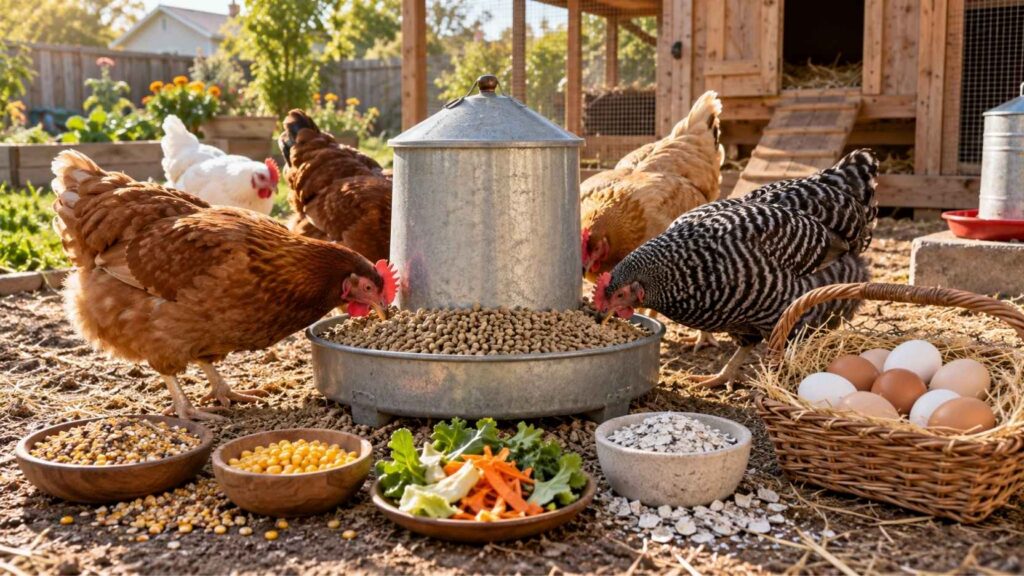
When a hen suddenly lays a thin-shelled or fragile egg, many backyard chicken keepers immediately think, “She needs more calcium,” and reach for the oyster shell. 🥚 Calcium certainly matters, but focusing only on oyster shell can hide another common feeding problem: the hen may be eating too little of the complete layer feed that was formulated to supply calcium, protein, energy, vitamins, minerals, and other nutrients together. A bowl full of oyster shell cannot replace everything that disappears when scratch grain, kitchen scraps, treats, and free-ranging extras begin taking over the daily menu.
This is why understanding layer feed and oyster shell as two different tools matters so much for beginners. Layer feed is supposed to form the nutritional foundation of an actively laying hen’s diet, while oyster shell is primarily an additional calcium source that hens can consume separately when needed. 🐔 If questionable shell quality appears, look at the whole diet first, rather than assuming that adding more calcium automatically solves whatever is happening.
What Layer Feed Is Designed To Provide
Commercial layer ration is not merely grain with some calcium sprinkled into it. It is formulated specifically for mature laying hens and commonly contains around 16% protein plus substantially more calcium than grower feed, along with carefully balanced amino acids, phosphorus, vitamins, trace minerals, fats, and carbohydrates needed to support maintenance and egg production. The important word is balanced: those nutrients are designed to be eaten together in appropriate proportions.
That balance is also why simply reading the calcium percentage on a feed bag does not tell the entire nutritional story. A hen building eggs needs nutrients for the yolk, albumen, reproductive processes, body maintenance, feathers, and shell, so calcium is only one part of a much larger system. 🍳 When complete feed consistently makes up the majority of what she eats, the ration has a much better chance of performing the job it was formulated to do.
Why Oyster Shell Does Not Replace Balanced Feed
Oyster shell is a calcium supplement, not a complete chicken feed. It can be especially useful when offered free-choice in a separate container, allowing laying hens to consume additional calcium without forcing non-laying birds to eat the same amount. Some actively laying hens may benefit from that extra calcium even while receiving an otherwise complete layer ration.
What oyster shell cannot supply is the full collection of nutrients that gets displaced when a hen fills herself with low-nutrient extras. Pouring more oyster shell beside a feeder does not restore missing protein, amino acids, vitamins, or energy balance caused by an improperly diluted ration. 🦪 Think of oyster shell as one specialized building material for egg production rather than another version of dinner.
How Treats Can Dilute The Daily Ration
The word dilution sounds technical, but the idea is extremely simple: chickens can only eat so much food during a day. If a hen fills a significant portion of that capacity with bread, corn, mealworms, fruit, leftover rice, vegetables, scratch, or other extras, she has less room available for her nutritionally balanced feed. 🍉 Even foods that seem wholesome can dilute the ration when given in sufficiently large amounts.
Imagine that the layer ration is a carefully measured recipe containing everything in the intended proportions, and then imagine replacing part of that recipe with random ingredients every day. The individual treat may not be inherently “bad,” but the final diet is no longer the same formulation, particularly if generous handfuls become routine. Oregon State University Extension specifically cautions that kitchen scraps and supplements can dilute nutrients when chickens consume those foods instead of enough complete ration.
Scratch Grain Vs Complete Feed
Scratch grain is particularly easy to misunderstand because chickens absolutely love it. 🌽 Typical scratch mixtures contain grains such as corn, wheat, oats, or barley, making them useful as a small enrichment food that encourages natural scratching and foraging behavior, but they are not nutritionally equivalent to complete layer feed. Chickens enthusiastically running toward scratch does not mean their bodies need scratch more than the balanced ration sitting in the feeder.
Oregon State guidance notes that feeding large amounts of scratch alongside prepared feed can dilute the nutrient concentration of the complete ration and recommends offering it sparingly. A practical guideline given there is roughly 10–15% or less of total daily food consumption, although backyard keepers do not need to weigh every kernel to understand the underlying principle. The simple rule is this: complete feed should look like the meal, while scratch should look like the extra.
Kitchen Scraps And Egg-Shell Quality
Kitchen scraps create a similar problem because “safe for chickens” and “nutritionally complete for laying hens” are two very different standards. A little leftover vegetable matter or another appropriate treat may fit comfortably into a feeding routine, but a flock receiving a large pan of scraps every day may arrive at its layer feeder already partially full. 🥬 The more substantial the extras become, the more important it is to ask what percentage of the hen’s appetite remains available for complete feed.
If shell quality begins deteriorating while the flock is receiving generous treats, increasing oyster shell without examining those extras can miss the larger picture. Calcium, phosphorus, and vitamin D all participate in normal shell formation, while other nutritional and environmental factors can influence egg quality as well. Mississippi State Extension specifically identifies inadequate calcium, phosphorus, or vitamin D3 as nutritional contributors to thin shells and emphasizes the value of a complete laying ration.
How To Estimate Whether Hens Are Eating Enough Complete Feed
You do not need a laboratory or a perfectly measured feeding schedule to notice when complete feed has stopped being the center of the diet. 👀 Watch what happens when you enter the run: if chickens ignore their normal feeder but mob you because they expect several rounds of treats, the flock may have learned that something tastier arrives frequently. Also look at how rapidly your bagged layer ration is disappearing relative to the number of birds you keep and how many alternative foods they receive.
Free-ranging makes the calculation less precise because hens may consume insects, vegetation, seeds, and other material throughout the day. That does not mean free-ranging automatically creates a nutritional problem, but it makes maintaining unrestricted access to an appropriate complete ration especially useful because hens can return to it whenever they choose. Keep the layer feeder available, dry, fresh, and easy to reach, rather than rationing it while providing treats generously.
The Daily Feed Priority Pyramid
A simple hierarchy can make backyard feeding much easier than trying to calculate every nutrient individually. 🔺 Think of the hen’s daily diet as a pyramid in which the largest level is the complete ration, smaller levels provide optional extras and enrichment, and specialized supplements remain available for their specific purpose. The pyramid helps answer the question “What should my chickens fill up on first?” rather than merely asking which individual foods are allowed.
| Priority | What Belongs Here | Role In The Diet |
|---|---|---|
| 1 — Foundation 🥇 | Complete layer feed for actively laying adult hens | Main source of balanced daily nutrition |
| 2 — Always Available 💧 | Clean, fresh water | Essential for normal eating and egg production |
| 3 — Separate Supplement 🦪 | Free-choice oyster shell for laying hens when appropriate | Additional calcium source |
| 4 — Small Extras 🌽 | Scratch grains and suitable treats | Enrichment, not nutritional foundation |
| 5 — Occasional Variety 🍎 | Appropriate kitchen or garden extras | Small supplemental foods rather than meal replacements |
The most important visual feature of this pyramid would be the large foundation at the bottom. Oyster shell belongs higher up because it performs a specialized job, while scratch and treats occupy much smaller areas because they should not crowd complete feed out of the diet. When the pyramid becomes inverted—huge amounts of treats, frequent scratch, and only casual access to layer ration—the nutritional balance becomes increasingly unpredictable.
Simple Feed-Reset Plan For Questionable Shell Quality
If your hens begin producing unusually fragile shells and their feeding routine has become complicated, simplify before adding more and more products. 🥣 Make a suitable complete layer ration the obvious primary food, keep it freely accessible, provide clean water continuously, offer oyster shell separately where appropriate, and temporarily scale back generous scratch and treats. This gives you a clearer baseline from which to observe whether the flock’s normal feeding pattern and shell quality improve.
Do not assume every unusual egg proves there is a dietary deficiency, because occasional odd eggs can happen even in well-managed flocks, and age, heat, stress, disease, reproductive disturbances, and other factors may influence shell quality. If abnormal shells become persistent, several hens are affected, egg production changes significantly, or birds appear unwell, the problem deserves more investigation than simply adding calcium. The goal is not to diagnose every strange egg at the feeder; it is to eliminate an unnecessarily diluted diet as one controllable variable.
The Whole Diet Matters More Than One Supplement
So, do chickens need calcium with layer feed? Some laying hens may benefit from free-choice oyster shell even when eating a complete ration, but that does not make oyster shell a substitute for the layer ration itself. 🐓 A hen cannot build her entire nutritional intake from calcium any more than a person could build a balanced dinner around a bottle of one vitamin.
When shell quality raises questions, look beyond the oyster-shell container and examine the entire feeding routine: How much complete feed is being eaten, how generous are the treats, how often is scratch offered, and are scraps replacing real meals? Keep complete layer feed at the center, water constantly available, supplemental calcium separate when appropriate, and everything else genuinely secondary. 🥚 That simple hierarchy is usually far more useful than continually adding another scoop of something and hoping the next egg comes out stronger.




