
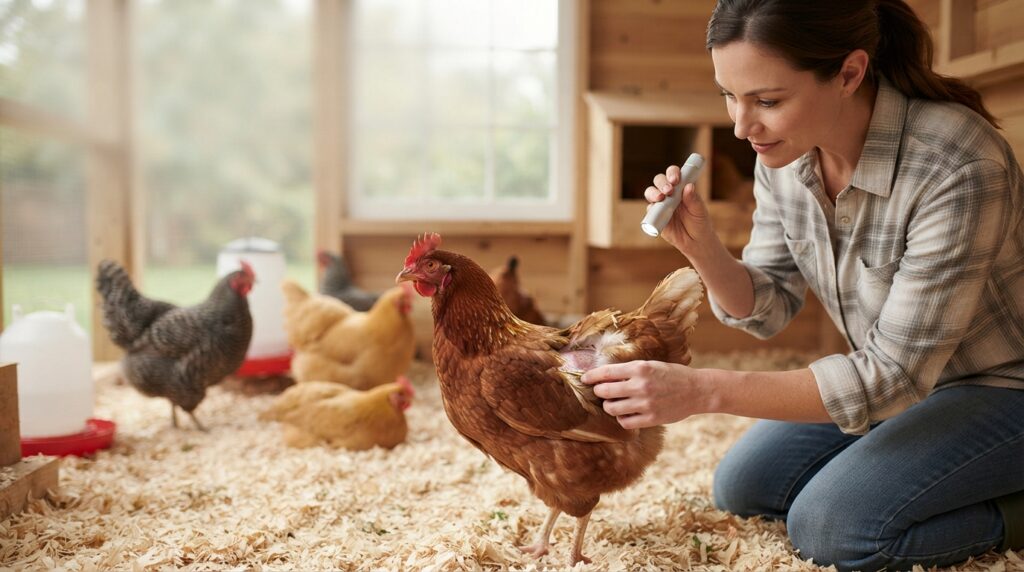
Introduction
You notice your chicken scratching more than usual.
Then you look closely and discover tiny insects moving through the feathers.
Chicken lice can be unsettling to find, especially for a first-time poultry keeper. But the important thing to understand is that finding lice is not the same as having a mysterious or untreatable disease.
Lice are external parasites that live primarily on the bird. They can irritate the skin, damage feathers, and cause chickens to spend more time scratching and preening.
The bigger challenge is often what happens afterward.
You treat one chicken, see improvement, and then a few weeks later the problem seems to return.
Why?
Because controlling lice is not simply about finding and treating one bird. The entire flock and its management need to be considered.
Here’s how to recognize lice, inspect your chickens properly, and reduce the chance of the problem continuing in a cycle. 🪶
🪳 What Are Chicken Lice?
Chicken lice are small, wingless insects adapted to living on birds.
Unlike blood-feeding mites, poultry lice generally feed on materials such as feather debris and skin scales.
They spend much of their life cycle on the host bird.
Common signs of a lice infestation can include:
- Increased scratching
- Excessive preening
- Feather damage
- Irritated skin
- Reduced feather quality
- Restlessness
- Visible insects
- Clusters of eggs attached to feathers
Heavy infestations can contribute to poor condition, particularly in young or already weakened birds.
However, scratching alone does not prove that a chicken has lice.
🔍 Where Should You Look for Lice?
A quick glance at the chicken’s back usually isn’t enough.
Lice can be easier to find when you part the feathers and examine the skin and feather bases closely.
Pay particular attention to:
🐔 Around the Vent
Carefully separate the feathers around the vent.
Look for:
- Moving insects
- Tiny pale eggs attached to feathers
- Excessive debris
- Skin irritation
- Broken or damaged feathers
This is one of the most useful areas to inspect.
🪶 Under the Wings
Lift the wing gently and inspect the skin and feather bases.
Look for insects moving between the feathers and any clusters of eggs attached to feather shafts.
Check both sides.
🐥 Around the Neck
Part the feathers around the neck and examine the bases.
A flashlight can make tiny insects easier to see.
🪶 Around the Tail
Check the base of the tail feathers and surrounding skin.
Don’t simply look at the ends of the feathers.
The important clues are often close to the skin.
🥚 Learn to Recognize Lice Eggs
One of the strongest clues is the presence of eggs attached to feather shafts.
Lice eggs can appear as small pale or whitish structures clustered near the base of feathers.
They may look like tiny grains or specks.
But be careful.
Not every white object on a feather is a lice egg.
Dust, skin flakes, dried material, and other debris can look similar.
The combination of attached egg clusters plus actual moving insects provides stronger evidence than a single pale speck.
🔦 Use Good Lighting
Lice are small.
A dim chicken coop can make an infestation surprisingly difficult to see.
Use:
- Bright natural light
- A flashlight
- A headlamp
- A phone camera for documentation
Part the feathers rather than simply shining the light over the chicken.
The goal is to see the skin and feather bases.
Move slowly.
If you rush, you can easily miss small insects moving through dense feathers.
🐔 Check More Than One Chicken
If you find lice on one bird, don’t stop there.
Chickens live in close contact with each other. They share roosts, dust-bathing areas, feeders, and sleeping spaces.
Inspect the entire flock.
Give extra attention to:
- Young chickens
- Birds with damaged feathers
- Birds that spend a lot of time scratching
- Birds with poor body condition
- Birds that appear unusually restless
Finding lice on several chickens suggests that the problem is not limited to a single bird.
🔄 Why Do Lice Keep Coming Back?
This is where the idea of a reinfestation cycle becomes important.
Female lice lay eggs on the feathers.
Those eggs hatch into immature stages, which develop into adults.
The developing lice remain associated with the host bird.
If an infestation is only partially controlled, surviving lice or newly developing stages can continue the life cycle.
In addition, chickens can acquire lice again through close contact with infested birds.
So when a chicken appears clear and then becomes infested again, it does not necessarily mean that the original treatment “failed.”
Possible explanations include:
- Other chickens were also infested
- Eggs remained on feathers
- Treatment did not affect every life stage
- Birds were exposed again through flock contact
- New birds introduced the parasites
- The treatment was not appropriate for the identified parasite
Understanding the life cycle is essential.
🐣 New Birds Can Introduce Lice
A common pathway for external parasites is the introduction of a new chicken.
A bird may look healthy while carrying lice.
This is why quarantine is an important biosecurity practice when adding birds to an established flock.
During quarantine, observe the new bird and perform a careful external-parasite inspection.
Check:
- Vent area
- Under the wings
- Neck
- Tail
- Feather shafts
- Skin condition
Don’t rely solely on whether the bird looks clean from a distance.
🏠 Do Chicken Lice Live in the Coop?
This is an important distinction between lice and certain mites.
Chicken lice generally spend their life cycle on the bird.
They are therefore different from some poultry mites that can spend substantial amounts of time hiding in the environment.
That doesn’t mean the coop should be ignored.
Clean housing, good management, and inspection of the flock are still important.
But if you are dealing with lice, repeatedly treating every crack in the building without understanding the parasite involved may not address the main source of the problem.
Identify the parasite first.
🧹 Keep the Flock Environment Clean
Good hygiene doesn’t magically eliminate every parasite, but it supports overall flock health and makes problems easier to detect.
Regularly manage:
- Accumulated droppings
- Dirty bedding
- Contaminated feeders
- Dirty drinkers
- Excessive dust and debris
- Overcrowding
Provide chickens with suitable opportunities for normal dust bathing.
Dust bathing is a natural chicken behavior and contributes to feather maintenance.
It should not, however, be treated as a guaranteed cure for an established lice infestation.
🌿 Don’t Assume Dust Bathing Will Solve Everything
You’ll often hear that chickens can simply “dust themselves clean.”
Dust bathing is certainly normal chicken behavior, but a significant lice infestation should not automatically be left untreated on the assumption that the bird will solve it naturally.
Think of dust bathing as normal husbandry, not a guaranteed parasite treatment.
If you have confirmed lice, follow appropriate poultry health guidance and use only products that are specifically labeled for the intended bird and situation.
⚠️ Be Careful With Home Remedies
When people discover lice, they often search for homemade solutions involving oils, powders, household chemicals, or strong-smelling substances.
Be cautious.
Natural does not automatically mean safe for chickens.
A substance can irritate the skin, damage feathers, contaminate eggs or feed, or create respiratory problems.
Avoid applying household pesticides or unapproved chemicals to chickens.
If treatment is necessary, use a product specifically approved or labeled for poultry and follow its directions carefully.
If you are uncertain about what you found, consult a veterinarian or qualified poultry professional before treating.
🧪 Treatment Needs to Match the Parasite
Lice and mites are not interchangeable.
Different external parasites have different biology and may require different management strategies.
This is why identifying the problem matters.
If you find a tiny organism but cannot determine whether it is a louse, mite, or something else, take a clear photograph or obtain professional identification when possible.
Correct identification helps prevent unnecessary or inappropriate pesticide use.
🔁 Think in Terms of the Whole Flock
If lice are confirmed, don’t think:
“Which chicken should I treat?”
Think:
“What is happening throughout this flock?”
Inspect every chicken.
Look for:
- Visible lice
- Egg clusters
- Feather damage
- Skin irritation
- Excessive scratching
- Changes in body condition
This approach makes it much easier to understand whether you are dealing with one affected bird or a flock-level problem.
🗓️ Follow-Up Checks Matter
One inspection isn’t necessarily enough.
After addressing a confirmed infestation according to appropriate veterinary or product guidance, continue observing the flock.
Check the feathers and skin again.
Look for:
- Newly visible lice
- Continuing egg clusters
- Persistent scratching
- New feather damage
- Birds that remain restless
If the problem persists, don’t simply keep repeating the same treatment indefinitely.
Reassess the diagnosis and management approach.
📋 Keep a Simple Parasite Record
A phone note can make recurring problems much easier to understand.
Record:
Date:
Bird:
Location of parasites:
What was observed:
Other affected birds:
Action taken:
Follow-up date:
For example:
September 10 — Hen 3 — vent area — several moving insects and attached egg clusters — two additional birds checked and showed similar findings — follow-up inspection planned.
This kind of record is much more useful than trying to remember what happened several weeks ago.
🚨 When Lice Are More Concerning
Lice can cause irritation, but don’t assume every sick chicken simply has a parasite problem.
Seek veterinary advice when a chicken has:
- Significant weight loss
- Severe weakness
- Very pale comb or wattles
- Extensive skin damage
- Severe feather loss
- Poor growth
- Persistent loss of appetite
- Multiple unexplained health problems
Young, weak, or otherwise compromised chickens deserve particular attention.
If the bird is deteriorating rapidly, don’t delay professional assessment while experimenting with home remedies.
🐔 A Simple Lice-Checking Routine
For beginners, this routine is easy to remember:
1. Pick up the chicken calmly
Support the body and avoid unnecessary stress.
2. Start around the vent
Part the feathers and inspect the skin.
3. Check under the wings
Look for insects and egg clusters.
4. Examine the neck and tail
Pay attention to feather bases.
5. Look for eggs
Check whether pale structures are actually attached to feather shafts.
6. Check for moving insects
Actual movement is an important clue.
7. Inspect the rest of the flock
Don’t assume only one chicken is affected.
8. Check newly introduced birds
Review your quarantine practices.
9. Identify before treating
Don’t assume every external parasite is a louse.
10. Recheck the flock
Follow-up observation helps determine whether the problem has actually been controlled.
💡 How to Break the Reinfestation Cycle
Think about the problem as a chain:
Infested bird → lice reproduce → eggs remain attached → other birds become exposed → infestation continues
Your goal is to interrupt that chain.
That means:
🔎 Find affected birds
🐔 Inspect the whole flock
🪶 Look for eggs as well as adult lice
🧪 Use appropriate, approved treatment when necessary
🐣 Quarantine new birds
🧹 Maintain sensible flock hygiene
📅 Perform follow-up checks
🔍 Reassess if the problem returns
The exact treatment schedule should come from the label of the approved poultry product you are using or from veterinary guidance. Some products may require repeat treatment because their activity does not necessarily eliminate every developmental stage.
Never assume that applying more product or treating more frequently will work better.
Final Thoughts 🌱🐔
Chicken lice are unpleasant to discover, but they become much easier to manage when you understand what you’re looking for.
Start with a careful inspection of the bird, especially around the vent, under the wings, neck, and tail. Look for both moving insects and clusters of eggs attached to feather shafts.
Then step back and consider the whole flock.
If the problem keeps returning, ask why. Another bird may be affected, a new chicken may have introduced the parasites, or the original identification may have been incorrect.
The most useful mindset is simple:
Inspect carefully. Identify accurately. Treat appropriately. Follow up.
That approach is far more effective than repeatedly applying products whenever a chicken starts scratching. 🐔❤️




