Introduction
Diatomaceous earth is one of those products that seems to appear in almost every backyard chicken discussion.
You may hear that it can control mites, lice, insects, and even help keep a chicken coop “naturally” pest-free.
But there is an important distinction between a product having insecticidal properties under certain conditions and being a reliable treatment for a mite infestation in chickens.
Diatomaceous earth, often shortened to DE, is a fine powder made primarily from the fossilized remains of microscopic aquatic organisms called diatoms. Its abrasive and absorbent properties can damage the waxy outer layer of some insects and arthropods, contributing to dehydration.
That sounds promising.
However, using DE around chickens requires realistic expectations.
It does not identify the parasite, guarantee elimination of an infestation, or replace appropriate veterinary treatment when chickens are seriously affected.
Here’s what backyard chicken keepers should know. 🐔🔎
🌿 What Is Diatomaceous Earth?
Diatomaceous earth is a naturally occurring mineral material composed largely of silica from fossilized diatom remains.
It is available in different grades and for different uses.
That distinction is extremely important.
You may encounter products marketed for:
- Agricultural use
- Industrial filtration
- Pest control
- Other applications
These products are not automatically interchangeable.
If you’re considering DE around poultry, read the product label carefully and use only a product appropriate for the intended purpose.
Never assume that because a product is called “food grade” it is automatically approved or appropriate for every use around chickens.
🕷️ How Can DE Affect Insects?
Diatomaceous earth does not work like a conventional chemical insecticide.
Its particles can interact physically with the outer surface of susceptible arthropods.
The powder can:
- Abrade the protective outer layer
- Remove or disrupt waxes
- Increase water loss
- Contribute to dehydration
This mechanism can affect certain insects and other small arthropods.
But there is an important limitation:
The powder generally needs to contact the organism to have a chance of working.
That becomes a major issue when dealing with parasites that hide deep inside structural cracks or spend only part of their life on a chicken.
🕷️ What Does This Mean for Chicken Mites?
It depends on the mite.
This is one of the most important points in the entire discussion.
Not all poultry mites have the same behavior.
Some remain primarily on the chicken.
Others, such as poultry red mites, can spend substantial amounts of time hiding in the environment and emerge to feed on birds.
If mites are hiding inside cracks, joints, or inaccessible areas of the coop, simply sprinkling powder on an exposed surface may not reach them.
That means DE may have a role as a supplementary environmental measure in some situations, but it should not be considered a guaranteed solution for an established mite infestation.
🐔 Can You Put DE Directly on Chickens?
This is where extra caution is necessary.
Fine powders can become airborne.
Chickens have sensitive respiratory systems, and inhaling dusty material is undesirable.
For that reason, deliberately creating clouds of DE around chickens is not a good idea.
Avoid:
- Throwing powder into the air
- Dusting birds aggressively
- Applying large amounts around their faces
- Getting powder into eyes
- Allowing chickens to breathe excessive airborne dust
If a product is labeled for a particular poultry use, follow that label exactly.
If the label does not specifically support the intended use, don’t assume it is safe simply because the product is marketed as “natural.”
Natural does not mean harmless.
😷 Why Respiratory Exposure Matters
Diatomaceous earth is a very fine powder.
Whenever you’re working with dusty materials, inhalation exposure is worth considering.
This applies to people as well as chickens.
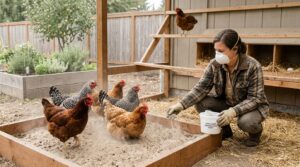
If you’re handling DE:
- Avoid creating dust clouds
- Work in a well-ventilated area
- Avoid breathing the powder
- Consider appropriate respiratory protection when the product label or safety information recommends it
- Keep powder away from eyes and mucous membranes
A parasite-control method that creates unnecessary airborne dust isn’t automatically better just because it is non-synthetic.
🧹 Where DE May Make More Sense
If you’re considering DE at all, the environmental setting is generally more logical to consider than turning the entire chicken into a walking powder cloud.
For example, some chicken keepers use appropriately labeled products in dry environmental areas as part of an integrated pest-management approach.
But there are limitations.
DE works best when it remains dry.
Moisture can reduce its effectiveness as a desiccating material.
That creates a practical problem in:
- Damp coops
- Wet bedding
- Humid conditions
- Areas exposed to rain
- Frequently washed surfaces
If the powder becomes wet or heavily contaminated with organic material, it may no longer behave the way you expect.
💧 Wet Coop Conditions Change the Equation
This is particularly relevant to backyard chicken keepers in humid or rainy climates.
A powder-based control method is difficult to maintain in a constantly damp environment.
Instead of repeatedly adding more powder, address the environmental conditions that contribute to moisture.
Look at:
- Waterer placement
- Roof leaks
- Ventilation
- Bedding management
- Drainage
- Overcrowding
- Wet areas around the coop
A dry, well-managed coop is valuable for many reasons beyond mite control.
🕷️ DE Is Not a Mite Detector
Another common misunderstanding is using DE as though it somehow tells you whether mites are present.
It doesn’t.
If your chicken is scratching, don’t start with:
“How much DE should I use?”
Start with:
“What is causing the scratching?”
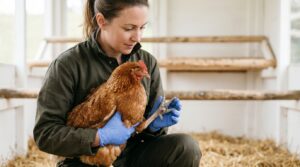
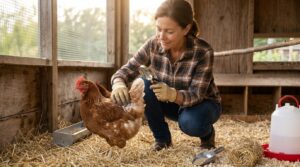
Inspect the bird.
Check the feathers.
Look around the vent and under the wings.
If mites are suspected, inspect the coop, particularly roosts, cracks, joints, and other hiding places.
Identification should come before treatment whenever possible.
🔎 Not Every Tiny Bug Is a Mite
This matters because different parasites require different approaches.
A tiny insect found on a chicken could be:
- A louse
- A mite
- Another arthropod
- Environmental debris
And a chicken that scratches could have another problem entirely.
If you repeatedly see an unidentified organism, photograph it or obtain professional identification when possible.
Using DE against an incorrectly identified pest can waste time while the actual problem continues.
🧪 DE Is Not a Replacement for Approved Treatment
Suppose you confirm a significant mite infestation.
Should you simply cover the coop in DE?
Not necessarily.
An established infestation may require a targeted control strategy appropriate for the specific parasite.
Depending on the parasite and local regulations, this may involve an approved poultry product, environmental treatment, management changes, or veterinary guidance.
The correct approach depends on the situation.
DE should not be treated as a universal substitute for an approved treatment.
🐔 What About Poultry Red Mites?
Poultry red mites, commonly associated with Dermanyssus gallinae, are a good example of why parasite behavior matters.
These mites can spend much of their time hiding away from the chicken and emerge to feed.
They may hide around:
- Roost joints
- Cracks
- Nest boxes
- Structural gaps
- Other protected areas
That means simply treating the visible chicken may not solve the underlying problem.
And sprinkling DE over an exposed surface does not guarantee that hidden mites will come into contact with enough material to be affected.
This is why environmental inspection is so important when poultry red mites are suspected.
🧹 Clean First, Then Think About Control
Good coop management can help reduce parasite pressure and make inspections easier.
Regularly address:
- Excessive manure buildup
- Dirty bedding
- Cracks and hidden debris
- Poor ventilation
- Moisture problems
- Overcrowding
However, cleaning is not a magic cure either.
Some mites can hide in structural cracks that are difficult to reach.
Think of cleaning as one part of integrated parasite management, not a guaranteed standalone treatment.
⚠️ What DE Cannot Do
Let’s make the limitations very clear.
Diatomaceous earth cannot:
❌ Diagnose mites
❌ Tell you which parasite you have
❌ Guarantee elimination of an infestation
❌ Reach every hidden parasite
❌ Replace veterinary diagnosis for a seriously ill chicken
❌ Make a wet coop dry
❌ Prevent all future infestations
❌ Safely justify coating chickens in airborne dust
❌ Replace an approved treatment when one is needed
Understanding these limitations is more useful than treating DE as a miracle product.
✅ What DE May Be Able to Do
Under appropriate conditions and with a product intended for the relevant use, DE may:
✔️ Provide physical insecticidal action against susceptible arthropods when they contact the dry material
✔️ Serve as one possible component of an integrated pest-management strategy
✔️ Be useful in certain dry environmental applications when the product label supports that use
But the key words are:
appropriate product + appropriate location + dry conditions + realistic expectations.
🐔 A Better Beginner Strategy for Suspected Mites
Instead of starting with DE, follow this sequence.
Step 1: Observe
What exactly is happening?
Is the chicken scratching, losing feathers, becoming restless, or losing weight?
Step 2: Inspect the bird
Check the vent, wings, neck, tail, and feather bases.
Step 3: Inspect the coop
Look at roosts, cracks, joints, nest boxes, and other hiding places.
Nighttime inspection can be particularly useful when certain environmental mites are suspected.
Step 4: Identify the parasite
Try to determine whether you’re dealing with lice, mites, or another problem.
Step 5: Assess severity
One or two visible parasites is different from a flock-wide infestation accompanied by weakness or anemia.
Step 6: Choose appropriate control
Use an approved product or veterinary guidance appropriate for the specific parasite and poultry situation.
Step 7: Follow up
Inspect the birds and housing again.
If the problem persists, reassess rather than endlessly adding more powder.
🌱 The “Natural” Label Isn’t the Whole Story
Modern chicken keepers often prefer lower-chemical or natural approaches.
That’s completely understandable.
But natural versus chemical is not the only question that matters.
The more useful questions are:
- Does it work against the specific parasite?
- Does the parasite have contact with it?
- Is the product appropriate for poultry?
- Is the application method safe?
- Does it create respiratory exposure?
- Will moisture reduce effectiveness?
- Does it address the entire parasite life cycle?
- Is a stronger or more targeted intervention necessary?
These questions lead to better flock decisions than simply choosing the product with the most natural-sounding label.
📝 Quick DE Decision Checklist
Before using diatomaceous earth around your flock, ask:
☐ Have I actually identified the suspected parasite?
☐ Is my DE product intended for the use I’m considering?
☐ Does the product label support use around poultry?
☐ Is the area dry?
☐ Can I avoid creating airborne dust?
☐ Am I protecting the chickens’ eyes and respiratory system?
☐ Am I addressing the underlying mite problem rather than simply covering symptoms?
☐ Do I need veterinary help?
If you cannot answer these questions confidently, pause before applying the product.
Final Thoughts 🐔🌿
Diatomaceous earth can sound like the perfect backyard solution because it is widely marketed as natural and versatile.
But chicken keeping works better when we replace “natural equals safe and effective” with a more practical question:
“Is this the right tool for this specific problem?”
DE has physical insecticidal properties against susceptible arthropods when contact occurs, particularly under dry conditions. However, it cannot identify a mite infestation, guarantee control, or reliably reach parasites hiding deep inside a coop.
If your chickens are scratching, start with inspection.
If you suspect mites, investigate both the flock and the coop.
If you confirm an infestation, choose a control method appropriate for the parasite, the birds, and the product’s approved use.
And if a chicken is weak, pale, losing weight, or rapidly deteriorating, don’t rely on DE or any other home remedy as a substitute for professional veterinary assessment.
The best backyard poultry care isn’t about finding one miracle product.
It’s about identifying the problem, understanding the parasite, and using the simplest effective approach that is appropriate for your flock. 🐔❤️