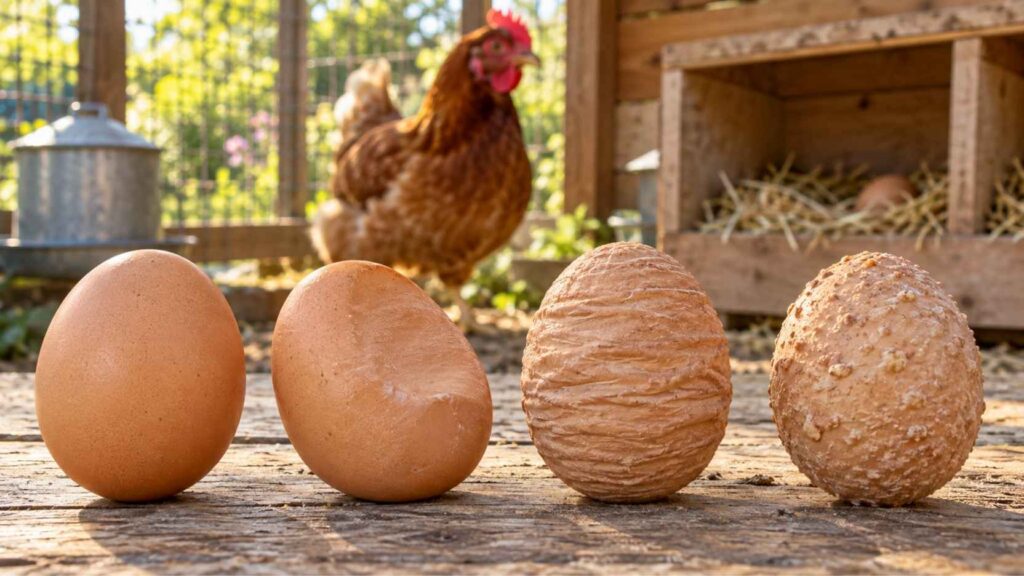
Finding an egg flat on one side can be surprising because it may look as though somebody pressed a thumb into the shell before it hardened. 🥚 The egg may be flattened, slightly dented, squeezed-looking, or noticeably asymmetrical while the rest of the shell appears relatively normal. This unusual shape is commonly called a slab-sided egg, and it usually reflects something that happened while eggs were moving through the hen’s reproductive tract.
The most important thing for a backyard chicken keeper to remember is that one strange egg is an observation, while a repeated pattern is a diagnostic clue. A single misshapen chicken egg does not automatically prove that your hen lacks calcium, has a disease, or needs supplements added to her feed. Instead, examine the egg, watch the hen, and compare the next several eggs before deciding whether there is actually an ongoing problem. 🔎
What Does A Slab-Sided Egg Look Like?
A typical chicken egg has a smooth, continuously curved outline, but a slab-sided egg has one distinctly flattened area along its shell. The flat section can be small and subtle or large enough that the egg looks as though it rested against another hard object while still soft. Sometimes the flattened area is accompanied by wrinkles, ridges, or a slightly thinner-looking section of shell.
This defect should not be confused with every other oddly shaped egg because several shell abnormalities can look similar at first glance. A corrugated egg generally has waves or wrinkles across its surface, while a rough egg has raised bumps, gritty areas, or irregular mineral deposits rather than one obvious flat side. 🐔 Looking at the overall shape instead of focusing on a single bump makes identifying a true slab-sided egg much easier.
Quick Egg Shape Comparison
| Egg Appearance | What You Usually Notice |
|---|---|
| Normal Shape 🥚 | Smooth oval outline with gently curved sides |
| Slab-Sided 📏 | One noticeably flattened or compressed-looking side |
| Corrugated 🌊 | Wrinkles, waves, grooves, or ridges across the shell |
| Rough Shell 🔸 | Raised bumps, gritty patches, or uneven mineral deposits |
Why Two Eggs Can “Bump Into Each Other” During Shell Formation
To understand a slab-sided egg, picture the hen’s reproductive system as an assembly line rather than an egg-storage container. After ovulation, the developing egg travels through sections of the oviduct where the egg white, membranes, and eventually the hard shell are added. The shell-forming section is commonly called the shell gland or uterus, and the egg normally spends many hours there while calcium carbonate is deposited around it.
Occasionally, another developing egg arrives in the shell-gland region before the previous egg has completely finished and moved out. The two eggs can contact or press against one another, and the egg whose shell is still less completely mineralized can become flattened where they touch. 🥚➡️🥚 The hen eventually lays the affected egg with that compressed area permanently preserved in the hardened shell.
Why Timing Matters More Than The Shape Suggests
The egg is not normally molded into a perfect shape by a rigid chamber, so disturbances in reproductive timing can produce surprisingly dramatic-looking results. If ovulation occurs sooner than expected or movement through the reproductive tract is temporarily disrupted, developing eggs can end up closer together than usual. The finished egg may therefore look badly deformed even though the underlying event was relatively brief.
This helps explain why a chicken can lay a bizarre misshapen egg one day and return to completely normal eggs afterward. Young pullets beginning to lay can experience irregular reproductive rhythms while their systems establish a more consistent cycle, and older hens may also produce more variable eggs. 🐣 A strange shape becomes much more informative when it happens repeatedly rather than when it appears once.
Is A Slab-Sided Egg A Calcium Deficiency?
A flat-sided egg by itself is not good evidence of calcium deficiency. Calcium is extremely important for eggshell formation, but slab-sided eggs are primarily associated with the physical timing and contact of developing eggs in the shell-gland region rather than simply an inability to build shell. Adding extra calcium every time an unusual egg appears can therefore target the wrong problem.
Instead, evaluate the hen’s overall feeding program before changing anything. Laying hens should receive a nutritionally complete ration appropriate for their stage of life, with a suitable calcium source available according to your flock-management system. 🥣 If you are seeing repeated thin shells, soft shells, shell-less eggs, or widespread shell-quality changes, nutrition becomes a much bigger part of the investigation than it is after one isolated slab-sided egg.
Check For Recent Stress Or Lighting Changes
Stress can disrupt normal laying patterns, so think about what happened around the flock during the days surrounding the unusual egg. Extreme heat, predator activity, handling, relocation, flock changes, competition, water interruptions, sudden disturbances, or changes around the coop may influence laying behavior and reproductive timing. 🌡️ None of these factors proves what caused one particular egg, but they provide useful context if abnormal eggs begin appearing repeatedly.
Lighting deserves attention because a hen’s reproductive activity is strongly influenced by day length. Natural seasonal changes are expected, but abrupt alterations to supplemental lighting can interfere with the normal rhythm keepers are trying to maintain. 💡 If you use artificial lighting, consistency is generally more useful than repeatedly changing the schedule in response to individual unusual eggs.
What To Observe Over The Next 3–5 Eggs
After finding one slab-sided egg, your most useful tool may simply be a small notebook or phone photo album. Record the date, photograph the abnormal egg beside a normal egg, identify the hen if possible, and examine her next three to five eggs for similar flattening, weakness, wrinkles, roughness, or other changes. 📸 This gives you evidence of a pattern rather than forcing you to diagnose an entire flock from one shell.
Also observe the chicken herself rather than concentrating exclusively on the egg. Check whether she remains active, eats and drinks normally, moves comfortably, visits the nest normally, and behaves similarly to the other birds. A healthy-looking hen that produces one strange egg followed by normal eggs presents a very different situation from a hen repeatedly producing abnormal eggs while also becoming inactive or showing other changes.
One Weird Egg Vs Several Weird Eggs
One weird egg is usually a reason to watch, not panic. Chicken reproduction involves a complicated sequence of ovulation, albumen formation, membrane formation, shell mineralization, pigmentation, and laying, so an occasional imperfect result is possible even under good management. 🐓 The shell may look dramatic because it provides a visible record of a temporary disruption that happened hours before the egg appeared in the nest.
Several abnormal eggs deserve a more systematic investigation, especially when the same defect repeatedly comes from the same hen. If multiple hens suddenly begin producing misshapen chicken eggs, the problem also becomes more important because a flock-wide pattern points beyond one individual’s temporary reproductive timing. At that stage, review nutrition, water availability, environmental stress, heat, lighting, flock health, and any recent management changes.
When Repeated Misshapen Eggs Deserve More Investigation
Repeated slab-sided eggs do not identify one specific disease or management failure on their own. Some reproductive diseases and infections can affect egg production and shell appearance, but abnormal shell shape overlaps with many much less serious causes, making the egg unsuitable as a stand-alone diagnostic test. ⚠️ Avoid diagnosing your hen from photographs of eggs alone when the pattern continues.
Pay particular attention when unusual eggs occur alongside a substantial drop in production, loss of appetite, weakness, abnormal breathing, diarrhea, swelling, obvious reproductive difficulty, or other signs that birds are unwell. Multiple affected chickens also raise the importance of professional investigation compared with a single otherwise healthy hen producing one unusual egg. A poultry veterinarian or appropriate animal-health professional can evaluate repeated or flock-wide abnormalities when management checks do not reveal an obvious explanation.
Quick Diagnostic Card: Observe → Record → Compare → Escalate
OBSERVE 👀 — Examine the flat area, shell strength, texture, cracks, and overall shape while also checking how the hen is behaving. Do not decide immediately that calcium, disease, or another single factor must be responsible. Start with what you can actually see rather than what you fear might be happening.
RECORD 📝 — Photograph the egg, note the date, and identify the hen if practical without creating unnecessary stress. Keep track of her next several eggs instead of throwing every strange shell away and forgetting what it looked like. A simple record can reveal whether you have one unusual event or a genuine recurring pattern.
COMPARE 🔍 — Compare the next three to five eggs with the abnormal one and compare the suspected hen with the rest of the flock. Look for changes in shell shape, strength, production, eating, drinking, activity, and laying behavior. Patterns across several eggs provide much more useful information than one unusual shell.
ESCALATE 🩺 — Investigate further when abnormalities repeatedly occur, several chickens become affected, egg production changes substantially, or abnormal eggs appear alongside signs of illness. Review feed, water, temperature, stress, lighting, and flock management before randomly changing supplements. Seek professional poultry-health guidance when repeated egg abnormalities occur with concerning changes in the birds themselves.
The Best Rule For Strange Chicken Eggs
A slab-sided egg is essentially a record of something unusual happening during shell formation, often because two developing eggs came into contact in the shell-gland region. That explanation is far more specific than assuming every strange-looking shell means the hen needs extra calcium. 🥚 Understanding the mechanism helps chicken keepers respond thoughtfully instead of making unnecessary feeding or management changes after every imperfect egg.
So when you discover an egg that is flat on one side, remember the Daily Care rule: one strange egg is an observation; repetition creates the clue. Watch the bird, document what you found, compare the next several eggs, and increase your investigation only when a pattern develops or additional concerning signs appear. ✅ Sometimes the most useful response to a remarkably strange chicken egg is not immediately fixing something—it is paying close enough attention to discover whether anything actually needs fixing.