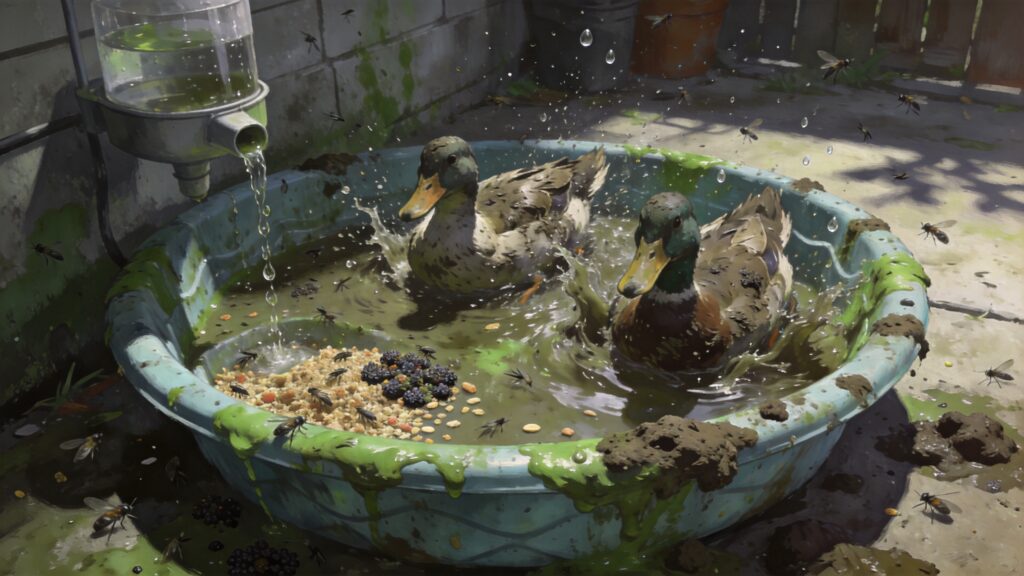
You love the idea of fresh eggs, quirky personalities, and the gentle quack in your backyard. But before you order that adorable duckling online, let me share the unfiltered reality: urban duck keeping is a mud-soaked, manure-laden, nose-wrinkling commitment that makes chickens look like low-maintenance pets. After spending hours on Reddit’s r/BackYardChickens and r/duckkeeping, I’ve collected the messy truth from actual city dwellers who learned the hard way. Here’s what you need to know.
Why Ducks Are Messier Than Chickens
If you’ve kept chickens, you might think you’re ready for ducks. You’re not. Ducks operate on a completely different level of chaos. Let’s break down the three main culprits: water, food, and poop.
Water: The Mud-Making Machine
Chickens drink from a nipple waterer and barely spill a drop. Ducks? They treat every water source like a personal swimming pool. They dunk their entire heads, shake off, and splash water everywhere. Within minutes, a clean water dish becomes a slimy, algae-filled swamp. The wet ground turns into mud — thick, stinking, fly-attracting mud. If you don’t manage water constantly, your yard becomes a bog.
One duck owner on BackYardChickens.com described it this way:
“I thought ‘duck pond’ was a cute idea. I built a small kiddie pool. Within 48 hours my entire patio was covered in green slime, and the smell was something I can’t un-smell. My neighbors called the health department.”
Food: The Slop Factor
Ducks have a different feeding style than chickens. They scoop up food with their bills, then immediately dip it into water to soften it. This turns their feed into a wet, gooey paste that sticks to everything. Chickens peck and swallow; ducks mix. Leftover wet feed spoils quickly, attracting flies, rats, and mold. You’ll be scrubbing feed dishes twice a day — and the area around their feeder will become a fermenting mush pile.
Poop: The Volume and Consistency Problem
Let’s talk numbers. A duck produces three times more manure per day than a chicken of similar size — and it’s about 85% water compared to chicken’s 70%. That means runny, splattery droppings that don’t form nice dry pellets. Ducks poop constantly, and they don’t care where they stand. Their feces smears over grass, concrete, and coops. In winter, it freezes into slippery ice patches; in summer, it liquefies into a putrid slime.
Here’s a quick comparison table that explains the stark difference:
| Factor | Chickens | Ducks |
|---|---|---|
| Daily manure per bird | ~0.3 lb | ~0.9–1.2 lb |
| Manure water content | ~70% | ~85% |
| Water spillage | Minimal | Extreme |
| Feed mess | Dry crumbs | Wet paste |
| Odor level (on a 1–10 scale) | 3–4 | 8–9 |
| Fly attraction | Moderate | Extreme |
Real Stories of Duck Owners Struggling with Cleanliness
Forums are full of cautionary tales from urban duck keepers who started with rose-colored glasses and ended up wearing rubber boots. Here are three firsthand accounts that illustrate just how challenging cleanliness can be.
The “Neighborhood Nuisance” Story
A user on Reddit’s r/homestead shared how her two Pekin ducks turned her city backyard into a public health hazard:
“I live in a dense suburb — houses on 1/4 acre lots. My ducks are in a 6×8 pen. I clean the water twice a day, but the splashing still soaks the ground. After two weeks, the smell was so bad that my next-door neighbor, who has asthma, couldn’t open her windows. Animal Control showed up. I had to rehome them. I cried, but she was right.”
The “I Spent $2,000 on a Coop and Still Lost” Story
Another duck keeper, posting on DuckDuckGooseForum.com, described upgrading from a plastic kiddie pool to an expensive automated water system:
“I bought a $400 automatic nipple waterer designed for ducks (supposedly leak-proof). Within a week, the lines clogged with slime, the nipples leaked, and the ground underneath became anaerobic mud. I tried a sand floor, then wood shavings, then straw. Every 48 hours I was knee-deep in waste. My wife said, ‘It’s either the ducks or me.’ I sold the ducks on Craigslist.”
The “I Thought I Could Handle It” Story
On a popular urban farming blog’s comment section, a woman detailed her experience with three Runner ducks in a city lot:
“I considered myself a dedicated homesteader. I changed water four times a day, scooped poop twice a day, used deep litter method, and still — the flies. Thousands of them. My house smelled like a farm. When I invited friends over for a barbecue, no one ate the burgers I grilled near the duck pen. That was my breaking point.”
These stories reveal a common thread: even diligent duck keepers struggle in urban spaces where neighbors are close, regulations are strict, and small yards can’t absorb the mess.
Solutions If You’re Determined to Keep Ducks in the City
Despite the challenges, many urban duck owners make it work. It requires a level of commitment that goes far beyond chicken keeping. If you’re absolutely determined, here are actionable strategies that experienced owners swear by.
1. Manage Water Like a Fanatic
Your number one enemy is standing water. Use a nipple waterer with a drain pan — but expect to clean the nipples weekly. Better yet, install a poultry waterer with a small moat that drains into a bucket. Some owners use a 5-gallon bucket with float valve and a mesh grate over the catch basin to keep ducks from swimming in it. Empty and scrub waterers daily. For their swimming needs, provide a separate kiddie pool that you refill and dump every day — yes, every single day. Don’t let water sit for more than 12 hours.
2. Master the Art of Deep Litter — With a Twist
For the coop and run, use a deep litter system with pine shavings, but add sweet PDZ (zeolite) or stall dry to absorb ammonia. You’ll need to turn the bedding daily and remove wet spots immediately. Many successful urban duck keepers use a sand base in the run with a tarp roof to keep rain out. Rake the sand like a cat litter box. Plan to do a full clean-out every 2 weeks instead of every month.
3. Manage Poop with Daily Scraping
Set a schedule: morning and evening poop scooping. Use a flat shovel and a bucket. If you have 3 ducks, you’ll collect about 3 pounds of wet manure per day. That’s 21 pounds a week. Have a composting system in place — but be aware that duck poop is wet and requires carbon-rich amendments (straw, leaves, wood chips) to compost properly. Some cities restrict composting of livestock manure; check local laws.
4. Control Odor and Flies
Odor mainly comes from wet feces and ammonia. Solutions include:
- Diatomaceous earth (food grade) sprinkled on bedding to kill fly larvae.
- Vinegar and water spray on surfaces to neutralize smell.
- Ventilation — ducted fans or open windows to keep air moving.
- Fly traps a minimum of 3–4 per coop.
One experienced owner suggests a surprising trick: add a small amount of apple cider vinegar to the ducks’ drinking water (1 tbsp per gallon). It reportedly reduces the ammonia smell in their droppings, though scientific evidence is mixed.
5. Rethink Your Space
If your yard is smaller than 200 square feet per duck, reconsider. Ducks need space to roam and also space for the mess to spread out. Many city codes require 10+ square feet per duck inside the coop and 20+ in the run. But even those minimums don’t account for mud. A dry run with concrete or pavers covered with deep bedding is far easier to clean than grass. Some owners use rubber mats or stall mats that can be hosed off into a drainage pit.
6. The Hardest Solution: Limit Your Flock
Don’t get more than two or three ducks in a typical city lot (1/8 to 1/4 acre). Every additional duck multiplies the mess exponentially. Also, avoid heavy breeds like Pekins and Muscovies — they produce more waste. Runner ducks and Call ducks are smaller and produce less manure, but they still require the same diligence.
For a quick reference, here’s a checklist summary of daily and weekly tasks that urban duck owners must commit to:
- Daily: Change water twice, skim pool, scoop poop morning and evening, spot-clean wet bedding, spray fly repellent.
- Weekly: Deep clean water system with bleach solution, replace all bedding, wash food dishes, rotate grazing areas (if any grass remains).
- Monthly: Hose down run with vinegar solution, check for mold in coop corners, reapply diatomaceous earth.
Conclusion
Urban duck keeping is not a hobby — it’s a mud-wrestling match with nature. The messy truth is that ducks produce triple the manure of chickens, turn every water source into a swamp, and create odors that can end friendships with neighbors. If you’re unwilling to scrub waterers twice daily and scoop poop like a tractor, stick to chickens. But if you have the grit, the space, and a strong stomach, the joy of fresh duck eggs and their comedic waddles might just be worth the stench. Just don’t say I didn’t warn you.