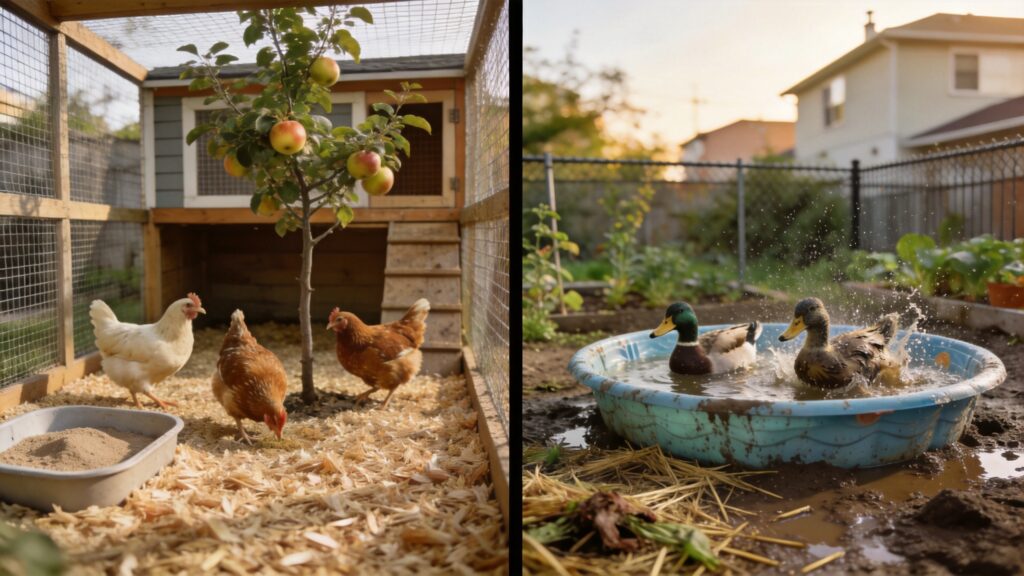
When your backyard spans just 4,000 to 5,000 square feet, every square inch counts. You want fresh eggs, a touch of rural charm, and maybe a conversation starter for dinner parties. But should you bring in ducks or chickens? Both have die‑hard fans, but their personalities, husbandry demands, and impacts on a small urban lot are dramatically different. This guide will walk you through the critical trade‑offs—noise, space, smell, egg output, and neighbor diplomacy—so you can make a confident, guilt‑free choice.
Noise Levels and the Art of Neighbor Diplomacy
In a tight urban setting, the loudest bird can be the one that gets your landlord called. Chickens have a reputation for crowing, but only roosters truly shatter the peace. A flock of hens clucks softly, peeping at less than 60 decibels—about the volume of a normal conversation. Most neighbors won’t even notice them three houses away.
Ducks, on the other hand, are vocal year‑round. Their classic quack is surprisingly loud (75–90 decibels) and carries farther than a hen’s chatter. Female ducks quack frequently to communicate with each other, and males (drakes) have a softer, raspy call. Still, the noise of a small flock can easily draw complaints, especially early morning or late evening. Pro tip: Choose a “quiet” duck breed like the Cayuga (known for being less vocal) or the Khaki Campbell, and keep only females.
“I’ve kept both in a 4,200‑sq‑ft lot near downtown Austin. My chickens never drew a complaint, but my two ducks—both females—got a formal warning from the HOA after three weeks. Ducks are chatty, and their calls echo off fences.” – Sarah M., urban poultry keeper
If your city ordinances prohibit roosters (as most do), chickens automatically become the quieter option. Ducks, even without a drake, can still trigger noise ordinances. Recommendation: Survey your neighbors honestly before committing to ducks. Offer them a dozen eggs in exchange for tolerance.
Space Requirements and Messiness on a 4,000–5,000 Sq Ft Lot
A typical urban yard of 4,000–5,000 square feet can comfortably house 3–4 chickens or 2–3 ducks—but the footprint feels very different.
Chickens: Low‑Profile Neatness
Chickens are dry‑land birds. They need a coop (about 2–3 sq ft per bird inside, plus 8–10 sq ft in a run per bird) and a dust bath area. With three hens, you’ll need roughly 40–50 sq ft of dedicated space. Their droppings are dryer and cake into the bedding, making cleanup manageable once a week. They do scratch and kick out bedding, but in a small yard it’s contained.
Ducks: Wet, Muddy, and Spacious
Ducks are aquatic fowl. They must have a water source deep enough to submerge their heads (a kiddie pool works) and will immediately turn it into a soupy mire. A single duck can splash 5 gallons of water a day, creating mud that attracts flies and smells. Even on a 4,500‑sq‑ft lot, you’ll need to zone off a dedicated wet area—otherwise, your entire backyard becomes a bog.
- Coop size: Similar to chickens (2–3 sq ft per duck inside), but the run must be larger because ducks forage widely. Plan on 20–30 sq ft of outdoor space per duck.
- Cleanliness: Ducks produce more liquid manure, which is slippery and high‑odor unless managed daily with straw or sand. You’ll need to replace wet bedding every 2–3 days in the splash zone.
- Vegetation: Ducks will trample delicate plants, so consider fencing off garden beds.
| Factor | Chickens (3 hens) | Ducks (2 ducks) |
|---|---|---|
| Minimum coop interior | 6–9 sq ft | 4–6 sq ft |
| Minimum outdoor run | 24–30 sq ft | 40–60 sq ft |
| Water feature needed | No (drinker only) | Yes (kiddie pool or pond) |
| Mud creation | Low | High |
| Weekly bedding change | Once a week | 3–4 times a week (wet areas) |
Practical advice for small‑yard duck keepers: Use a deep‑litter method with pine shavings in the run and a gravel drainage base under the pool. Install a French drain if your soil is clay. This reduces odor and fly breeding significantly.
Egg Production and Feed Conversion Efficiency
Both species lay delicious eggs, but the numbers and nutritional profiles differ markedly.
Hen Eggs: Reliable and Frequent
A good laying chicken (like a Rhode Island Red or Leghorn) produces 250–300 eggs per year when day‑light is supplemented. They start laying at 18–20 weeks and continue for 2–3 years at peak. Feed conversion ratio (pounds of feed per dozen eggs) averages 4–5 lb per dozen for small flocks.
Duck Eggs: Bigger, Richer, but Fewer
Duck eggs are 30–50% larger than chicken eggs, with a higher fat and protein content—perfect for baking or custards. A Khaki Campbell or Indian Runner can lay 280–340 eggs per year, surpassing many chickens. However, duck eggs are seasonal; production drops in winter without artificial light. Feed conversion is similar (4–5.5 lb per dozen), but because each duck egg holds more volume, you get more edible weight per pound of feed.
- Taste: Duck eggs are richer and “eggy” – some say they taste like free‑range chicken eggs but with a stronger yolk.
- Allergies: Some people allergic to chicken eggs can tolerate duck eggs due to different protein structures.
- Storage: Duck eggs have a thicker shell and keep fresh in the fridge for up to 6 weeks.
“I switched from 4 chickens to 3 ducks last year. My feed costs stayed the same, but I now get about 1.5 dozen duck eggs per week versus 2 dozen smaller chicken eggs. The real win? I use duck eggs for my sourdough baking—the texture is unbeatable.” – Mark T., urban farmer in Seattle
Feed Efficiency Comparison
Consider the edible yield per bird. A duck egg weighs about 70 g vs. a chicken egg at 50 g. If you feed 100 lb of feed per bird per year:
- Chicken: 250 eggs × 50 g = 12,500 g total (about 27.6 lb of egg mass)
- Duck: 300 eggs × 70 g = 21,000 g total (about 46.3 lb of egg mass)
Ducks convert feed to egg mass ~40% more efficiently. This is a huge advantage if you want maximum food from limited feed storage space.
Odor, Varmints, and the “Wet Factor”
Smell is a prime concern in a 4,000‑sq‑ft yard where your deck is 20 feet from the coop.
Chickens
Dry droppings, well‑bedded with pine shavings, produce minimal odor. Clean the coop twice a week and it’s almost neutral. Chickens attract fewer flies than ducks because their manure isn’t as liquid.
Ducks
Wet manure ferments quickly. Without daily spot‑cleaning of the pool area, a small duck yard can smell like a swamp in 90°F summer. Key mitigation: Use a “duck tractor” or movable pen that shifts to fresh grass every 2 days. Also, adding diatomaceous earth to bedding helps dry drops and reduce ammonia.
Varmints: Both attract raccoons, opossums, and rats. Ducks are more vulnerable because they sleep on the ground (some breeds) and their water source attracts nocturnal visitors. A robust, fully enclosed run with ½‑inch hardware cloth buried 12 inches underground is essential for both.
Legal and Lifestyle Realities
Many U.S. cities allow 3–6 chickens but prohibit ducks outright or limit them to 2. Check your municipal code before buying. Even if ducks are allowed, neighbor consent forms can save you a citation.
Ducks are messier, louder, and require more daily time for water management. Chickens are easier for beginners and families with kids. Ducks, however, are friendlier, more curious, and excellent at pest control (they devour slugs and mosquitoes).
Practical Decision Framework
Here’s a simple checklist to decide:
- Choose chickens if…
- • You have close neighbors with thin walls
• Your yard gets minimal direct sun (less mud)
• You want the simplest daily routine
• You prefer traditional egg size for breakfast - Choose ducks if…
- • You have a drainage solution (gravel pit or slope)
• You bake often or want extra‑large eggs
• You can commit to 20‑minute daily water changes
• Your HOA/city is duck‑friendly (or you have a tolerant neighbor)
Conclusion
In a small urban yard of 4,000–5,000 sq ft, chickens are the safer, lower‑maintenance choice for most people. They keep a cleaner profile, produce reliably, and rarely trigger neighbor complaints. Ducks can be a fantastic alternative if you have the space, time, and willingness to manage water—and you value richer, larger eggs over convenience. Listen to your yard, talk to your neighbors, and choose the flock that fits your daily reality. Both will reward you with eggs and joy; the difference is in the mess you’re willing to embrace.