Why Chickens Are the Ultimate Homestead Workhorses
“I used to spend hours battling ticks and dragging kitchen scraps to the curb. Then I got six chickens, and my yard transformed. They don’t just give me eggs—they clean up pests, process waste, and improve my soil better than any machine I’ve owned.” — Sarah T., Virginia homesteader
When most Americans think of backyard chickens, they picture fresh eggs and a quaint farmyard aesthetic. But for serious homesteaders, chickens are far more than egg machines. They are living, breathing pest-control agents, waste processors, and soil builders that can dramatically reduce your workload while increasing the productivity of your land. This article dives deep into the practical, money-saving roles chickens play as homestead workhorses, from reducing tick populations to turning kitchen scraps into rich compost—and how they stack up against ducks when it comes to maintenance.
Natural Pest Control: The Tick Terminators
Lyme disease and other tick-borne illnesses are a growing concern across the United States, especially in the Northeast and upper Midwest. While chemical sprays and permethrin-treated clothing offer partial solutions, chickens provide a sustainable, 24/7 biological control.
How Chickens Hunt Ticks
Chickens are natural foragers. A single free-range hen can consume hundreds of ticks per day. Research from the University of California found that chickens will actively seek out ticks in leaf litter, tall grass, and brush piles—the very habitats where blacklegged ticks (the vectors for Lyme) thrive. Unlike wild birds that may only pass through, chickens patrol the same area daily, creating a sustained pressure on tick populations.
Practical case: A homesteader in upstate New York reported a 90% reduction in tick encounters after letting a flock of 12 Rhode Island Reds roam their 3-acre property during the spring and summer. The key was allowing the chickens access to the “transition zones” where grass meets woods—the classic tick corridor.
Actionable Tips for Tick Control
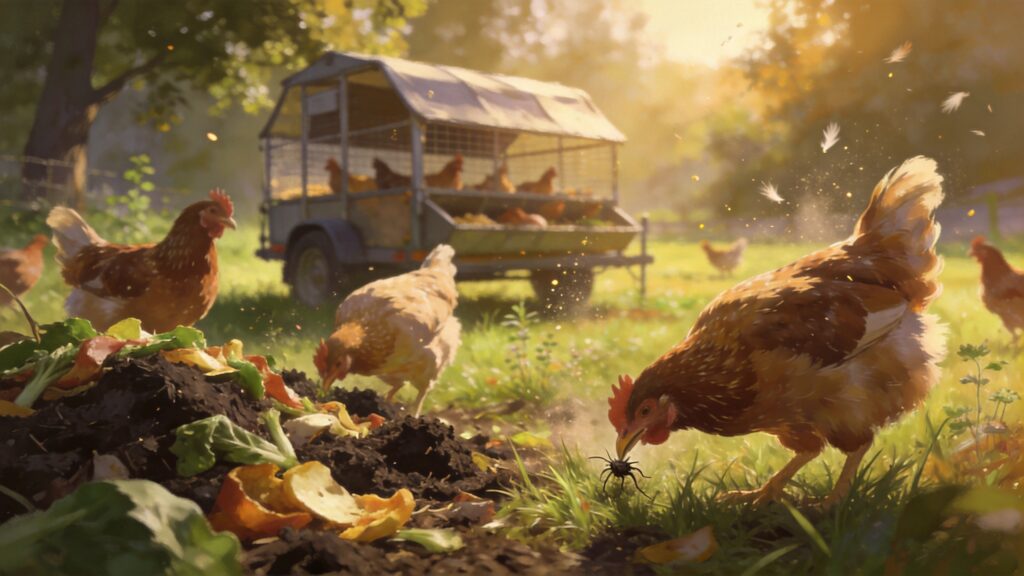
- Rotate grazing areas with a chicken tractor (a mobile coop) to prevent over-concentration of manure and ensure all ground gets foraged.
- Encourage deep litter in run areas: a 6–12 inch layer of wood chips, leaves, and straw provides perfect micro-habitat for chickens to scratch and find ticks hiding underneath.
- Time your release: Ticks are most active in morning and evening humidity. Let chickens out early and at dusk for maximum hunting efficiency.
- Avoid using chemical tick treatments on your property if you free-range chickens—pesticides can harm the birds or accumulate in eggs.
Beyond ticks, chickens devour flies, grasshoppers, beetles, mosquito larvae (if they have damp ground), and even small slugs. This reduces the need for chemical pest control in gardens and around livestock pens.
Kitchen Scrap Processors: From Waste to Eggs
The average American household throws away nearly a quarter of the food they buy. Chickens turn that waste stream into a valuable resource: protein-rich eggs and nutrient-dense manure.
What to Feed and What to Avoid
Chickens will eagerly consume vegetable peels, fruit cores, stale bread, cooked rice, leftover oatmeal, eggshells (crushed), and even small amounts of meat scraps. However, there are important rules:
- DO feed: apple peels, carrot tops, lettuce, cucumber ends, squash seeds, corn cobs, melon rinds, and overripe berries.
- DO NOT feed: avocado pits and skins (persin toxicity), raw potato peels (solanine), dried beans (lectins), chocolate, or salty foods. Also avoid moldy or rotten scraps that could introduce mycotoxins.
Pro tip: Keep a dedicated kitchen scrap bucket with a lid near your prep area. Dump scraps into the chicken run once or twice a day. The birds will scratch through the material, consuming edible portions while breaking down the rest. This not only diverts waste from landfills—a single flock of 6 hens can process 5–10 pounds of kitchen scraps per week—but also reduces the attraction of rodents and flies that would otherwise gather in an open compost pile.
The “Chicken Composter” Method
Many homesteaders use a chicken-powered compost system: a deep litter bed (wood shavings + straw) in the coop or run that absorbs manure and food waste. The birds constantly scratch and turn the material, aerating it naturally. After 6–12 months, you can remove the decomposed matter as finished compost. This system requires zero turning by you, and the chickens’ droppings add high nitrogen (their manure is 2–3% N by dry weight, far richer than cow manure).
Composting Champions: Turning Scraps into Black Gold
Chickens don’t just tolerate living on a compost pile—they accelerate the process dramatically. Their constant scratching mixes carbon and nitrogen layers, their manure inoculates the pile with microorganisms, and their consumption of weed seeds stops many weeds from sprouting later.
How to Integrate Chickens into Your Composting System
The deep litter method (mentioned above) is the simplest starting point, but you can also build a dedicated “compost corral” near the garden. Here’s a typical setup:
- Construct a 6×8 foot pen with low fencing (2–3 feet tall) and a roof or shade cloth.
- Add alternating layers: a 12-inch base of wood chips (carbon), then 6 inches of kitchen scraps and green garden waste (nitrogen), then another 6 inches of dry leaves or straw.
- Release 3–4 chickens into the pen. They will scratch, peck, and turn the pile daily.
- Every 2–3 weeks, add a new layer of carbon material (shavings, dried grass) and fresh greens. The chickens will incorporate it.
- After 2–3 months, remove the chickens and let the pile cure (undisturbed) for another month. The resulting compost is rich, dark, and ready for garden beds.
Real-world example: Mark and Jenna from Oregon use this method to process all their household fruit/vegetable waste plus stall bedding from their goats. They report that their chickens reduce composting time from 6 months to 8 weeks, and they save on commercial soil amendments worth about $200 per year.
Pasture Management: Fertilizers and Weed Control
If you have a pasture, lawn, or orchard, chickens can be your living soil amendment team. Unlike cows or sheep that selectively graze, chickens spread their manure uniformly as they roam, and they target the very plants that compete with grasses—especially broadleaf weeds and grasshoppers.
Chicken Tractors: Targeted Foraging
A chicken tractor is a lightweight, mobile coop that you move across pasture every day or two. The birds scratch, eat weed seedlings and insect pests, and deposit their droppings directly onto the soil. After the tract is moved, the grass grows back thicker and greener, thanks to the natural fertilizer. This mimics the natural pattern of wild fowl flocks that move continuously, never overloading one spot.
| Aspect | Chicken Pasture Team | Commercial Fertilizer |
|---|---|---|
| Cost | Essentially free after initial coop investment | Variable; $20–50 per acre per application |
| Weed control | Active removal of seeds and seedlings | None (may require herbicide) |
| Soil biology | Adds microbes and organic matter | Often lacks beneficial biology |
| Labor | Move coop daily (5 minutes) | Spreading time + equipment |
| Environmental impact | Zero carbon footprint; closes nutrient loop | Fossil fuel production and transport |
Actionable pasture plan: For a 1-acre pasture, run 25–30 hens in a mobile coop. Move it every 2 days during the growing season. You’ll see a visible reduction in dandelions, plantain, thistle, and other broadleaf weeds, while grass clumps thicken. The chickens will also break up cow patties (if you have cattle), exposing fly larvae to sunlight and birds, further breaking the pest cycle.
Direct Soil Improvement
Chicken manure is a “hot” fertilizer—it burns plants if applied fresh. But when deposited on pasture during rotation, the rapid drying and microbial breakdown in the turf prevent burn while still releasing nutrients slowly. The result: increased soil organic matter (by 1–2% per year in one case study from Missouri), better water infiltration, and higher mineral content in forage.
Ducks vs. Chickens: A Maintenance Comparison
Many homesteaders consider ducks as an alternative or complement. While ducks are excellent at slug and snail control, and their eggs are richer, they differ significantly from chickens in maintenance demands. Here’s a side-by-side comparison to help you decide which species suits your “workhorse” needs.
| Factor | Chickens | Ducks |
|---|---|---|
| Water requirement | Standard drinker; can go 12 hours without | Need open water to dunk heads daily (mud puddles, kiddie pool); otherwise prone to eye infections |
| Noise | Low to moderate; loud only when alarmed or laying | Moderate to high; females quack loudly, especially morning/evening (neighbors may complain) |
| Pest control specialty | Excellent for ticks, beetles, grasshoppers, weed seeds | Superb for slugs, snails, mosquito larvae; poor for ticks |
| Composting behavior | Active scratchers and deep-litter workers | Less scratching; they trample and compact, which slows aeration |
| Egg production | ~5–6 eggs/week per hen (best layers) | ~6–7 eggs/week per hen (Khaki Campbell, Welsh Harlequin) |
| Manure quality | High nitrogen, drier, easier to handle | Very wet, high ammonia, can burn plants; must be composted carefully |
| Predator vulnerability | Moderate; perch at night, but weak fliers | Higher; can’t fly, slower on land; need more secure housing |
| Space requirement per bird | 4 sq ft coop, 10 sq ft run (min) | 6 sq ft shelter, 15 sq ft run (need water access) |
When to Choose Chickens Over Ducks
If your primary goals are tick and fly control, composting with low water management, and efficient pasture fertilization, chickens win hands down. Ducks require cleaner water, produce wetter manure, and are louder—making them less suitable for suburban or small lots. However, if your biggest pest problem is slugs (common in Pacific Northwest gardens) or you want superior egg production per bird, ducks may be worth the extra effort.
Hybrid approach: Many successful homesteaders keep both, using chickens as the primary “scavenger/composter” and a small duck flock for slug control around gardens and wet areas. Just be aware that ducks and chickens have different dietary needs—ducks need niacin supplements (brewer’s yeast) and cannot tolerate medicated chick starter feed. Keep them in separate coops or runs if possible.
Conclusion
From reducing tick-borne disease risk to transforming kitchen waste into rich compost and fertilizing pastures without machinery, chickens prove themselves as the homestead’s hardest-working livestock. Their low-maintenance profile, combined with the passive benefits they provide to soil and pest management, far outweighs the initial setup effort. For any American homesteader looking to close the loop—feeding the land while the land feeds the flock—chickens remain the ultimate workhorses. Start with a small flock, integrate them into your daily waste and garden routines, and watch your property become healthier with every scratch and peck.