Introduction
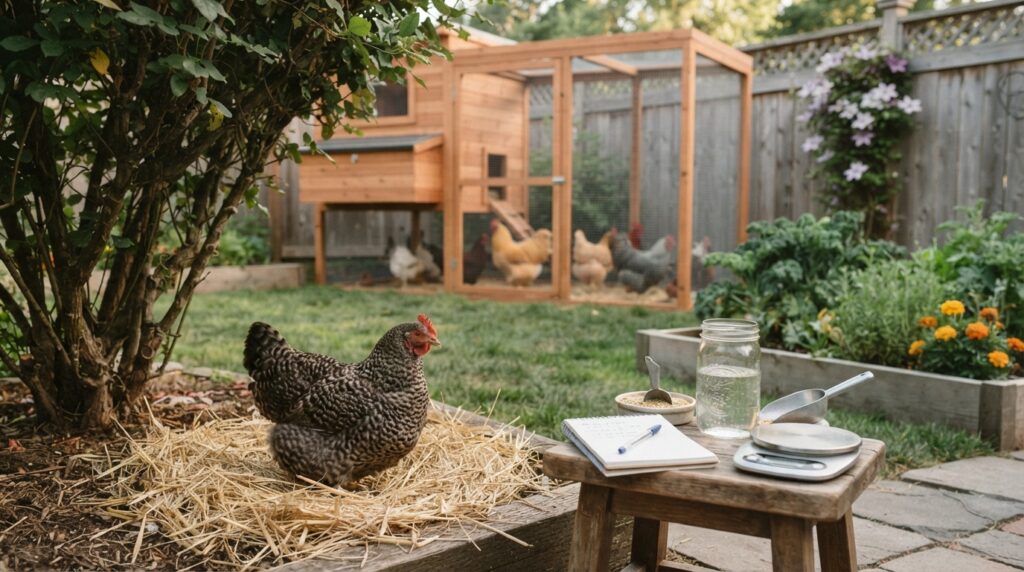
Seeing one chicken sitting alone while the rest of the flock is busy scratching, eating, and exploring can immediately make you wonder:
“Is something wrong?”
Sometimes the answer is no.
Chickens naturally spend periods resting, dust-bathing, nesting, laying eggs, or simply taking a break from the group. A bird sitting by itself for a short time can be completely normal.
But a sudden change in social behavior can also be an early sign of illness, pain, injury, bullying, or environmental stress.
The key isn’t simply whether your chicken is alone.
It’s whether being alone is different from that chicken’s normal behavior and whether other signs are appearing at the same time.
Here’s how to tell the difference. 🔎
🟢 When Sitting Alone Can Be Normal
Before assuming illness, consider what the chicken is actually doing.
A healthy chicken may temporarily separate from the flock to:
- Rest
- Dust-bathe
- Lay an egg
- Explore another part of the yard
- Avoid excessive flock activity
- Sit in a preferred shaded location
- Nest or brood
If the chicken is alert, eating normally, drinking normally, walking normally, and returning to the flock later, brief solitude is usually less concerning.
The important word is brief.
A chicken that regularly spends a little time alone but otherwise behaves normally is different from a bird that suddenly becomes withdrawn.
🟡 When Isolation Becomes More Concerning
The situation deserves more attention when the behavior represents a clear change.
For example:
Yesterday: Active, eating, scratching, interacting.
Today: Sitting alone, barely moving, not approaching food.
That change matters.
Other warning signs include:
- Staying separated for long periods
- Sitting in one place most of the day
- Reduced appetite
- Reduced drinking
- Ruffled feathers
- Drooping wings
- Unusual posture
- Weight loss
- Abnormal droppings
- Difficulty walking
- Changes in breathing
- Avoiding normal flock activity
Veterinary guidance emphasizes that changes in behavior, posture, appetite, and activity can be important indicators of illness in backyard poultry.
1. Check Whether the Chicken Is Eating 🥣
One of the first things to investigate is food intake.
Watch the chicken quietly.
Does it:
- Walk toward the feeder?
- Peck at food?
- Eat a normal amount?
- Ignore food completely?
- Try to eat but appear unable to?
A chicken that sits alone but continues eating normally is less concerning than one that isolates itself and refuses food.
If possible, provide a separate feeding area temporarily so you can determine whether the bird is actually eating without competition.
Don’t assume that food refusal is simply “picky behavior.”
Loss of appetite can accompany many different health problems.
2. Check Water Intake 💧
Water is just as important.
Make sure the chicken can easily access clean drinking water.
Look for:
- Empty drinkers
- Dirty water
- Spilled water
- Frozen water in cold conditions
- Competition around the drinker
- A drinker that is difficult for a weak bird to reach
If the chicken is isolated for monitoring, observing its water intake becomes easier.
A chicken that is sitting alone and refusing both food and water deserves much closer attention than a chicken that is simply taking a quiet break.
3. Look at Its Posture
Posture can provide useful clues.
Observe the chicken without immediately handling it.
Does it:
- Stand normally?
- Sit comfortably?
- Keep its head up?
- Keep its wings in a normal position?
- Stand when approached?
- Remain hunched or unusually still?
A bird that remains fluffed up and inactive for prolonged periods can be showing a sign of illness rather than simply relaxing.
However, posture alone does not identify the cause.
Think of it as another piece of information.
4. Check for Injuries 🩹
A chicken may isolate itself because it hurts.
Look for obvious problems involving:
- Feet
- Legs
- Wings
- Skin
- Comb
- Face
- Vent area
Check whether the bird is walking normally.
Watch for:
- Limping
- Favoring one leg
- Difficulty standing
- Swelling
- Bleeding
- Visible wounds
- Repeated pecking from other chickens
Flock members can sometimes target a bird that appears weak or injured.
If the chicken is being bullied, temporary separation may protect it while you determine what is wrong.
5. Watch How It Breathes 🫁
Breathing changes can be especially important.
Observe the chicken from a distance.
Look for:
- Open-mouth breathing
- Obvious effort while breathing
- Abnormal respiratory sounds
- Repeated sneezing or coughing
- Stretching the neck while breathing
A chicken showing significant breathing difficulty should not simply be monitored for several days.
Minimize unnecessary handling and seek veterinary advice promptly.
6. Check the Droppings 💩
If a chicken is sitting alone, inspect its droppings when possible.
Look for persistent changes in:
- Consistency
- Color
- Amount
- Frequency
- Presence of blood
One unusual dropping isn’t enough to diagnose a disease.
But isolation combined with repeated abnormal droppings is more concerning.
Take a photograph if useful and keep a record of what you observe.
This can be helpful if veterinary assessment becomes necessary.
7. Consider the Weather ☀️🌧️
Environmental conditions can change chicken behavior.
During hot weather, chickens may:
- Seek shade
- Reduce activity
- Spread their wings
- Pant
- Drink more
A chicken sitting alone in a cool shaded area may simply be trying to escape the heat.
But severe heat stress is different.
Make sure chickens have access to shade, clean water, and appropriate ventilation.
Similarly, during cold or wet weather, a chicken may seek a sheltered area.
Always consider environmental conditions before interpreting behavior.
8. Check Whether the Flock Is Bullying the Chicken
Sometimes the chicken isn’t choosing solitude.
The flock may be pushing it away.
Watch what happens when the bird approaches:
- Does another chicken chase it?
- Does it get pecked away from food?
- Does it avoid the feeder?
- Does it hide when other chickens approach?
- Is it being repeatedly attacked?
A weaker chicken can become vulnerable to bullying.
If necessary, create a safe temporary separation where the bird can eat, drink, rest, and recover without being attacked.
9. Look for Weight Loss ⚖️
Weight is one of the easiest objective measurements you can track.
A chicken can look approximately the same while gradually losing weight.
If you have a suitable scale and can safely weigh the bird, record the measurement.
For example:
| Date | Weight | Appetite | Activity |
|---|---|---|---|
| Day 1 | 1.85 kg | Normal | Active |
| Day 3 | 1.78 kg | Reduced | Low |
| Day 5 | 1.70 kg | Poor | Very low |
The numbers above are only an example of how to record a trend.
Your actual chicken’s measurements will be different.
Repeated weight loss combined with social withdrawal is a reason to contact a veterinarian.
10. Ask Whether Anything Recently Changed 🏡
Think about the previous few days.
Has anything changed?
For example:
- A new chicken joined the flock
- The coop was moved
- A predator appeared
- The weather changed dramatically
- The chicken was injured
- Feed was changed
- The flock was relocated
- There was unusual noise or activity
- Another chicken became aggressive
A sudden environmental change can affect behavior.
But don’t automatically blame stress if the chicken is also showing physical symptoms.
Stress and illness can look similar at first.
11. Watch the Rest of the Flock 👀
This question is extremely important:
Is one chicken sitting alone, or are several chickens acting differently?
If only one bird is withdrawn, an individual problem is possible.
If several chickens become:
- Lethargic
- Less interested in food
- Less active
- Respiratory
- Diarrheic
- Socially withdrawn
the problem may affect the flock as a whole.
Multiple sick birds require greater concern because some poultry diseases can spread between birds.
USDA APHIS lists changes such as decreased activity or appetite, respiratory signs, diarrhea, neurological abnormalities, and increased deaths among signs that can indicate serious poultry disease.
12. Don’t Force a Lonely Chicken Back Into the Flock 🚫
If a chicken is sitting alone, don’t assume the solution is simply to put it back with everyone else.
If the bird is sick or injured, flock members may harass it.
If it is contagious, returning it immediately could expose healthy birds.
Instead, first determine:
Is the chicken healthy but resting?
or
Is the chicken separating because it is weak or unwell?
If illness is suspected, a clean, quiet isolation area can make observation easier and protect the bird from bullying.
13. Know the Red Flags 🚨
Sitting alone becomes much more concerning when it occurs with serious symptoms.
Seek veterinary help promptly if the chicken:
- Cannot stand
- Is severely weak
- Has difficulty breathing
- Is bleeding significantly
- Has seizures or severe neurological abnormalities
- Refuses both food and water
- Is rapidly losing weight
- Has severe diarrhea
- Is rapidly deteriorating
Multiple sudden deaths or several birds becoming sick at the same time are also important flock-health warning signs.
These situations are not appropriate for “wait and see” indefinitely.
14. Use a Simple Observation Log 📝
You don’t need a complicated poultry-health system.
Record:
Chicken: Daisy
Date:
Eating: Normal / Reduced / None observed
Drinking: Normal / Reduced / None observed
Activity: Normal / Reduced / Very low
Posture: Normal / Unusual
Droppings: Normal / Changed
Breathing: Normal / Abnormal
Weight:
Injuries:
Other observations:
Repeat the observations regularly.
This helps you recognize whether the chicken is improving, staying stable, or getting worse.
It also gives a veterinarian more useful information than simply saying:
“My chicken has been sitting alone.”
🚦 A Simple Isolation Decision Guide
| What you observe | What it may mean | Practical next step |
|---|---|---|
| Briefly sits alone but eats and behaves normally | May be normal resting behavior | Continue normal observation |
| Sits alone more often than usual | Possible stress, bullying, pain, or illness | Monitor closely |
| Isolation + reduced appetite | More concerning | Check food, water, injuries, and other symptoms |
| Isolation + weight loss | Concerning health change | Keep records and seek veterinary advice |
| Isolation + abnormal breathing | Potential emergency | Seek prompt veterinary attention |
| Isolation + inability to stand | Serious problem | Urgent veterinary attention |
| Several birds become withdrawn | Possible flock-wide problem | Seek veterinary/poultry-health guidance |
Remember that these categories are a practical monitoring framework, not a diagnosis.
Final Thoughts ❤️
A chicken sitting alone isn’t automatically sick.
Sometimes it is simply resting, seeking shade, laying an egg, or finding a quieter place away from the flock.
The concern begins when solitude is a new behavior or comes with other changes.
Pay attention to appetite, drinking, posture, movement, breathing, droppings, weight, injuries, and the behavior of the rest of the flock.
The most useful question isn’t:
“Why is my chicken sitting alone?”
It’s:
“What else has changed?”
That question can help you distinguish an ordinary quiet moment from a potentially important health warning.
When a chicken is severely weak, struggling to breathe, unable to stand, bleeding heavily, refusing food and water, or rapidly deteriorating, don’t rely on observation alone. Seek veterinary help promptly.
Good flock care starts with noticing the small changes. 🐔🌱