Introduction
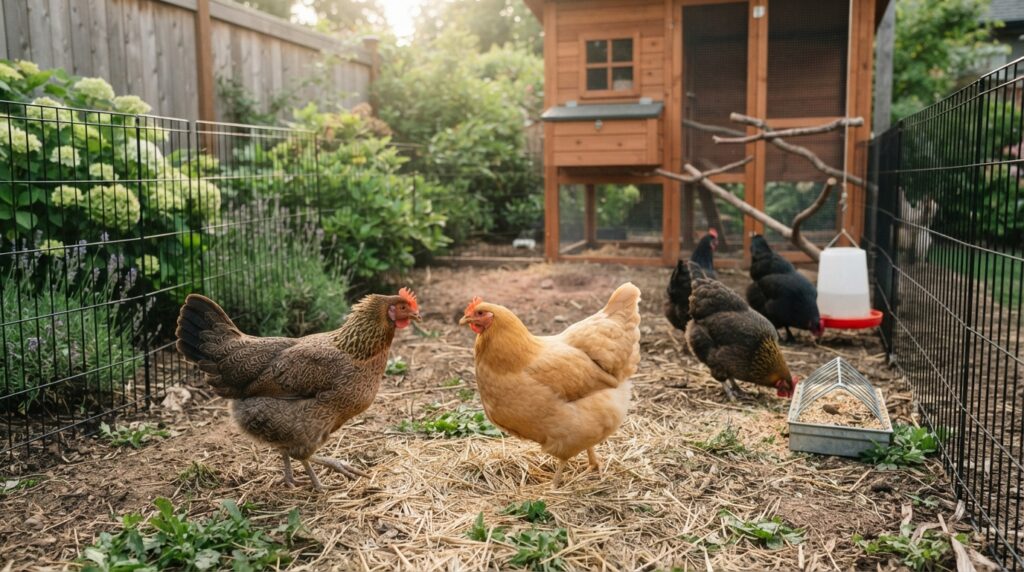
You walk into the backyard expecting to collect eggs, refill the feeders, and enjoy watching your chickens roam. Instead, you notice one hen chasing another, pecking at her feathers, or repeatedly targeting the same bird.
Is this normal chicken behavior, or is something wrong?
Chickens naturally peck as they explore their surroundings, establish social relationships, and investigate food. A little chasing and occasional pecking can happen in a healthy flock. However, persistent aggression, feather pulling, injuries, and repeated attacks should not be ignored.
The challenge is identifying why the chickens are fighting. Overcrowding, competition for food, stress, changes in flock membership, parasites, and unsuitable environmental conditions can all contribute to pecking.
The good news is that many common causes can be addressed by improving the flock’s environment and management. Here’s how to recognize the problem, identify possible triggers, and reduce conflict before it becomes a serious injury.
1. Understand the Difference Between Normal Pecking and Aggression
Not every peck means your chickens are fighting.
Chickens use their beaks to investigate objects, establish social boundaries, and interact with other flock members. When a new bird joins the group, some chasing and pecking may occur as the social order adjusts.
The important question is whether the behavior is brief and occasional or persistent and harmful.
| Behavior | What it may mean |
|---|---|
| Occasional light pecking | Normal exploration or social interaction |
| Brief chasing | Establishing or maintaining social order |
| Pecking near the feeder | Competition for food |
| Pulling out feathers | Possible aggression, stress, or feather-pecking behavior |
| Repeatedly targeting one bird | Bullying or an underlying problem |
| Pecking an injured or bleeding bird | Serious risk of escalating injury |
| Persistent attacks that prevent eating or drinking | Harmful aggression requiring intervention |
Watch the targeted chicken, not just the aggressor. A bird that hides, avoids the feeder, loses feathers, or becomes increasingly withdrawn may be experiencing more than ordinary flock behavior.
2. Overcrowding and Limited Space
One of the most common environmental contributors to conflict is insufficient space.
When chickens cannot move away from one another, competition and frustration can increase. Birds may struggle to access feeders, waterers, perches, nest boxes, and preferred resting areas.
Overcrowding can also make it difficult for lower-ranking birds to escape persistent attention from dominant flock members.
What you can do
- Evaluate the usable space inside the coop and outdoor run.
- Make sure birds can move around without constantly squeezing past one another.
- Provide enough feeder and waterer access points.
- Add perches and environmental features that allow chickens to spread out.
- Give the flock safe opportunities to forage and explore.
There is no single space requirement that works for every flock. Breed size, climate, time spent confined, ventilation, run design, and flock dynamics all matter.
If your chickens spend most of the day in a small enclosure, simply adding more birds may make the problem worse.
3. Competition for Food and Water
Sometimes what looks like bullying is actually competition over limited resources.
A dominant hen may guard a feeder, chase away another chicken, or repeatedly peck birds approaching her preferred feeding area.
This becomes particularly concerning when smaller or lower-ranking chickens cannot eat or drink enough.
Signs to watch for
- Chickens chasing one another away from feeders.
- One bird standing guard near the food.
- Smaller birds waiting until others finish eating.
- Repeated pecking around waterers.
- Unequal body condition within the flock.
How to reduce competition
Provide multiple feeding and watering locations, ideally arranged so one dominant bird cannot control all of them from a single position.
Spread resources around the enclosure rather than placing everything in one crowded corner.
Check that every chicken can comfortably reach the feeders and waterers. Monitor individual birds to make sure they are actually eating and drinking.
4. Introducing New Chickens Too Quickly
Adding new chickens can disturb an established flock’s social order.
Existing birds may chase, threaten, or peck newcomers while adjusting to their presence. However, placing unfamiliar chickens directly into the same coop without preparation can increase the risk of severe bullying and injury.
A safer introduction approach
Step 1: Quarantine newcomers. Keep new birds separate from the existing flock for an appropriate period, using separate equipment and following sound biosecurity practices. A commonly recommended starting point is 30 days, although veterinary advice and local disease risks may require adjustments.
Step 2: Allow visual contact. After quarantine, use a secure barrier that lets chickens see one another without physical contact.
Step 3: Provide supervised interaction. Introduce them gradually in a spacious area with multiple escape routes and access to food and water.
Step 4: Monitor closely. Some brief chasing may occur, but repeated attacks, injuries, or blocked access to resources require intervention.
Step 5: Check the flock afterward. Look for wounds, missing feathers, and birds that are being excluded from food or water.
Never assume that chickens will automatically settle their differences without help.
5. Stress, Boredom, and Lack of Enrichment
Chickens are active animals. They naturally spend much of their day scratching, searching for food, dust bathing, and exploring.
When their environment offers little opportunity for these behaviors, abnormal feather pecking may become more likely.
Boredom is not the only possible cause, but a bare, crowded, or unstimulating enclosure can contribute to behavioral problems.
Simple ways to improve enrichment
- Provide safe areas for scratching and foraging.
- Offer appropriate dust-bathing areas with suitable dry material.
- Add perches at safe, accessible heights.
- Scatter a portion of their normal feed in clean, appropriate foraging areas.
- Use chicken-safe hanging vegetables occasionally.
- Rotate enrichment items to maintain interest.
Avoid overcrowding the enclosure with decorations or objects that create sharp edges, trapped spaces, or hazards.
Enrichment should encourage natural behavior without introducing unsafe materials or inappropriate foods.
6. Changes in the Flock’s Pecking Order
Chickens have social hierarchies, often called the pecking order.
A flock may have dominant and subordinate birds. This can influence which chicken gets access to preferred perches, food, water, and nesting areas.
Changes in the flock can temporarily disrupt this structure.
Common triggers include:
- Introducing new birds.
- Removing a dominant chicken.
- Returning a bird after illness or isolation.
- Changes in the flock’s age or maturity.
- Changes in housing or access to resources.
Some social adjustment is expected, but repeated attacks should not be dismissed as simply part of the pecking order.
A lower-ranking chicken should still be able to eat, drink, rest, and move around safely.
7. Feather Pecking, Nutrition, and Other Health Problems
Feather pecking can have several contributing factors, including environmental stress, social competition, poor feather condition, and nutritional problems.
A nutritionally unbalanced diet may contribute to poor feather condition and behavioral problems. However, it is not accurate to assume that every pecking problem is caused by a protein deficiency.
Review the flock’s diet
- Use a complete feed appropriate for the chickens’ age and production stage.
- Avoid allowing treats and scratch grains to replace too much of their balanced feed.
- Provide clean drinking water at all times.
- Check that feed is fresh, dry, and stored safely.
- Ask a poultry veterinarian about possible nutritional deficiencies if feather loss or poor condition persists.
For laying hens, a complete layer ration is generally appropriate when they have reached the correct laying stage. Growing birds need feed formulated for their age rather than automatically receiving adult layer feed.
Check for parasites
External parasites such as mites and lice can irritate chickens and damage feather condition.
Inspect the skin, feathers, and areas around the vent. Look for irritation, visible parasites, damaged feathers, and other unusual signs.
If parasites are suspected, identify the problem and use an appropriate treatment according to veterinary or product-label guidance. Avoid assuming that every case of feather loss is caused by parasites.
8. What to Do When One Chicken Is Being Bullied
If one bird is being repeatedly attacked, take action before the injuries become severe.
1. Separate an injured or targeted chicken when necessary.
Move the bird to a clean, safe, quiet recovery area where it can access food and water. Keep it protected from further pecking while you assess its condition.
2. Treat wounds appropriately.
Check for bleeding, punctures, swelling, and damaged skin. Serious wounds, deep injuries, or signs of infection need prompt veterinary attention.
3. Remove visible triggers.
Check for overcrowding, resource competition, recent flock changes, parasites, and environmental stress.
4. Monitor the entire flock.
Identify which birds are involved and when the attacks happen. A chicken may be aggressive around food but behave normally elsewhere.
5. Reintroduce carefully if appropriate.
Once the injured bird has recovered and is safe to return, use a gradual reintroduction process. Do not return a bird with an open or bleeding wound to a flock where it may be pecked.
Important: Chickens can be attracted to blood and exposed wounds. A bleeding bird should be protected from the flock immediately.
9. When Is Pecking a Serious Emergency?
Some situations require more than routine flock management.
Seek veterinary help promptly if you notice:
- Deep or actively bleeding wounds.
- Injuries around the eyes or head.
- Severe swelling or suspected infection.
- A chicken that cannot stand or walk normally.
- Extreme weakness or difficulty breathing.
- A bird that refuses food or water.
- Rapid weight loss or marked changes in behavior.
- Multiple birds suddenly becoming ill.
Do not assume that an isolated chicken is simply being bullied. Illness or pain can make a bird behave differently and may attract pecking from flock mates.
A veterinary assessment can help distinguish behavioral problems from underlying health conditions.
10. A Simple Daily Routine to Prevent Flock Conflict
Prevention is easier when you make flock observation part of your normal routine.
| When | What to check |
|---|---|
| Morning | Observe feeding behavior and make sure every bird gets access to food and water. |
| Midday | Look for chasing, feather pulling, and birds hiding from the flock. |
| Evening | Check for injuries, unusual behavior, and safe access to roosting areas. |
| Weekly | Inspect the coop, run, feeders, waterers, and dust-bathing areas. |
Keep a simple record of recurring incidents. Note which chicken is involved, where the pecking happens, and whether anything recently changed.
This can help you identify patterns instead of treating every incident as an isolated event.
❤️ Final Thoughts
Chickens peck for different reasons. Sometimes it is normal social behavior, but persistent aggression can signal overcrowding, competition, stress, poor environmental conditions, nutritional problems, parasites, or illness.
The most effective response is to identify the underlying cause rather than simply punishing the aggressive bird or assuming the flock will resolve everything naturally.
Provide enough space, reduce competition, offer enrichment, introduce new chickens gradually, and protect injured birds immediately.
Most importantly, observe your flock regularly. A chicken that repeatedly hides, loses feathers, or cannot access food and water needs attention.
A healthy backyard flock is not one where chickens never disagree. It is one where every bird can eat, drink, rest, and live without being constantly attacked. 🐓