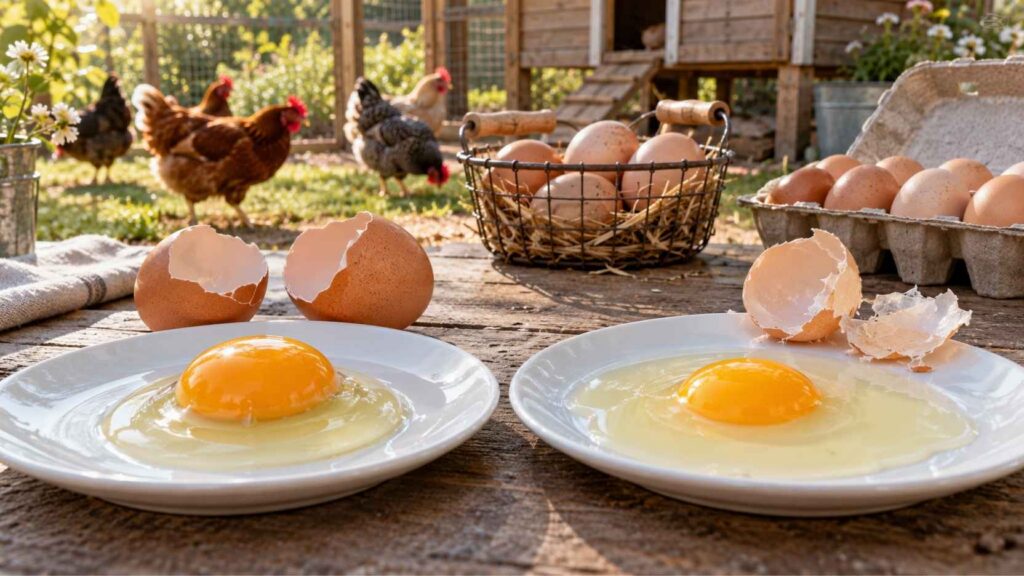
Crack a backyard egg into a skillet and you normally expect the white to have some body, with thicker albumen sitting close to the yolk instead of immediately flooding across the pan. 🍳 When one hen’s egg white spreads out almost like water, especially beside an egg with a thin or fragile shell, it is easy to assume both problems point to one nutritional deficiency. The important first step is separating shell quality from internal egg quality, because they are related to different parts of egg formation and do not automatically share the same cause.
That distinction matters for anyone searching for answers about watery chicken egg white, thin watery egg whites from backyard chickens, or watery egg whites and thin shells. A thin shell can involve nutrition, hen age, heat stress, shell-gland function, or disease, while thin albumen is strongly influenced by freshness and storage conditions and can also vary between hens. 🐔 Instead of immediately adding supplements or changing feed, use the egg itself as a clue and investigate the simplest possibilities first.
Shell Quality And Internal Egg Quality Are Different Problems
An egg is assembled in stages as it moves through the hen’s reproductive tract, which helps explain why the shell and white should not be treated as a single quality measurement. Much of the albumen is deposited earlier in the oviduct, while the shell is formed later in the shell gland and is composed primarily of calcium carbonate. 🥚 Therefore, a defect in shell formation does not automatically mean the albumen inside must also be abnormal.
Thin or soft shells deserve their own investigation because calcium, phosphorus, vitamin D3, age, environmental stress, and other factors can influence shell quality. Mississippi State Extension specifically identifies inadequate calcium, phosphorus, or vitamin D3 and hot weather among factors associated with thin shells, while other shell abnormalities can have additional causes. 🦴 That makes shell condition an important clue, but it is not proof that a watery white was produced by the same nutritional problem.
What Thick Versus Watery Albumen Actually Looks Like
When a high-quality fresh egg is cracked onto a flat plate, some of the egg white should remain relatively thick and elevated around the yolk rather than immediately flowing outward. The yolk also tends to sit higher because the dense albumen helps support it, giving the entire egg a more compact appearance. Penn State describes thick rather than watery albumen around an upright yolk as one characteristic of good internal egg quality.
A thinner egg white spreads farther across the plate and may leave the yolk appearing flatter or less supported, which is why owners often describe it as “running everywhere.” 💧 That observation tells you about albumen quality, but by itself it does not identify why the white became thin. Before blaming protein levels, calcium, or a sick hen, ask one basic question: How old was this egg when you cracked it?
Why Egg Age Can Make The White Look Watery
Albumen does not remain chemically and physically unchanged after the egg is laid. As an egg ages, changes inside the egg cause the thick albumen to gradually lose firmness, while moisture loss contributes to an enlarging air cell. 🕐 This is why egg grading systems use albumen firmness and air-cell size as indicators of internal quality and freshness.
That means an egg collected several days or weeks earlier can naturally spread more than an egg cracked shortly after laying, even when both came from a healthy hen. If your cartons contain eggs collected on different dates, comparing them without considering age can create the illusion that one bird suddenly has an egg-quality problem. 📅 Dating cartons or collection batches gives you a simple way to separate normal storage-related thinning from something consistently happening at lay.
Refrigeration Slows The Decline In Internal Egg Quality
Temperature matters because refrigeration slows the processes that reduce egg freshness and albumen firmness. Penn State notes that deterioration of albumen quality occurs over time and that refrigeration slows this change, helping eggs retain freshness and quality longer. ❄️ For home-flock eggs, consistent refrigerated storage also makes comparisons between eggs much more meaningful because temperature becomes less of an uncontrolled variable.
A useful troubleshooting rule is therefore check the collection date and storage conditions before changing the chicken’s diet. An older egg that sat warm for an extended period should not be compared directly with an egg collected that morning and promptly refrigerated. If the supposedly problematic egg becomes much more normal when you crack one freshly laid from the same hen, storage was probably contributing substantially to what you were seeing.
Compare Fresh Eggs From Different Hens
Backyard flocks make troubleshooting easier because individual hens often lay eggs with recognizable differences in color, size, shape, or nesting habits. 🐓 If possible, collect known fresh eggs from several hens on the same day, store them the same way, and crack them onto separate plates within the same general time period. That simple comparison controls for egg age and storage temperature, allowing differences between individual birds to become much easier to spot.
Suppose Hen A’s freshly laid white consistently stands higher while Hen B’s freshly laid white repeatedly spreads very thin, even though both eggs were handled identically. That pattern deserves more attention than comparing Hen B’s fresh egg with an unidentified egg that may have been sitting in the refrigerator for three weeks. 🔍 The goal is not to diagnose a hen from one breakfast but to determine whether you are seeing a repeatable individual pattern.
Track Whether The Same Hen Produces Watery Whites
One unusual egg should usually be treated as a data point rather than an immediate flock emergency. Hens occasionally produce odd eggs, and small variations in shell shape, size, texture, yolk position, or albumen consistency can occur without establishing a persistent problem. 📝 Recording the date, suspected hen, shell condition, white consistency, and any other unusual characteristics gives you far more useful information than reacting to a single egg.
Watch the trend over several freshly collected eggs when you can identify the layer reliably. If one hen repeatedly produces watery egg whites immediately after laying while comparable eggs from the rest of the flock remain firm, the explanation is less likely to be ordinary refrigerator aging alone. Likewise, if eggs from several hens suddenly change at approximately the same time, start looking for a flock-level change such as environment, feed, heat, or health rather than assuming one bird is responsible.
Check Storage Before Changing The Diet
Online discussions sometimes jump quickly from watery albumen to claims about insufficient dietary protein, but appearance alone does not justify that conclusion. A complete layer ration is designed to provide laying hens with balanced nutrients, and adding random supplements can make troubleshooting harder because several variables change at once. 🌾 If your flock is already eating an appropriate complete layer feed, first investigate freshness, storage temperature, hen identity, and the consistency of the pattern.
Thin shells are different because mineral nutrition has a much clearer direct relationship with shell formation, particularly adequate calcium alongside phosphorus and vitamin D3. Even there, however, repeatedly pouring more calcium into the diet is not a complete diagnostic strategy because older hens, heat stress, feed problems, and certain diseases can also affect shells. 🥚 Use feed evaluation as one part of the investigation rather than assuming every abnormal egg means the ration is deficient.
When Watery Whites And Abnormal Shells Appear Together
Although watery albumen and thin shells can occur independently, there are situations in which both can be part of a larger reproductive or flock-health problem. Infectious bronchitis, for example, can affect laying hens and has been associated with reduced production, thin or irregular shells, and thin watery albumen. 🦠 The presence of both abnormalities therefore becomes more meaningful when accompanied by other flock changes rather than when you simply find one watery egg beside one thin-shelled egg.
Look for the broader pattern: a sudden decline in egg production, multiple hens producing abnormal eggs, respiratory signs, unusual mortality, or persistent deterioration in shell and internal quality deserves professional attention. Those signs do not automatically mean infectious bronchitis, because poultry diseases and management problems can produce overlapping symptoms that cannot be reliably diagnosed from eggs alone. If several abnormalities appear together or birds seem unwell, consult a poultry veterinarian, diagnostic laboratory, or qualified Extension professional rather than trying to diagnose the flock from internet photographs.
Hen Problem Or Egg-Storage Problem?
A practical comparison works better than guessing from one cracked egg. 🧐 Start with the factors you can control—collection date, refrigeration, and comparison with same-day eggs—and only move toward hen-specific explanations when a repeatable difference remains. This simple sequence prevents owners from redesigning the flock’s diet because of an egg that was simply older than expected.
| What You Notice | Storage Or Egg-Age Clue | Hen Or Flock Clue |
|---|---|---|
| White spreads widely | Egg is older or storage history is uncertain | Happens repeatedly in freshly laid eggs from the same hen |
| Several old eggs are watery | Strong reason to investigate storage first | Less useful for identifying an individual hen |
| Fresh eggs from one hen are consistently watery | Storage becomes less convincing | Track that hen and look for additional changes |
| Thin shell but normal thick white | Two traits may be unrelated | Investigate shell formation separately |
| Watery white plus repeated abnormal shells | Still verify egg age | Broader hen or flock investigation becomes more important |
| Multiple hens suddenly produce abnormal eggs | Check storage and handling | Also review heat, feed, environment, and flock health |
| Respiratory or behavioral changes accompany egg problems | Storage alone cannot explain the flock signs | Seek qualified poultry-health guidance |
The most useful test is surprisingly simple: crack a genuinely fresh egg from the suspected hen beside a genuinely fresh egg from another hen. 🍳 If both whites are reasonably thick, the original watery egg may have reflected age or storage; if one hen repeatedly produces noticeably thinner albumen under the same conditions, continue tracking her and look at the bigger picture. Either way, you have learned more than you would by immediately adding protein, calcium, or multiple supplements at once.
The Bottom Line
Watery egg whites and thin shells are not automatically connected, even when they happen in eggs from the same backyard flock. Thin shells mainly direct your attention toward shell formation, nutrition, environmental conditions, age, and health, while watery albumen should first make you consider freshness, storage temperature, and whether the pattern occurs consistently in newly laid eggs. 🐔 One abnormal egg is therefore much less informative than several eggs collected, stored, and compared under controlled conditions.
For backyard keepers, the best diagnostic tool is not a complicated laboratory test but a simple record: which hen, what date, how fresh, how stored, what did the shell look like, and how did the white behave? When those observations reveal a repeatable problem alongside other changes in egg production or flock health, professional evaluation becomes more appropriate. Until then, avoid treating a watery white as automatic proof that your chickens need more dietary protein—or assuming that every thin shell and runny white share the same cause.