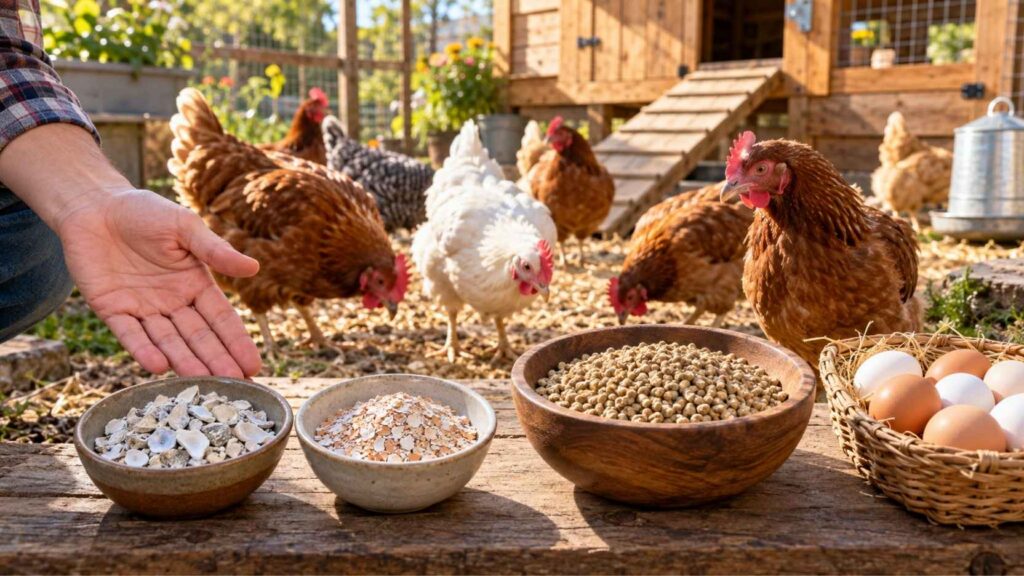
If you keep laying hens, you will eventually hear two pieces of advice: buy oyster shell or save your chickens’ eggshells and feed them back to the flock. 🐔 Both can provide calcium, but asking “oyster shell vs eggshells for chickens—which is better?” misses an important part of the feeding system. The primary nutritional foundation for a laying hen should still be an appropriately formulated complete layer ration, with supplemental calcium filling a supporting role rather than replacing balanced feed.
For most backyard keepers, oyster shell is the simplest and most consistent free-choice supplemental calcium option, while crushed eggshells can be a useful way to recycle something the flock already produces. Eggshells require collection, drying, and crushing, whereas commercially prepared oyster shell can simply be kept in a separate feeder where laying hens can consume it as needed. 🥚 Understanding those differences makes choosing the best calcium for laying hens much easier.
Why Laying Hens Need So Much Calcium
Every egg a hen produces requires minerals to build the hard shell surrounding its contents, with calcium being the major mineral involved in shell formation. That creates a substantially different nutritional demand for an actively laying hen than for a chick or growing pullet that is primarily building its own body. 🥚 This is why poultry feeds are formulated differently for the bird’s age and production stage rather than using one feed from hatch through adulthood.
Layer feeds consequently contain substantially more calcium than starter and grower diets, while also supplying protein, energy, phosphorus, vitamins, and other nutrients in appropriate proportions. Extension feeding recommendations distinguish starter, grower, and layer rations specifically because the nutritional requirements change as the bird matures and begins producing eggs. Calcium therefore matters greatly, but it works as part of an overall nutritional system rather than as an isolated ingredient.
Start With The Layer Feed
A complete layer ration is feed formulated to provide laying hens with the nutrients they need when it makes up the primary diet. It is not simply grain with calcium added, because hens also require appropriate amounts and ratios of amino acids, energy, vitamins, phosphorus, and other minerals. 🌾 Feeding large quantities of scratch grains, table scraps, or other extras can dilute that carefully formulated nutrient balance even if plenty of oyster shell is sitting nearby.
That distinction matters when a keeper sees thin shells and immediately starts pouring additional calcium into the feeder. If the hen’s basic diet is nutritionally unbalanced, adding more shell material does not automatically correct deficiencies elsewhere in the ration. Mississippi State Extension specifically emphasizes complete layer feed as the foundation for good shell formation because calcium, phosphorus, vitamin D and other nutrients interact in the process.
Oyster Shell: The Simple Free-Choice Option
Commercial poultry oyster shell is primarily useful as a supplemental source of calcium for laying hens, and its biggest practical advantage is convenience. You can place it in a small separate container rather than trying to calculate how much additional calcium should be mixed into every scoop of feed. 🐓 Penn State recommends providing laying hens with a calcium source such as oyster shell free-choice in a separate feeder alongside their layer ration.
Keeping oyster shell separate is especially useful because it allows birds that need supplemental calcium to consume it without forcing the same additional amount into every bird. Do not confuse oyster shell with grit: oyster shell supplies calcium, while insoluble grit consists of hard particles chickens use in the gizzard to help grind food. The two products may look somewhat similar in a feed store, but they perform different jobs and should not be treated as interchangeable.
Which Birds Should Have Access To Oyster Shell?
Free-choice oyster shell is intended primarily for actively laying hens, not chicks that are still growing. Chicks and immature pullets have lower calcium requirements than laying birds, which is why starter and grower feeds contain different mineral levels from layer feed. 🐣 Switching young birds prematurely to a high-calcium layer ration simply because adult hens are eating it ignores those stage-specific nutritional needs.
This becomes especially important in a mixed-age flock containing young birds and laying adults. Rather than automatically increasing the calcium concentration of everybody’s feed, keep age-appropriate feeding requirements in mind and make supplemental calcium available appropriately to the laying birds. A separate calcium station is therefore not merely convenient—it can make managing different nutritional needs easier.
Can You Feed Eggshells Back To Chickens?
Yes, clean, thoroughly dried, finely crushed eggshells can be fed back to laying hens as a calcium source, making them an appealing low-waste option for backyard keepers. ♻️ Instead of throwing every breakfast shell away, you can save the shells, allow them to dry thoroughly, and crush them into particles before offering them. The important point is that recycled eggshell is supplemental calcium, not a replacement for nutritionally complete poultry feed.
Penn State advises drying used eggshells and smashing them into very fine particles rather than offering obvious shell pieces that hens could associate with intact eggs. Avoid tossing half an eggshell directly from the kitchen into the chicken run, because recognizable shell pieces unnecessarily encourage birds to investigate something that looks like the eggs sitting in their nest boxes. 🪺 Crushing the material also makes it easier to handle and provide alongside other flock-management supplies.
Oyster Shell Vs Eggshells: Quick Comparison
Neither option needs to become a backyard-chicken rivalry because both can supply calcium, but oyster shell usually wins on consistency and convenience. A purchased bag is ready to place into a feeder, stores easily when kept dry, and does not depend on how many eggs your household happens to consume. Eggshells win on recycling because they turn an existing household by-product into something potentially useful instead of immediately discarding it.
The practical difference becomes preparation. 🧺 Oyster shell is essentially a pour-and-monitor product, whereas recycled eggshells must be collected, dried, crushed sufficiently, stored appropriately, and replenished as your household generates them. For a small flock you may happily use eggshells, oyster shell, or both, but your complete layer ration remains the nutritional anchor whichever supplement you choose.
| Factor | Oyster Shell | Crushed Eggshells |
|---|---|---|
| Convenience | Very high; ready to use | Requires preparation |
| Consistency | Reliable commercial product | Depends on household supply |
| Upfront Cost | Must be purchased | Uses shells you already have |
| Preparation | Minimal | Dry and crush thoroughly |
| Best Role | Regular free-choice calcium supplement | Recycled supplemental calcium |
| Replaces layer feed? | No | No |
What To Observe Before Adding More Calcium
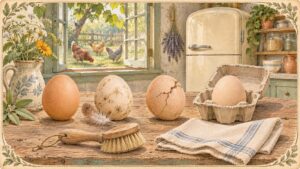
Do not judge a flock’s entire diet from one strange-looking egg. A hen can occasionally produce an unusually thin, wrinkled, misshapen, or otherwise imperfect egg even when the flock generally receives appropriate feed, water, and management. 🔍 Instead, watch for patterns by paying attention to several eggs over time and determining whether the same problem repeatedly appears.
Normal, firm shells across most of the flock are reassuring, particularly when the hens are eating an appropriate layer ration and have constant access to clean drinking water. If unusual shells repeatedly appear, examine the complete feeding program rather than assuming that dumping additional calcium into the ration is automatically the answer. Consider how much complete feed the hens actually consume versus treats, scratch, scraps, forage, and other foods that may dilute the formulated diet.
Repeated Thin Or Shell-Less Eggs Deserve More Attention
Repeated thin-shelled or shell-less eggs are different from finding one odd egg occasionally. Persistent problems can have multiple causes, including nutritional imbalance, age, heat stress, interruptions in normal laying, and health-related factors, so calcium deficiency should not automatically be diagnosed from shell appearance alone. 🩺 A good first management check is whether the affected hen has consistent access to appropriate layer feed, supplemental calcium, and fresh water.
Pay closer attention when several hens begin producing abnormal shells simultaneously or when one hen repeatedly produces poor shells despite appropriate feeding and management. That pattern gives you more reason to review the flock’s diet, feed freshness, water availability, age, environment, and general condition instead of continually increasing supplements. If persistent abnormalities continue or are accompanied by illness, weakness, abnormal behavior, or other concerning signs, consulting a poultry veterinarian or qualified poultry professional is appropriate.
Oyster Shell Or Eggshells: Which Should You Choose?
For the backyard keeper who wants the simplest calcium system, a complete layer ration paired with free-choice oyster shell is difficult to beat. 🐔 Oyster shell requires almost no preparation, is easy to keep available consistently, and lets laying hens access a supplemental calcium source separately from their regular food. Crushed eggshells can then be added as an optional recycling practice rather than something you must produce in sufficient quantity every day.
If you prefer using what you already have, properly dried and finely crushed eggshells are a reasonable addition to the calcium station. The important lesson is not that oyster shell is good and eggshells are bad—or vice versa—but that neither compensates for an inadequate overall diet. 🌿 Start with nutritionally complete layer feed, make supplemental calcium available appropriately, watch the eggs your hens produce, and adjust management based on patterns rather than reacting to one imperfect shell.