
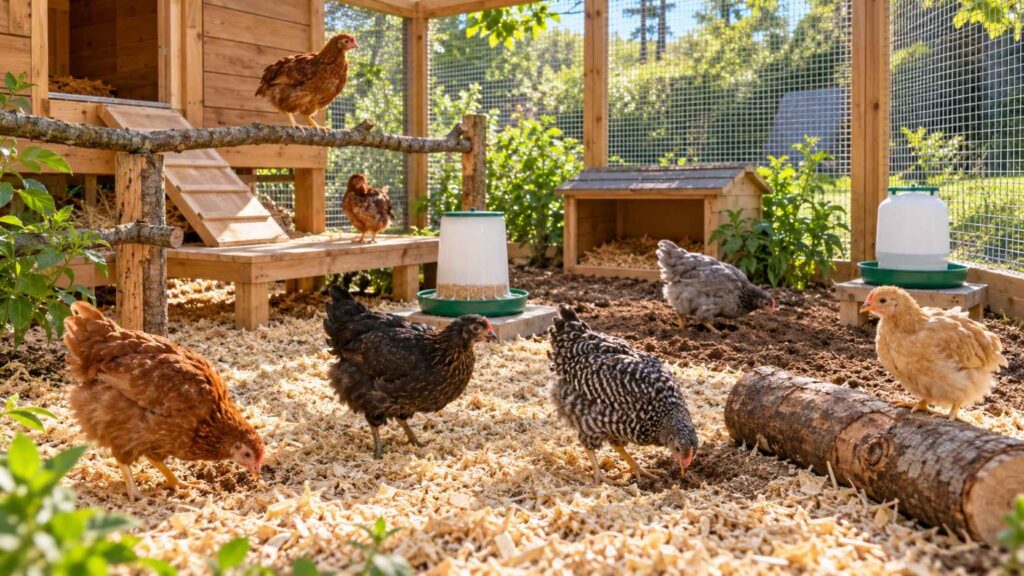
Moving young chickens from a familiar brooder into their first real coop is exciting, but a big empty building can feel very different to a six-week-old pullet. 🐔 Good chicken coop enrichment for young chickens does not require swings, expensive toys, or a coop packed with decorations; it means giving growing birds safe opportunities to perch, scratch, explore, hide, forage, and rest. The goal during the first week is to make the environment interesting without making it so complicated that you cannot tell whether the chickens are actually comfortable.
That distinction matters because enrichment should support normal chicken behavior rather than distract from basic care. Before adding branches, scratch areas, or movable objects, the coop must already provide appropriate feed, clean water, dry bedding, ventilation, weather protection, and serious predator security. 🌿 Once those fundamentals are working, a few simple features can transform the first coop into an environment the pullets gradually learn to use.
Are 6-Week-Old Chickens Ready To Move Outside?
There is no magic birthday when every chicken suddenly becomes ready for outdoor living. Many chicks are substantially or fully feathered by this stage, but breed, feather development, health, recent brooder temperature, nighttime weather, wind, and rain should all influence the decision. 🌤️ A healthy six-week-old covered in juvenile feathers and accustomed to progressively cooler conditions is very different from a poorly feathered chick suddenly moved from a warm brooder into a cold, wet night.
Watch the birds as well as the thermometer when making the transition. Chicks comfortably walking, eating, drinking, scratching, and settling without constantly clustering for warmth are giving you more useful information than age alone, while persistent distressed huddling can signal that conditions are too cold or otherwise uncomfortable. If outdoor temperatures are dramatically different from the brooder environment, gradual daytime exposure before the permanent move can make the transition less abrupt.
What Should Go In The Coop Before The Chickens Arrive?
Set up the essentials before enrichment so the chickens do not arrive while you are still rearranging their environment. They need an age-appropriate grower feed, continuous access to fresh water, clean dry bedding, good ventilation without harsh drafts at bird level, shade or weather protection, and a secure place to spend the night. 💧 At approximately six weeks, these growing birds generally are not ready for a standard calcium-rich layer ration simply because they will eventually become laying hens.
Predator protection deserves more attention than decorative coop features because chicken wire that keeps birds contained is not necessarily strong enough to stop determined predators. Check doors, latches, roof openings, ventilation gaps, corners, and the bottom edge of the run before the first unsupervised night. 🔒 Once the basic setup is secure and functional, enrichment can be added where it will not block feeders, waterers, doors, ventilation, or your ability to clean the coop.
Seven Enrichment Ideas For Young Chickens
The best pullet enrichment ideas are often ordinary materials arranged to encourage behaviors chickens already want to perform. Avoid sharp edges, loose strings, unstable towers, peeling finishes, tiny swallowable hardware, or anything that can trap a leg or head. 🪵 Young birds are still learning their new space, so start with low, stable structures before giving them anything that requires ambitious jumping.
| Enrichment idea | Simple setup | What it encourages |
|---|---|---|
| 1. Low branches 🌳 | Secure a thick natural branch close to the ground so it cannot roll or collapse. | Climbing, balancing, investigating |
| 2. Shallow scratch piles 🍂 | Create a small area of clean loose litter or suitable natural material where birds can rake with their feet. | Scratching and searching |
| 3. Safe hiding spaces 🏠 | Use an open-ended sturdy box, low platform, or visual barrier that cannot trap a bird. | Retreating, resting, exploration |
| 4. Young-bird perches 🪵 | Install stable, easily reached perches rather than immediately expecting high adult roosting. | Perching and nighttime practice |
| 5. Supervised foraging 🌱 | Allow controlled exploration of a secure grassy or natural area when conditions permit. | Pecking, investigating, movement |
| 6. Loose-soil area 🛁 | Provide a dry area of suitable loose soil or litter where birds can begin dust-bathing behavior. | Dust bathing and body care |
| 7. Movable objects 🔄 | Occasionally reposition a sturdy log, low block, or safe object rather than adding endless new toys. | Curiosity and environmental exploration |
The important word is stable. A branch that rotates under a bird, a box that tips over, or a high perch that requires an awkward landing creates risk rather than meaningful enrichment. Make every addition easy to inspect and remove so the coop remains an adaptable environment instead of becoming permanently cluttered.
Should You Add Everything On The First Day?
You can prepare several basic features in advance, but there is no advantage in overwhelming the birds with constant novelty. A simple perch, scratchable bedding, and one sheltered exploration area may be enough initially; additional objects can appear after the flock begins eating, drinking, and moving confidently around the new space. 🐥 Gradual introduction also makes it easier for you to see which features the birds actually use.
Do not assume immediate avoidance means an enrichment idea has failed. Chickens can be cautious around unfamiliar objects, and some may circle, stare at, or avoid a new branch or box before eventually investigating it. Give safe objects time, but remove anything that consistently causes frantic behavior, blocks normal movement, creates conflict, or interferes with access to feed and water.
What Does Normal Exploration Look Like?
Normal exploration usually looks less dramatic than owners expect. One bird may scratch through bedding while another tests a low perch, naps in a sheltered corner, takes a drink, or follows a flockmate around the run. 👀 The flock does not need to interact with every enrichment feature immediately for the first chicken coop setup to be successful.
Look at the overall daily pattern instead of waiting for birds to “play” with the objects you provided. Healthy settling-in behavior includes finding food and water, moving around normally, resting comfortably, scratching, preening, responding to flockmates, and gradually becoming more confident in different parts of the enclosure. A chicken choosing to sit quietly for a while can be perfectly normal, particularly after the stimulation of a major environmental change.
When Should You Worry About A Chick That Won’t Explore?
Normal caution should gradually give way to routine activity, so pay closer attention when one bird remains persistently separated or inactive while flockmates become comfortable. 🚨 More concerning signs can include pronounced weakness, persistent inability or reluctance to stand, abnormal breathing, sustained loss of appetite or thirst, obvious injury, persistent diarrhea, or behavior that is clearly different from the rest of the flock. Enrichment should never be used as an explanation for a bird that appears genuinely unwell.
First check practical causes such as temperature, access to food and water, bullying, injury, and whether the chick can physically navigate the new setup. Remove unnecessary environmental obstacles while you observe the bird, and seek qualified veterinary guidance when illness or significant weakness is suspected rather than waiting for enrichment to make the chicken more active. A good keeper uses enrichment to improve daily life, not to mask a health problem.
Printable First-Week Pullet Enrichment Checklist
Use the first week as an observation period rather than trying to create the “perfect” coop in a single afternoon. 📋 The checklist below focuses on both enrichment and essential function, because interesting surroundings cannot compensate for missing water, inappropriate feed, unsafe housing, or severe weather exposure. Print it or save it with your flock records and check the setup again whenever the pullets enter a new developmental stage.
- ☐ Day 1: Confirm every pullet finds the grower feed and water; keep enrichment simple and low.
- ☐ Day 2: Check whether birds are scratching, resting, preening, and moving around normally.
- ☐ Day 3: Inspect low perches and branches for stability, sharp areas, or difficult landings.
- ☐ Day 4: Add or refresh one simple scratching, loose-soil, or supervised foraging opportunity.
- ☐ Day 5: Watch for bullying, birds being blocked from resources, or one pullet remaining isolated.
- ☐ Day 6: Move one safe object slightly or introduce one small new feature and observe the reaction.
- ☐ Day 7: Review what the birds actually use, remove unnecessary clutter, and keep the useful features.
At the end of the week, your coop may still look simple—and that is completely fine. 🌿 Chickens benefit more from usable space, secure housing, appropriate perches, scratchable ground, clean resources, and opportunities for natural behavior than from a collection of human-style toys. The best enrichment system is one that remains safe, observable, adjustable, and easy to maintain as the pullets grow.
Build The Coop Around Chickens, Not Decorations
When 6-week-old chickens move outside, the transition itself provides enormous novelty: new sounds, temperatures, textures, smells, sunlight, bedding, flock movement, and outdoor sights. Adding seven enrichment features does not mean installing all seven on day one; it means creating a toolbox you can draw from as the birds gain confidence. 🐔 Low branches, scratching material, hiding places, perches, supervised forage, loose soil, and movable objects can provide plenty of variety without turning the coop into an obstacle course.
Start with safety, food, water, shelter, and security, then watch what your pullets tell you through their behavior. If they are eating, drinking, scratching, resting, preening, exploring, and interacting normally, you are already building a useful first environment for them. The best chicken coop enrichment for young chickens is not the setup with the most objects—it is the setup that lets growing birds confidently behave like chickens.




