Introduction
When a chicken is sick, appearance alone doesn’t always tell you whether it is improving.
A bird may look slightly more alert one morning and tired again later. It may eat a little more but still be losing weight. Or it may appear stable while gradually becoming weaker.
That’s why regular weighing can provide useful information.
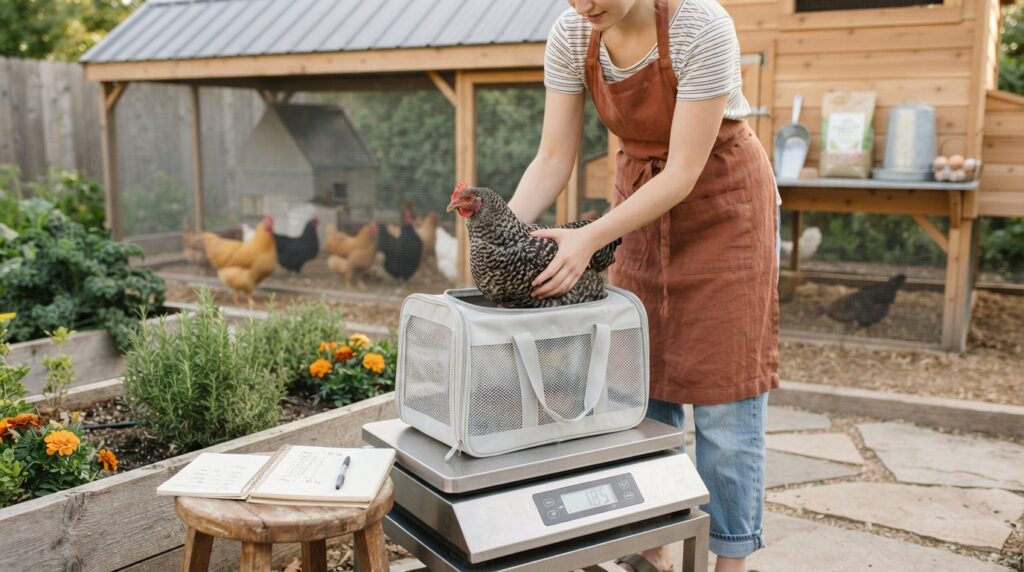
A kitchen scale or small digital luggage scale, combined with a suitable container, can turn an uncertain situation into a simple record of what is happening over time.
The important part is consistency.
You don’t need to weigh a sick chicken constantly. You need to measure it in a way that is safe, repeatable, and easy to interpret. 📋
1. Choose a Scale That Can Handle the Chicken’s Weight
A digital scale with sufficient capacity and a readable display is usually the easiest option.
The scale should:
- Support the chicken’s weight
- Display small changes clearly
- Have a stable weighing surface
- Be easy to reset or tare
- Be used on a flat surface
A kitchen scale can work well for smaller chickens if its capacity is adequate.
For larger birds, a suitable luggage or livestock scale may be more practical.
Check the manufacturer’s maximum capacity rather than assuming the scale can safely handle the bird.
2. Use a Container Instead of Putting the Chicken Directly on the Scale 🧺
Most chickens will not calmly stand on a small scale.
A container makes the process easier and safer.
Choose a container that allows the chicken to sit or stand comfortably without escaping.
For example:
- A sturdy cardboard box with ventilation
- A pet carrier
- A small plastic crate
- A laundry basket for an appropriately sized bird
The container must provide adequate ventilation and should not have sharp edges, loose strings, or anything that could injure the chicken.
Avoid sealing a chicken inside an airtight container, even briefly.
3. Tare the Container Before Weighing
This is one of the easiest ways to simplify the calculation.
Place the empty container on the scale.
Press the tare or zero button.
The display should return to zero.
Then carefully place the chicken inside.
The displayed number represents the chicken’s weight, assuming nothing else has been added to the container.
If your scale does not have a tare function, weigh the empty container first and subtract its weight from the combined weight.
Example
Container: 850 g
Container + chicken: 2,650 g
Chicken:
2,650 − 850 = 1,800 g
Record the result as 1.80 kg.
4. Keep the Weighing Process Calm 🐔
A sick chicken may already be stressed.
Don’t chase it around the yard just to obtain a measurement.
If possible, weigh it during a calm handling session, such as when you are already checking its condition.
Move slowly.
Support the chicken securely.
Avoid squeezing its chest because birds need normal chest movement to breathe.
If the bird is extremely weak, struggling to breathe, or showing severe distress, don’t turn weighing into a prolonged procedure. Veterinary assessment should take priority.
5. Weigh at Approximately the Same Time
Consistency makes your measurements more useful.
Try to weigh the chicken under similar conditions each time.
For example:
Every morning before breakfast
or
At the same point in your daily care routine
Food and water intake can temporarily affect body weight, so comparing measurements taken under similar conditions reduces some unnecessary variation.
You don’t need laboratory-level precision.
You need a consistent method that you can repeat.
6. Record More Than Just the Number 📱
Weight is useful, but it shouldn’t be the only measurement.
Create a simple health log.
| Date | Weight | Appetite | Drinking | Activity | Droppings | Notes |
|---|---|---|---|---|---|---|
| Day 1 | 1.80 kg | Low | Normal | Low | Observed | First measurement |
| Day 2 | 1.76 kg | Low | Normal | Low | Observed | Still lethargic |
| Day 3 | 1.78 kg | Improving | Normal | More alert | Observed | More active |
The exact values above are only an example of how to format a record. Your chicken’s numbers will be different.
The benefit comes from recording your actual measurements.
7. Look for a Trend Instead of One Reading 📈
One measurement rarely tells the whole story.
Scales can have small measurement differences, and a chicken’s weight can naturally vary.
Instead of asking:
“Did the chicken gain weight today?”
look at the broader pattern.
Ask:
- Is weight generally stable?
- Is it continuing to decline?
- Has the rate of weight loss changed?
- Is appetite improving?
- Is the bird becoming more active?
- Is drinking normal?
- Are droppings changing?
- Are other symptoms improving or worsening?
A stable or increasing weight can be encouraging when it occurs alongside improvement in other signs, but it does not by itself prove that the underlying illness has resolved.
8. Understand Percentage Weight Change
Percentage change can make weight trends easier to understand, particularly when comparing birds of different sizes.
The basic calculation is:
Percentage change = (new weight − original weight) ÷ original weight × 100
For example, suppose a chicken weighs 2,000 g initially and later weighs 1,900 g.
The change is:
100 g ÷ 2,000 g × 100 = 5% decrease
This gives you a clearer picture than simply saying the chicken lost 100 g.
For a sick bird, record the actual weights and discuss concerning changes with a veterinarian rather than relying on a single universal percentage as a treatment threshold.
9. Watch Appetite and Drinking Closely 🥣
Weight loss can occur because a chicken isn’t consuming enough food or water, but the underlying reason matters.
Record simple observations:
Appetite
- Eating normally
- Eating less
- Picking at food
- Not eating
Water
- Drinking normally
- Drinking less
- Drinking more than usual
- Not observed drinking
Don’t assume that increased drinking is automatically good.
A significant change in drinking behavior can also be clinically relevant.
If a chicken stops eating or drinking, becomes increasingly weak, or deteriorates quickly, contact a veterinarian.
10. Observe Activity Without Forcing Exercise
A sick chicken shouldn’t be tested like an athlete.
You don’t need to make it walk around to see whether it is stronger.
Instead, observe normal behavior during care.
Is it:
- Standing voluntarily?
- Walking normally when necessary?
- Sitting constantly?
- Responding to its surroundings?
- Able to reach food and water?
- Maintaining normal posture?
A chicken that goes from barely moving to voluntarily standing, eating, and interacting with its surroundings may be showing behavioral improvement.
But again, consider the entire picture rather than one sign.
11. Droppings Can Provide Additional Information 💩
Droppings can change with diet, stress, hydration, and illness.
When monitoring a sick chicken, note major changes in:
- Frequency
- Consistency
- Color
- Presence of obvious blood
- Unusual material
Don’t diagnose a disease based solely on dropping appearance.
If droppings are severely abnormal, persistent, or accompanied by other concerning symptoms, veterinary evaluation is appropriate.
A photograph can sometimes help you document changes for a veterinarian, provided it can be done hygienically.
12. Don’t Let a Weight Increase Fool You
This is an important point.
A higher scale reading does not automatically mean the chicken is recovering.
Weight can be affected by:
- Food in the digestive tract
- Water intake
- Droppings
- Measurement conditions
- Scale variation
That’s why weight should be considered alongside appetite, activity, hydration, breathing, droppings, posture, and other clinical signs.
Think of weight as one useful piece of evidence, not a complete diagnosis.
13. Know When Monitoring Isn’t Enough 🚨
Home monitoring is useful, but it has limits.
Seek veterinary help promptly if a chicken has signs such as:
- Difficulty breathing
- Severe weakness
- Inability to stand
- Neurological abnormalities
- Significant bleeding
- Repeated vomiting or regurgitation
- Severe dehydration
- Rapid deterioration
- Sudden death in another flock member
- Multiple birds developing similar signs
Some poultry diseases can spread rapidly, so unusual illness affecting multiple birds deserves particular attention.
If you are concerned about a potentially infectious disease, follow local veterinary or animal-health guidance regarding isolation and reporting.
14. Make the Health Log Easy Enough to Maintain
The best tracking system is one you will actually use.
You can keep the record in:
- A notebook
- A spreadsheet
- A phone note
- A simple flock-management app
You don’t need dozens of columns.
A basic record might be:
Chicken: Daisy
Starting weight: 1.82 kg
Date: September 10
Weight: 1.76 kg
Eating: Reduced
Drinking: Normal
Activity: Low
Droppings: No major change observed
Notes: More alert in afternoon
Repeat the same format each day or as often as your care plan requires.
15. Turn Your Notes Into a Simple Recovery Picture 🌱
After several measurements, your notes can reveal patterns that are difficult to remember from day to day.
For example:
Weight: declining → stable → gradually increasing
Appetite: poor → improving → normal
Activity: very low → moderate → normal
That overall pattern is much more informative than remembering that “she seemed better yesterday.”
If the trend is going in the opposite direction, your records can also help you recognize that earlier.
A Simple Sick-Chicken Monitoring Checklist 🐔✅
Each time you check the bird, record:
☐ Weight
☐ Appetite
☐ Water intake
☐ Activity
☐ Posture
☐ Breathing
☐ Droppings
☐ Visible injuries or changes
☐ Medication or treatment given according to veterinary instructions
☐ Any major change since the previous check
Keep treatment records especially carefully. Never change medication, dosage, or treatment duration simply because the scale number changes.
Final Thoughts
Weighing a sick chicken is not about chasing a perfect number.
It is about creating a repeatable record that helps you see what is actually happening over time. ⚖️🐔
Use a suitable container, tare the scale, handle the bird gently, and weigh under similar conditions. Then combine the weight with observations about appetite, drinking, activity, breathing, droppings, and general behavior.
Most importantly, don’t wait for the scale to become alarming before seeking help.
A chicken that is losing weight, becoming weaker, refusing food or water, developing breathing problems, or showing other serious symptoms needs more than a spreadsheet. Veterinary assessment can help determine the underlying problem and appropriate treatment.
A simple daily record can make that conversation much more useful and can help you notice important changes sooner. ❤️