
Introduction
You can build a sturdy chicken run with strong fencing, a secure gate, and a protective roof, yet still have a dangerous weak point: the ground beneath the fence.
Foxes, dogs, and other digging animals may try to burrow underneath an enclosure to reach your flock. Even a small gap caused by soil erosion or an uneven gate can create an opportunity for a predator to get inside.
The good news is that you can reduce this risk with practical solutions that fit different budgets. Two of the most useful options are a wire apron around the run and a properly installed buried barrier.
Here is how to protect the bottom of your chicken run, choose suitable materials, and check for weak spots before a predator finds them.
1. Understand How Predators Get Under a Fence
Digging predators may start at the base of a fence, where the soil is soft or the barrier is poorly secured. They may also exploit gaps beneath gates, corners, and areas where rain has washed away soil.
Common warning signs include:
- Freshly disturbed soil along the fence line
- Small holes or shallow trenches near corners
- Bent or loose wire at ground level
- Gaps beneath a gate
- Soil erosion exposing the bottom of the fence
These signs do not prove which animal is responsible, but they indicate that the enclosure needs inspection.
Important: Do not assume that a fence is secure simply because it extends all the way to the ground. A determined animal may be able to dig underneath it.
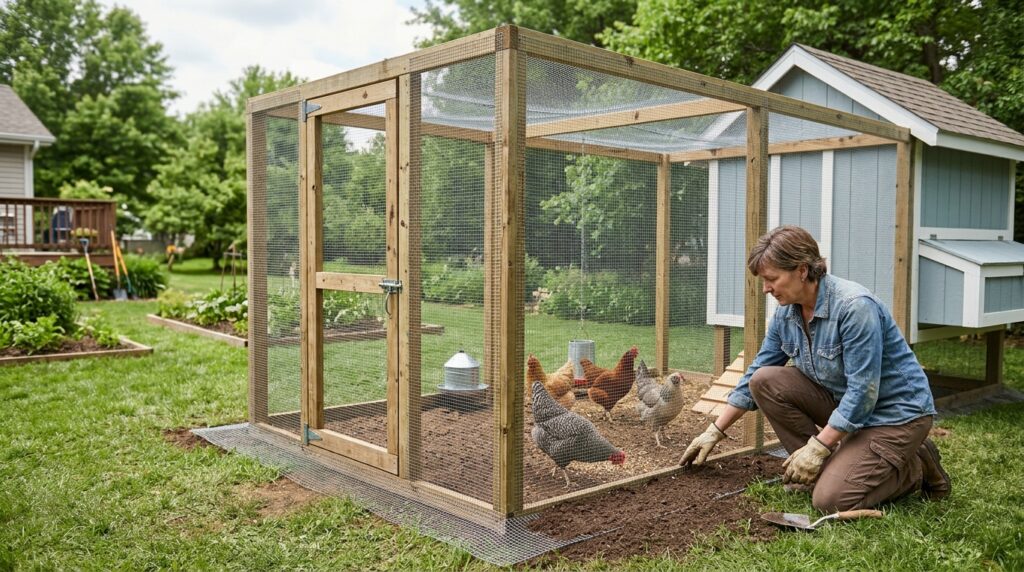
2. Install a Wire Apron Around the Run
A wire apron is one of the most practical ways to discourage digging around an existing chicken run.
Instead of digging a deep trench, you attach sturdy wire mesh to the bottom of the fence and extend it horizontally outward. The apron is secured to the ground and covered with soil, grass, or another suitable ground covering.
When a predator starts digging beside the fence, it encounters the wire rather than finding a clear path underneath.
How to install a wire apron
- Choose suitable mesh. Use durable, corrosion-resistant welded wire or other appropriate predator-resistant mesh. Ordinary chicken wire alone is generally not a reliable barrier against determined predators.
- Attach it securely. Fasten the apron firmly to the bottom of the existing fence using suitable fasteners.
- Extend it outward. A practical starting point is approximately 12–24 inches, depending on local predator risks and the layout.
- Secure it to the ground. Use appropriate landscape staples, stakes, or other fasteners to keep the mesh from lifting.
- Cover it if desired. A layer of soil, grass, or mulch can help conceal the wire and make the area easier to use.
- Inspect the edges. Check for loose joints, exposed sharp wire, and gaps where sections meet.
The apron should extend outward from the enclosure, not simply lie loosely against the fence. Otherwise, an animal may move it or dig around an unsecured edge.
3. Bury a Wire Barrier for Added Protection
A buried barrier is another option, particularly when you are constructing a new run or renovating the existing one.
This involves digging a trench around the perimeter and installing suitable mesh below ground level. The wire is then securely connected to the main fence, and the trench is backfilled.
The required depth depends on the threats in your area, soil conditions, and the barrier design. There is no single depth that guarantees protection from every digging animal.
Benefits of a buried barrier
- It creates an underground obstacle.
- It can be incorporated into a permanent enclosure.
- It may be useful where an outward-facing apron would obstruct a walkway or garden bed.
Potential drawbacks
- Digging a trench requires more time and labor.
- Roots, rocks, and buried utilities may complicate installation.
- Buried metal can corrode if it is not suitable for ground contact.
- Future repairs may be harder because the barrier is underground.
Before digging, check for buried utility lines and avoid disturbing areas where underground services may be present.
For an existing run, an outward apron may be easier and less expensive to install. For a new build, a buried barrier may be easier to plan from the beginning.
4. Secure the Gate and Corners
The fence itself is only part of the system. Gates and corners often need special attention because they contain joints, moving parts, or uneven ground.
Check that:
- The gate reaches close enough to the ground to prevent a predator from squeezing underneath.
- The ground apron connects securely around both sides of the gate.
- Mesh overlaps are firmly fastened.
- Corners have no open seams.
- Soil has not washed away beneath posts.
- The gate latch closes reliably.
If the gate sits on uneven ground, consider a properly fitted threshold or additional mesh barrier that does not prevent the gate from opening.
Do not leave sharp wire ends exposed where chickens, children, pets, or people could be injured.
5. Choose Materials That Match Your Budget 💰
You do not necessarily need to rebuild the entire chicken run to improve its security.
Start by identifying the weak points, then estimate the materials required to repair them.
| Material | Main purpose |
|---|---|
| Welded wire mesh | Creates a physical barrier against digging |
| Suitable hardware cloth | Helps block smaller predators and vulnerable openings |
| Galvanized fasteners | Secures mesh to the frame |
| Landscape staples or stakes | Helps hold a ground apron in place |
| Suitable lumber or metal supports | Repairs weak sections of the run |
| Soil or mulch | Covers an installed apron and helps integrate it with the ground |
Prices vary by location, mesh dimensions, wire thickness, and roll size. Measure the entire perimeter and compare the cost per unit of usable material before buying.
If you already have a sturdy fence, repairing its base may be more economical than replacing the whole structure.
However, avoid saving money by using weak, damaged, or heavily corroded wire where a reliable barrier is needed.
6. Do Not Forget Overhead and Other Entry Points
Stopping digging is important, but it does not make a chicken run completely predator-proof.
Some animals climb, reach through openings, or enter from above. Dogs may also push against weak fencing, while birds of prey can threaten chickens in uncovered runs.
For more complete protection:
- Use appropriate mesh and sturdy framing for the main enclosure.
- Cover the run with suitable overhead protection where aerial or climbing predators are a concern.
- Secure the coop itself, especially at night.
- Use a reliable gate latch.
- Store feed securely and clean up spills that may attract rodents or other wildlife.
- Inspect the entire enclosure after storms or attempted attacks.
Think of predator protection as a system. A strong ground barrier cannot compensate for a large hole in the roof or an unsecured door.
7. Check the Run Regularly
A wire apron or buried barrier can become less effective over time if the ground shifts or the materials deteriorate.
Make a quick inspection part of your chicken-care routine. Pay special attention after heavy rain, strong winds, landscaping work, or signs of digging.
Look for fresh holes, exposed mesh, loose fasteners, rust, and gaps beneath gates. Repair small problems promptly rather than waiting until the fence has visibly failed.
If you find evidence of a predator, inspect beyond the immediate hole. The animal may have tested several locations before finding a weak point.
Final Thoughts 🌿
Protecting the bottom of a chicken run is one of the most important steps in reducing the risk of digging predators.
For many existing backyard runs, a properly secured outward-facing wire apron offers a practical starting point. A buried barrier may also be suitable, especially when planned during construction. The best choice depends on your soil, local wildlife, enclosure design, and budget.
Remember that no single method guarantees complete protection. Combine a secure ground barrier with strong fencing, a reliable gate, suitable overhead protection, and regular inspections.
A few careful improvements at ground level can help close one of the easiest routes into your chicken run and give your flock a safer place to scratch, forage, and roam.




